
Figure: Official R language logo (adopted 2016). Author: The R Foundation; source: Wikimedia Commons; license: CC BY-SA 4.0.

When research work in R gets stuck, the two most common public help channels are the R Project’s R-help mailing list and the Posit Community forum run by Posit. The former discusses R and CRAN package use in plain-text email, in a terse, direct style; the latter answers questions around RStudio, tidyverse, Shiny, and related tools, with emphasis on reproducible examples. This article compares positioning, how to ask, etiquette, and limits from both sides’ official guidance.
Positioning and who uses them
R-help is the “main” list among official R Project mailing lists, hosted at ETH Zurich; the R Project page thanks Martin Maechler and ETH Zurich for the set of lists. Officially it is for problems and solutions when using R, covering the standard distribution and CRAN packages, and also accepts discussion of new features, documentation, and examples; traffic from R-announce and R-packages is forwarded into R-help. The list sees multiple messages per day; subscribers can choose a daily digest. The posting guide casts readers as people who want to solve problems with R but do not necessarily know programming.
R-help is not the only R list. Official guidance routes by topic: R language development and C/C++ issues to R-devel; writing packages and passing R CMD check to R-package-devel (created May 2015); macOS, Debian, and Fedora platform issues to the matching R-SIG lists; mixed-effects models to R-SIG-mixed-models; Bioconductor and bioinformatics to Bioconductor channels. Ecology, epidemiology, geospatial data, meta-analysis, phylogenetics, and other fields also have SIG lists. The official judgment is that a more specialized list usually yields better help when it fits; posting the same question to multiple lists at once is considered rude.
Posit Community (forum.posit.co) is a Discourse forum run by Posit. Its About page calls it “A community for all things Posit”; several admins and moderators carry Posit staff badges. The homework policy page lists welcome topics such as how to use R, the RStudio IDE, tidyverse packages, and where to find learning resources. The categories page shows coverage of tidyverse, Shiny, RStudio IDE, Positron, package development, machine learning and modeling, Quarto/R Markdown publishing, Posit commercial and hosted products, and more; “General,” which takes everyday data and programming questions, has the most topics.
In short, R-help sits closer to base R and CRAN packages—recent archive replies include long-active community members such as Duncan Murdoch, Peter Dalgaard, and Ben Bolker; Posit Community sits closer to the RStudio, Positron, Shiny, Quarto, and tidyverse toolchain, where Posit staff reply in relevant categories. Askers on both range from students and research assistants to package authors; discussion is public.
How to ask: plain-text email vs reprex
Asking on R-help is writing email to every subscriber. Since 31 January 2008, the From address must be subscribed before free posting; mail from non-subscribers waits for volunteer moderator approval and is delayed. New topics should be new mail to r-help@r-project.org—do not reply to an old thread and change the subject, or you scramble the archive thread. Mail must be plain text: HTML mail may be dropped with no notice to the sender; most binary attachments are stripped, keeping only a few formats such as PDF, PostScript, and PNG; larger files should be posted online with a link. Subject lines should be specific—not just “question.”
The posting guide requires homework first: search with help.search(), apropos(), RSiteSearch(), and ?functionname; check NEWS, the R FAQ, and relevant chapters of An Introduction to R. For unexpected behavior or suspected bugs, paste at least sessionInfo() output, full version and OS, and locale and package info when needed; do not say only “R crashed”—state what happened and the exact error text. Prefer a small example others can run directly, with data built by R commands; complex objects can be exported with dump(). Bugs in contributed packages should generally go first to the maintainer via maintainer("pkgname").
Posit Community’s core requirement is a reprex (minimal reproducible example). The official FAQ splits it into two parts: the smallest dataset needed to reproduce the problem, and the smallest code that runs on that data and names the packages used. Data can be turned into pasteable form with the datapasta package or base dput(), then reprex::reprex() can format code and output for the post. Note that reprex runs in a temporary directory by default, so relative paths to local files fail—embed the data in the example. The welcome page also reminds: when code runs but results are wrong, state what you expected; after solving, mark the matching reply as the solution so later readers can find it.
Course homework has a separate policy: ask the instructor or TA first; do not paste assignment text verbatim (including MOOCs); name the course, add a homework tag, and ask with a reprex. If you also want to post elsewhere (for example after asking on R-help), the cross-posting FAQ does not fully forbid it, but requires posting in one place at a time, waiting “days not hours,” linking both ways, and syncing answers; repeating the same question in multiple forum categories is auto-hidden by the spam filter.
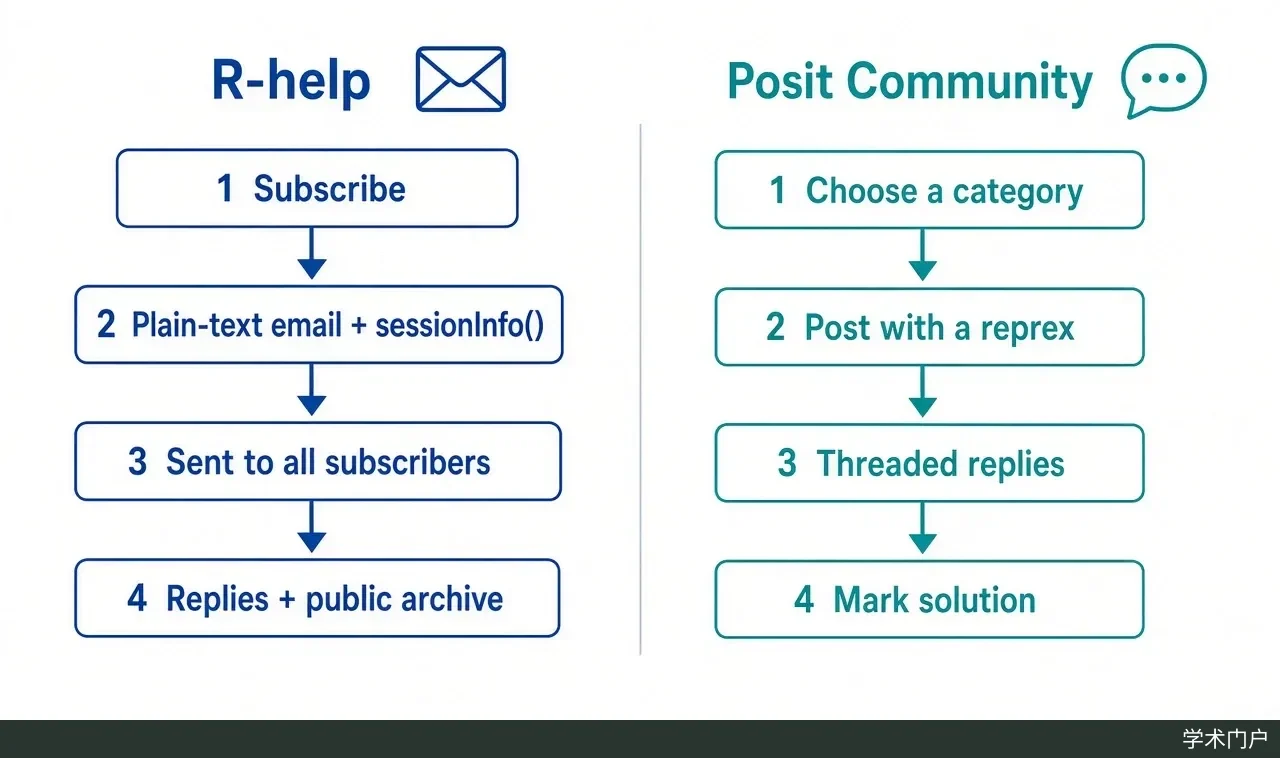
Figure: Two ask-path comparison: left, R-help (subscribe, write plain-text mail with sessionInfo(), send to all subscribers, replies enter the public archive); right, Posit Community (pick a category, post with reprex, threaded replies, mark a solution). AI-generated schematic.
Community etiquette and posting rules
R-help’s posting guide opens by saying replies are often short—that is leaving limited time for technical substance, not intentional coldness; R is free software built and maintained by volunteers, and answerers’ time is limited too. The guide asks readers to tolerate different styles of expression: rudeness is never acceptable, but “read the manual” is sometimes the right answer, while personal attacks never are. It states R-help is not for basic statistics or classroom homework; stats-methods questions sometimes appear and may get answers if well posed and someone is interested. Replies should generally go to both the list and the asker; private mail must not be quoted without permission. Common mistakes include calling documented behavior a bug, finding in an old version a problem long fixed, and threatening to “stop using R.”
Posit Community’s guidelines compare the forum to a public park: criticize ideas not people; avoid insults, personal attacks, and reflexive contradiction; if you see bad behavior, do not reply—flag it. Post in the right category; do not repost across topics; skip “+1” empty replies (use likes); do not derail threads midstream; signatures at the end of posts are unnecessary. Moderators reserve the right to delete content and accounts at any time; they do not pre-screen new posts, and the site operator is not responsible for community content. The welcome page asks answerers for more empathy: a question you have seen a hundred times may still be new to the asker.
Both sides stress that discussion is public. R-help’s info page says posts are archived and kept for years on multiple sites; Posit Community posts are indexed by search engines, and the guidelines advise against sharing email, phone, full name, and similar personal data. For researchers, that means example data should not include un-deidentified subject data or unpublished research data—simulated data or built-in R datasets are safer.
Recent discussion, reference value, and limits
A recent R-help example: on 9 October 2026, Michael Kristensen, identifying as a biostatistics research-assistant intern in public health at Aarhus University, asked why standardized residuals (normalized residuals) from a mixed model (nlme) differed between R and Stata; Ben Bolker and Peter Dalgaard replied on 10 and 11 October (see “NLME Package - Normalized Residuals” in the R-help October 2026 thread archive[5]). Implementation-layer questions of “same model, different results in two packages” fit R-help well; nlme’s CRAN help also lists R-help@r-project.org as that package’s mailing list.
A recent Posit Community example: on 15 October 2026, a user wanted renv so a Quarto paper would be reproducible for collaborators, but on another Windows machine cloning the repo and opening the .Rproj produced “R session failed to start,” and only deleting a one-line .Rprofile with source("renv/activate.R") allowed startup (original post[14]). On 16 October, moderator Kevin Ushey with a Posit staff badge replied: the workflow itself was fine; the bug was in Windows RStudio 2026.04—renv’s bootstrap download at R startup crashed the session (rstudio/rstudio#17450), fixed in RStudio 2026.05.0; if you cannot upgrade yet, finish bootstrap and renv::restore() in plain R in the project directory, then open in RStudio. When this article checked, the thread was not yet marked solved. IDE and project-environment issues can get direct Posit staff answers here.
For scholars, the two communities can be split by question type (this article’s suggestion): for computational details of R itself, base or recommended packages (such as nlme), and domain R use in ecology, epidemiology, meta-analysis, or mixed models, search the R-help archive or the matching SIG first; for RStudio/Positron, Quarto and R Markdown publishing, Shiny, tidyverse, or renv project workflows, Posit Community is a better fit. Wherever you ask, assembling a reprex and sessionInfo() often helps you locate the problem yourself—and that is the environment information you need in a paper appendix or code repository.
Limits are equally clear. First, both are volunteer or community Q&A, not formal tech support or statistical consulting: R-help explicitly declines basic stats and homework; Posit Community moderators do not pre-screen posts, and whether an answer is correct is yours to judge and verify. Second, the R-help posting guide was last updated July 2013; some outbound links (such as Usenet statistics groups) are stale; the info page also notes that some third-party searchable archives stopped updating in April 2018—check whether a source is still maintained when searching old discussion. Third, Posit Community’s remit is “all things Posit,” and its homework policy page admits it “may not be the best place to solve your specific problem.” Fourth, public archives mean long-lived visibility—handle data privacy and unpublished results before posting.
References
-
The R Project. R: Mailing Lists
-
Tony Plate (ed.). Posting Guide: How to ask good questions that prompt useful answers, updated July 2013
-
R-help. R-help Info Page
-
The R Project. R: Getting Help with R
-
CRAN. Help for package nlme, 3.1-171, 2026-09-01
-
Posit Community. Guidelines
-
Posit Community. About Posit Community
-
Posit Community. Welcome to the Posit Community!, 2016-09-25
-
Posit Community. FAQ: How to do a minimal reproducible example ( reprex ) for beginners
-
Posit Community. FAQ: Homework Policy, 2018-02-13
-
Posit Community. FAQ: Is it OK if I cross-post?, 2018-02-14
-
Posit Community. Categories, retrieved 2026-10-18
-
Posit Community. RStudio startup error when restoring renv as a collaborator, 2026-10-15
-
Information compiled and published by the Scholay academic one-stop platform; report infringement for takedown.
-
Also published on Enter Scholar, a scholars’ community for the intelligent age