Project overview
Prefect is an open-source Python workflow orchestration framework that uses decorators to turn ordinary functions into schedulable, monitorable flows that can retry automatically after failure. Version 3.8.8 was released on 6 October 2026, focusing on fixes for task retries, transaction hooks, and run scheduling; it is also the last version that supports Python 3.10. This article is source verification; we did not install or test hands-on.
Project positioning and how it runs
- What it is: Official docs position Prefect as an open-source orchestration engine for writing workflows in pure Python—no special DSL or YAML configuration. Decorate the entry function with
@flowand steps with@task; at runtime Prefect dynamically builds an execution graph from tasks and their upstream dependencies, runs them in order, and can recover workflow state on failure.[2,4,7] - Core capabilities: Record success, failure, retry, and other run states; cache expensive results to avoid re-execution; trigger runs on cron schedules, external events, or APIs; pause flows for human confirmation; view logs, status, and dependency graphs live in a web UI.[4] Retries can set counts, delays (fixed, list, or exponential backoff), custom condition functions, and random jitter.[5] Transactions group multiple tasks so a rollback hook runs if any step fails.[6]
- How it runs: With the open-source edition,
prefect server startstarts the server and UI athttp://localhost:4200locally; official Docker images also work. Prefect Cloud is the hosted offering. Switching the script ending to.serve()with a cron expression schedules runs.[2,7] - Install and license: Install with
pip install -U prefectoruv add prefect; PyPI’s 3.8.8 requires Python 3.10 or newer and below 3.15. The repository is PrefectHQ/prefect at https://github.com/PrefectHQ/prefect; the LICENSE file is Apache License 2.0 (Copyright 2019- Prefect Technologies, Inc.).[2,3]
What’s new in 3.8.8
3.8.8 was published on GitHub Releases on 6 October 2026. The release notes open by stating this is the last version that supports Python 3.10; later versions require Python 3.11 or higher. The release is mostly bug fixes; items most relevant to long, unattended runs include:[1]
- Retry jitter now takes effect: The task parameter
retry_jitter_factorwas previously accepted and stored but never applied by the task engine, contrary to the docs; after the fix, random jitter is added to retry delays so many tasks do not retry in lockstep and hammer external services. The PR author notes the parameter applies only to task retries.[5,8] - Retry conditions receive the original failed state: When a task returned a custom failed state (for example a Failed state named RateLimited), the engine previously folded it with the exception into a generic Failed state, so names and other metadata passed to
retry_condition_fnwere lost; the original state is now passed through so retry-by-failure-type logic works.[9] with_optionskeeps transaction hooks: Copying a task withTask.with_optionssilently dropped rollback and commit hooks and version info; this release fixes that.[10]- Termination signals no longer restart finished runs: With
PREFECT_FLOW_RUN_EXECUTE_SIGTERM_BEHAVIOR=reschedule, on SIGTERM the process first reads the run state from the server: cancelled, completed, or failed runs stay as they are; only crashed or not-yet-finished runs are rescheduled. Previously a cancelled run could start again.[11] - Other fixes: Cancellation cleanup and pause-expiry monitoring now page through all run records; HTTP date formats or invalid
Retry-Afterresponse headers no longer crash; worker health checks stay healthy during API maintenance; cache-policy config is preserved when excluding inputs; cron-schedule help text that reversed OR/AND switch meanings was corrected; plus dependency upgrades.[1] - Later versions: As of 21 October 2026 the latest GitHub Releases formal version was 3.9.0 published that day. It drops Python 3.10 support, removes the deprecated Runner execution path, adds Python 3.15 support, and fixes silent skipping of task retries when using
retry_condition_fn—details follow the release notes.[12]
Why they help
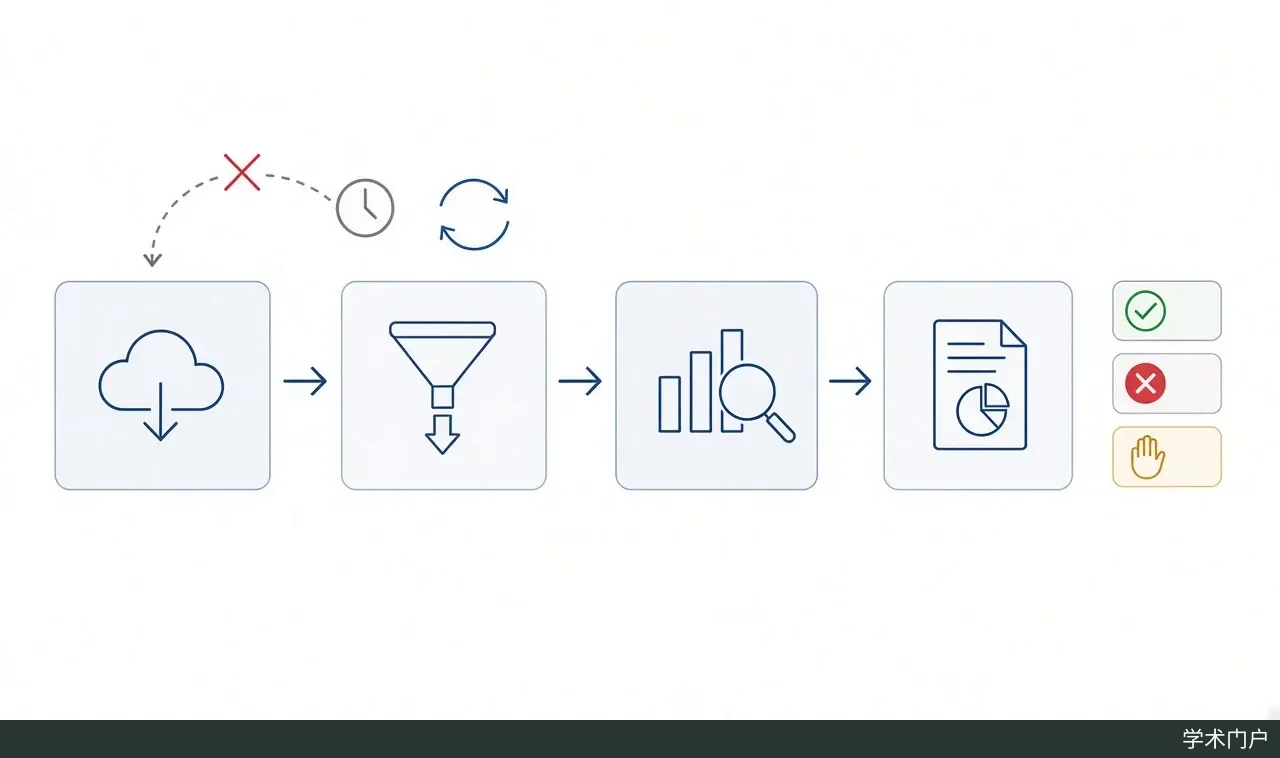
For research users, Prefect fits data-processing pipelines already chained in Python scripts that need to run on a schedule or for a long time—for example downloading public data daily, cleaning it, running analysis, and generating reports. It pulls retries, scheduling, state recording, and failure cleanup out of research code into the framework. The following is based on official docs, release notes, and related PRs—source verification, not a hands-on install.
Suitable use cases
- Periodically updated data processing: Write each step of “download → clean → analyze → report” as a
@task, the entry as a@flow, then.serve()with a cron expression; every run’s status and logs are reviewable in the UI.[2,7] - Unstable external services: When calling databases, public APIs, or remote services, set
retriesand lengtheningretry_delay_secondsonly on fragile steps so already-successful steps need not re-run; for errors where retrying will not help (401, 404, and so on), useretry_condition_fnto give up. After 3.8.8,retry_jitter_factorand retry-by-failure-type work as documented.[5,8,9] - Avoid re-running expensive steps: Caching and result persistence can reuse completed steps when restarting after interruption; transactions with a
keyensure a segment runs only once—for example if a day’s data is already downloaded and written, a later run skips it.[4,6] - Clean up intermediate artifacts on failure: Put “write result files” and “quality check” in one transaction; if the check fails, an
on_rollbackhook deletes written files so half-finished products do not remain.[6] - Move from a laptop to a server: The same flow can be developed locally, then deployed to a single process, container, Kubernetes, or cloud service.[4]
Limits and cautions
- Not hands-on tested: This article is source verification without install testing; content comes from GitHub Releases, related PR pages, official docs, LICENSE, and PyPI.
- Higher Python version requirements: 3.8.8 is the last release supporting Python 3.10; environments that must stay on 3.10 can only remain on 3.8.x. 3.9.0 also removes the deprecated Runner path and deprecates Pendulum datetime behavior on Python 3.11–3.12—read the release notes before upgrading.[1,12]
- Needs server support: Prefect stores workflow metadata in a database; viewing run history and scheduled jobs depends on a self-hosted Prefect server or Prefect Cloud. Cron jobs set with
.serve()only apply while that process keeps running.[7] - Rollback does not automatically undo external actions: Official docs note that file writes, API calls, and other external side effects must be cleaned up in rollback hooks; under EAGER commit mode, already-committed tasks are not rolled back again.[6]
- Some fixes have limited scope:
retry_jitter_factorapplies only to task retries, not flow retries; the SIGTERM-related fix only targets the reschedule setting, and the PR notes that reading state and submitting a new state are two separate calls—races are not fully eliminated.[8,11] - Many concepts, frequent updates: flow, task, deployment, work pool, transactions, cache policies, and so on take learning time; one-off analysis scripts may not justify adopting it. Besides formal releases the project ships nightly builds; research projects should pin versions for reproducibility.[12]
References
-
PrefectHQ/prefect. 3.8.8 - I take my wildcards literally (GitHub Releases, 2026-10-06). https://github.com/PrefectHQ/prefect/releases/tag/3.8.8 (accessed 2026-10-21)
-
prefect 3.8.8 (PyPI project page, including README). https://pypi.org/project/prefect/3.8.8/ (accessed 2026-10-21)
-
PrefectHQ/prefect. LICENSE (GitHub repository license file). https://github.com/PrefectHQ/prefect/blob/main/LICENSE (accessed 2026-10-21)
-
Prefect docs. Introduction. https://docs.prefect.io/v3/get-started (accessed 2026-10-21)
-
Prefect docs. How to automatically rerun your workflow when it fails. https://docs.prefect.io/v3/how-to-guides/workflows/retries (accessed 2026-10-21)
-
Prefect docs. How to write transactional workflows. https://docs.prefect.io/v3/advanced/transactions (accessed 2026-10-21)
-
Prefect docs. Quickstart. https://docs.prefect.io/v3/get-started/quickstart (accessed 2026-10-21)
-
PrefectHQ/prefect. Apply
retry_jitter_factorin the task engine (PR #23222). https://github.com/PrefectHQ/prefect/pull/23222 (accessed 2026-10-21) -
PrefectHQ/prefect. Fix failed state losing metadata during retry (PR #23256). https://github.com/PrefectHQ/prefect/pull/23256 (accessed 2026-10-21)
-
PrefectHQ/prefect. fix rollback and commit hooks not working (PR #23186). https://github.com/PrefectHQ/prefect/pull/23186 (accessed 2026-10-21)
-
PrefectHQ/prefect. Don't reschedule a flow run the server already finished on SIGTERM (PR #23244). https://github.com/PrefectHQ/prefect/pull/23244 (accessed 2026-10-21)
-
PrefectHQ/prefect. Releases (GitHub release list). https://github.com/PrefectHQ/prefect/releases (accessed 2026-10-21)
-
Information compiled and published by the Scholay academic one-stop platform; report infringement for takedown.
-
Also published on Enter Scholar, a scholars’ community for the intelligent age