
Web source code on a screen, used as an image of “pasting code for help”—not a Stata or Statalist interface. Photo: markus spiske; source: Flickr; license: CC0 1.0.
Statalist is the public technical forum for Stata users. It began in August 1994 as a mailing list and moved to a web forum in March 2014, run and moderated by Stata users with StataCorp maintaining the platform. It has written posting norms: search first, state your Stata version, paste commands and output verbatim, provide example data with dataex, and use your real name. The sections below follow the official FAQ on how to take part, etiquette, reference value, and limits.
Community overview and participants
Per the FAQ’s definition, Statalist serves the Stata community and “anything related to Stata is appropriate.” StataCorp’s intro page summarizes the scope as Stata, statistics, and the combination of the two; the forum is run and moderated by Stata users, with StataCorp responsible for maintenance. Browsing needs no registration; posting or asking requires registration and a real name; the site also welcomes new users just starting with Stata.
There are three sections: Stata general holds almost all threads—when unsure, post there; Mata is only for Stata’s matrix programming language Mata; Sandbox is for practicing posts and usually gets no answers.
Official pages do not publish user-composition statistics. From public threads, participants include long-time Stata teachers and researchers, people who provide statistical consulting for clinical researchers, and students writing Stata code for courses and theses. The FAQ was written and is continually revised by Nicholas J. Cox of Durham University; he is also one of the main answerers, and discussion pages cited below show his post count already above 36,000.
Search before posting, and how to write a question
The FAQ opens by warning that people who skip the long text are likelier to get no reply—or only a string of follow-up questions. Before posting, search similar threads on the forum and try other channels: Stata’s built-in help and the search command, the PDF manuals, the Stata Journal and its predecessor the Stata Technical Bulletin, and authors of community-contributed commands; for genuine software issues, contact Stata technical support. The FAQ also draws a line around “basic questions”: askers are assumed to have read documentation and basic literature at the relevant level, so “how do I run a regression in Stata,” what the mean and median are, or what an instrumental variable is, are out of scope.
When writing a question, the FAQ’s requirements boil down to precise, complete, and reproducible.
- Make the title specific: “Question” or “Please help” does not help; “Problem with instrumental variables regression” lets others see at a glance whether they can answer.
- State version and platform: The FAQ says the current version is Stata 19; if you use an older version, say so, and update before asking when possible; if the issue may be platform-related, name the operating system.
- Paste commands and output verbatim: State “what you typed and what Stata returned,” wrap code and results in [CODE] tags; for community-contributed commands, say whether they come from the Stata Journal, SSC, or another archive. Do not only say “it doesn’t work,” do not call an error a “crash,” and write “52 variables” instead of “lots of variables.”
- Use dataex for example data: The command was written for Statalist; it ships with Stata 16 onward; usually about 20 observations are enough; if data are confidential, invent fake data or use built-in datasets such as auto or Grunfeld.
- Attachments have rules: Upload graphics as .png; no screenshots; do not upload .gph, Word, Excel, .dta, or .zip files. Paste do-files of at most 100 lines as CODE; longer ones need a cut-down fragment that shows the problem.
- Cite literature fully: Give a publicly accessible link, or full author, year, title, journal, volume/issue, and pages—not just “Author (year).”
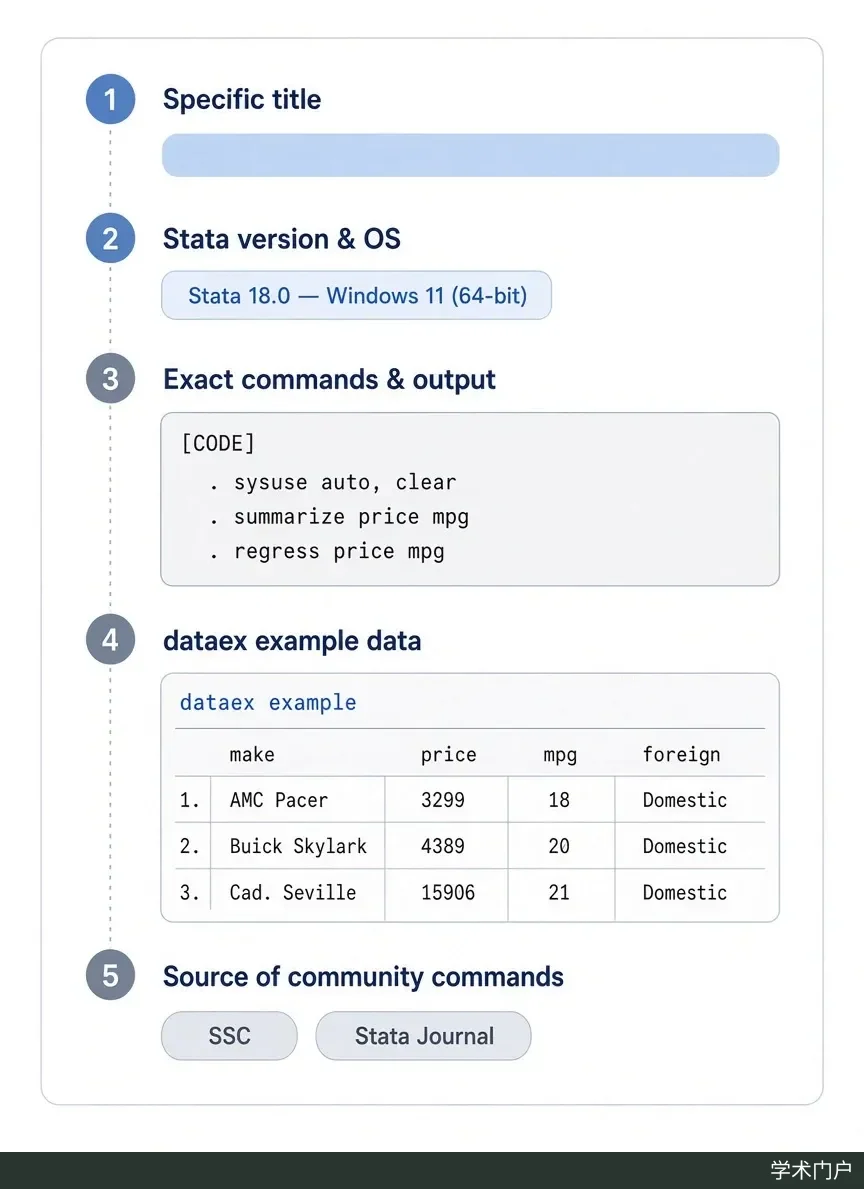
Parts of a solid Statalist question: a specific title, Stata version and platform, verbatim commands and output (CODE block), dataex example data, and the source of any community command. Content based on the Statalist FAQ[1] (revised 11 April 2025). AI-generated schematic.
Community rules and etiquette
Statalist positions itself as a technical forum: when you see clear errors or confusion, point them out directly and honestly, but correct politely without personal attacks; rudeness, swearing, and mean personal remarks are never acceptable. Askers need not dwell on how urgent they are, how much they need help, or how grateful they will be—just ask the question clearly.
- Real names: The FAQ requires a full real name with given name and surname, on the grounds that it shows respect and helps people know each other; if registration was wrong, change it via Contact us at the bottom right of the page.
- Cross-posting is allowed if disclosed: Rules do not ban posting the same question elsewhere, but you must include a searchable link; if a good answer appears elsewhere, please reply with the link.
- Reply in public: Except for job or consulting opportunities, do not ask for private replies; discussion should stay on the forum for others to learn from.
- Close the loop and edit carefully: Askers should summarize what fixed the problem and thank answerers; “Thanks in advance” and likes do not replace that. Posts cannot be deleted; there is a one-hour edit window after posting; even if you solve it yourself, do not rewrite the original beyond recognition—write the solution instead. Posts are not owned by the starter; returning years later with a new solution or program update is welcome.
- Write Stata, not STATA: The FAQ explains specially that writing STATA shows you did not finish reading the guide.
Reference value and limits
For scholars, Statalist is first a searchable Q&A library. Discussion runs from the 1994 mailing list to today, and posting norms that require version, code, and example data make it easier for later readers to judge whether an answer fits their case. Real names and public replies also leave answerers’ identities and the discussion trail checkable.
A recent example is Stephen Weinberg’s “Warning about chatGPT” thread started 8 September 2025. He described a student who asked ChatGPT for code to fix a memory problem and was taught to declare every generated variable as double even when byte would do. Follow-ups disagreed: some had seen ChatGPT invent methods and functions that do not exist; Benno Schoenberger posted an ado program generated by ChatGPT that ran unmodified, and daniel klein immediately noted it was reliable only when the data had no string variables. That “paste code, others check” exchange is exactly the discussion style the norms aim for. Note that the FAQ has no dedicated clause on AI-generated content.
Limits are equally clear. First, the FAQ lists common reasons for no reply: no ready-made Stata program, something the help or manuals should answer, asking others to code a whole project, asking whether an approach is “correct,” unclear or overly complex questions, models that fail to converge because they do not match the data, and so on; the forum also cannot make research trade-offs for the asker—the FAQ’s line is that “this is ultimately your own judgment.” Second, basic questions are out of scope; beginners need to read the docs first. Third, answers come from the user community; neither the FAQ nor the official site promises reply time or correctness, so practices taken from the forum still need independent verification.
Fourth, generative AI may be changing forum activity. A working paper by Ambre Elsas-Nicolle and Ralf Elsas-Nicolle compares Statalist with Stack Overflow and Cross Validated before and after ChatGPT’s release (November 2022). The abstract says posting fell on all platforms, but the drop was smaller on real-name Statalist, and the share of high-complexity questions rose more clearly; at the same time, more recent data suggest that resilience may be only transitional. The paper is an unreviewed working paper with no date on the page; conclusions need re-checking after formal publication. In the thread above, George Ford also noted that very simple questions appear less often on the forum.
References
-
Cox, N. J. Advice on posting to Statalist (Statalist FAQ, revised 11 April 2025). https://www.statalist.org/forums/help
-
StataCorp. Statalist | The Stata Forum (publication date not stated). https://www.stata.com/statalist/
-
Weinberg, S., et al. Warning about chatGPT (Statalist discussion thread, started 8 September 2025). https://www.statalist.org/forums/forum/general-stata-discussion/general/1781664-warning-about-chatgpt
-
Elsas-Nicolle, A., & Elsas-Nicolle, R. Is There (Still) Anybody Out There? Online Forums in the Age of Generative AI (working paper, date not stated). https://ambrenicolle.com/statalist-ai/
-
Academic Gateway · a living guide for scholars in the intelligent age
-
Information compiled and published by the Scholay academic one-stop platform; report infringement for takedown.
-
Also published on Enter Scholar, a scholars’ community for the intelligent age