Project overview
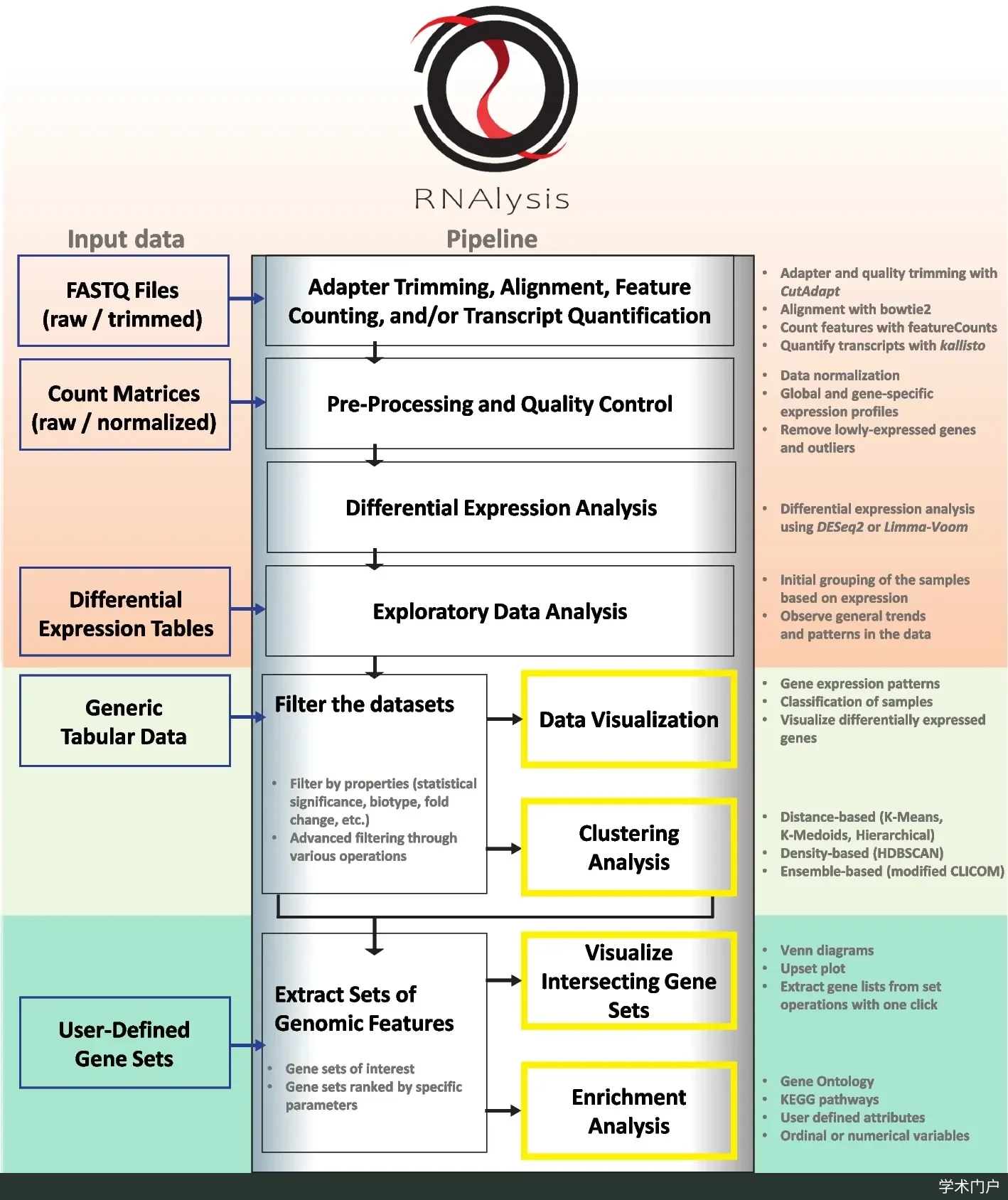
RNAlysis is open-source RNA-seq analysis software written in Python. The GitHub repository is GuyTeichman/RNAlysis under the MIT license. A graphical interface chains FASTQ preprocessing, differential expression, clustering, enrichment, and visualization so researchers need not write code. The latest stable release, V4.3.0, shipped on 27 August 2026. This article is a source check; the software was not installed or tested hands-on.
Project position and how to get it
- Project position: In a software paper published in BMC Biology on 7 April 2023, developer Guy Teichman and colleagues describe RNAlysis as modular RNA-seq analysis software built around three task classes: data preprocessing and exploratory analysis; finding gene sets of interest via filtering, clustering, and set operations; and intersection visualization plus enrichment of those gene sets. Demo data come from C. elegans; the authors note the software also applies to any species with a reference genome.[1]
- Hooks into existing tools: From the GUI you can call CutAdapt (adapter trimming), kallisto (transcript quantification), bowtie2 (alignment), featureCounts (feature counting), and DESeq2 or limma-voom (differential expression), so analysis can start from raw FASTQ; you can also import count matrices, differential-expression tables, or gene lists from other software. When external tools are called, RNAlysis exports the actual command lines or R scripts used, which helps report methods in papers.[1,2]
- Two ways to use it: Windows and macOS users can download standalone installers from GitHub Releases (the V4.3.0 macOS package filename is marked M1); or install with
pip install RNAlysisand open the UI withrnalysis-gui. Users who write Python can call the same functions from scripts; Pipelines built in the UI and scripts can import each other. The PyPI page lists support for Python 3.10 through 3.14.[1,4,5,6] - Repository and license: The repository is GuyTeichman/RNAlysis; the default branch is development; the LICENSE file is MIT (Copyright (c) 2022, Guy Teichman). Official docs: guyteichman.github.io/RNAlysis.[2,3]
Recent version updates
- Latest stable V4.3.0: Published on GitHub Releases on 27 August 2026 (changelog entry dated 26 August), with Windows and macOS standalone packages. New features include filtering genes or adding annotation columns by any attribute in GTF/GFF annotation files (e.g. chromosome, strand, annotation source, biotype); full reading of GFF3 and gzip-compressed annotation files; and optional log2(x+1) transforms for PCA and each clustering method. Performance improved for GO/KEGG enrichment, CLICOM clustering, PCA, and UniProt gene-ID conversion; startup no longer needs a network call for species and ID-type lists.[6,7]
- Fixes that can change results: V4.3.0 fixed KEGG enrichment dropping pathways that lack a COMPOUND section (e.g. ribosome, spliceosome, proteasome). Officials report recovering 36 pathways in C. elegans and note that KEGG enrichment results and multiple-testing correction may therefore differ from older versions. Another fix targets Box-Cox transforms: for genes that are high and nearly constant in a few samples (e.g. GFP reporters), the transform could overflow and raise a confusing NaN error; the run now stops and names the genes so users can filter them or switch to a log transform.[6,7]
- Merged but unreleased fixes: As of 21 October 2026, the latest GitHub Release was still V4.3.0. The development-branch HISTORY.rst lists later fixes under “4.3.1 (unreleased),” including two PRs merged on 15 October 2026 (UTC):[7,8,9]
- PR #340, differential-expression output filenames: DESeq2 and limma-voom result filenames are built from factor names and levels; levels containing
/,:, double quotes, and similar characters used to fail only after model fitting finished. After the fix,< > : " / \ | ? *and control characters are replaced with_, while already-legal names stay unchanged; if two contrasts would yield the same filename (including case-only differences such asKOvsko), the error is raised before R starts; strings passed into R are escaped uniformly, and the R script also checks that design- and count-matrix sample names and order match. Officials say analyses that previously succeeded keep the same results.[7,8] - PR #337, parallel compute in the standalone build: The standalone build is PyInstaller-packaged and does not support joblib’s
lokyparallel backend. When a Pipeline recorded in the pip build withparallel_backend='loky'is replayed in the standalone build,lokycould be passed into enrichment and clustering. After the fix, the standalone build usesmultiprocessingat every parallel entry point; pip-build behavior is unchanged. The PR notes that only a packaged environment was simulated, not a real packaged build.[7,9]
- PR #340, differential-expression output filenames: DESeq2 and limma-voom result filenames are built from factor names and levels; levels containing
Practical value
For lab researchers who are not fluent in programming, RNAlysis puts common RNA-seq steps—filtering, clustering, set operations, and enrichment—into one GUI and can save the sequence as a shareable Pipeline; users who write Python can call the same functions from scripts. The scenarios and cautions below are drawn from the paper, official docs, and changelogs; this is a source check, not hands-on testing.
Suitable analysis scenarios
- Downstream analysis from count tables: After importing a count matrix or differential-expression table, you can normalize (the paper lists median of ratios, RLE, TMM, and others), filter low-expression genes, select by significance and fold change, and run intersection, difference, and other set operations across any number of tables or gene sets, then export gene lists directly.[1]
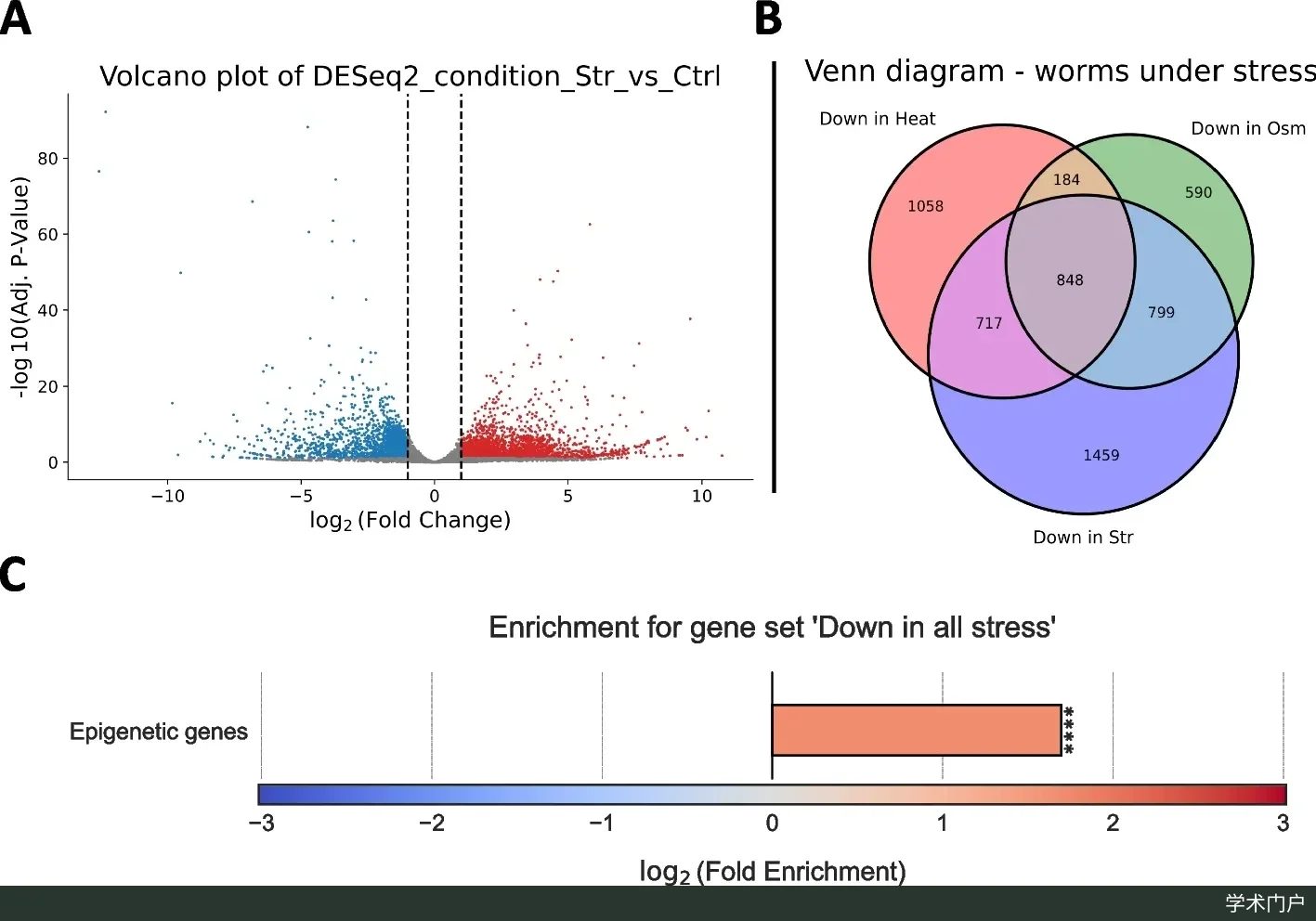
- Clustering by expression pattern: Offers K-Means, K-Medoids, hierarchical clustering, HDBSCAN, and an improved CLICOM ensemble, plus multiple distance metrics; methods such as HDBSCAN do not require specifying the number of clusters in advance.[1]
- Enrichment analysis: Can fetch GO and KEGG annotations for major model organisms automatically, and also accepts user-defined gene attributes for enrichment—useful for lab-curated gene lists. Statistical methods include hypergeometric tests, permutation tests, and single-set XL-mHG tests, among others.[1,2]
- Reproducibility and sharing: A sequence of operations can be packaged as a Pipeline, applied with the same parameters to many similar tables, and exported for collaborators; the software can also generate an interactive analysis report that records the full analysis path in one click.[1,2]
Limitations and cautions
- Not hands-on tested: This article is a source check; content comes from the paper, official docs, GitHub Releases, HISTORY.rst, and PR notes.
- External programs install separately: The standalone build still needs separately installed external programs—for example R for DESeq2, kallisto for quantification. The full pip install (
RNAlysis[all]) needs GraphViz, R, and kallisto first; on Windows you may also need Microsoft Visual C++ 14.0 or newer and Perl.[4] - Platforms: Standalone packages are Windows and macOS only; Linux users install via pip or source. Officials note the standalone build may take a minute or two to start.[2,4]
- Depends on online databases: GO/KEGG enrichment, gene-ID conversion, and ortholog mapping need live access to UniProt, Ensembl, KEGG, and similar services; results change as those databases update. From V4.3.0, UniProt tasks that stay unresponsive for a long time warn and return only partial results.[6,7]
- Upgrades may change results or filenames: V4.3.0 changed which KEGG pathways are included; development-branch changes labeled 4.3.1 will change output filenames that contain special-character levels, and case-only contrast pairs will error immediately. Recording the RNAlysis version in a paper’s methods helps others reproduce results.[6,7]
- New fixes are not in the installer yet: PRs #340 and #337 are only on the development branch; stable V4.3.0 does not include them. Users who need those fixes can wait for the next stable release or install the development branch from source and accept the risk of an unreleased build.[6,7,8,9]
- Citation requirements: The official README asks users to cite the BMC Biology paper; when analyses use DESeq2, limma-voom, kallisto, bowtie2, and similar tools, cite those tools as well.[2]
References
-
Teichman G, Cohen D, Ganon O, Dunsky N, Shani S, Gingold H, Rechavi O. RNAlysis: analyze your RNA sequencing data without writing a single line of code. BMC Biology, 2023, 21: 74. https://doi.org/10.1186/s12915-023-01574-6 (accessed 2026-10-21)
-
GuyTeichman/RNAlysis. README (GitHub repository). https://github.com/GuyTeichman/RNAlysis (accessed 2026-10-21)
-
GuyTeichman/RNAlysis. LICENSE (GitHub repository license file). https://github.com/GuyTeichman/RNAlysis/blob/development/LICENSE (accessed 2026-10-21)
-
RNAlysis Documentation. Installation. https://guyteichman.github.io/RNAlysis/build/installation.html (accessed 2026-10-21)
-
PyPI. RNAlysis. https://pypi.org/project/RNAlysis/ (accessed 2026-10-21)
-
GuyTeichman/RNAlysis. Stable release V4.3.0 (GitHub Releases, 2026-08-27). https://github.com/GuyTeichman/RNAlysis/releases/tag/V4.3.0 (accessed 2026-10-21)
-
GuyTeichman/RNAlysis. HISTORY.rst (development branch). https://github.com/GuyTeichman/RNAlysis/blob/development/HISTORY.rst (accessed 2026-10-21)
-
GuyTeichman/RNAlysis. Pull Request #340: Sanitize DE output file names and escape strings spliced into R (#281) (merged 2026-10-15). https://github.com/GuyTeichman/RNAlysis/pull/340 (accessed 2026-10-21)
-
GuyTeichman/RNAlysis. Pull Request #337: Clamp 'loky' to 'multiprocessing' at every joblib entry point when frozen (merged 2026-10-15). https://github.com/GuyTeichman/RNAlysis/pull/337 (accessed 2026-10-21)
-
Information compiled and published by the Scholay academic one-stop platform; report infringement for takedown.
-
Also published on Enter Scholar, a scholars’ community for the intelligent age