If you want to discuss research transparency and reproducibility with others but lack a clear community entry point, ReproducibiliTea is a checkable place to start. The network helps researchers set up open-research journal clubs at their universities to discuss papers, ideas, and ways to make research more transparent and reproducible. It began in 2018 at the University of Oxford, is now volunteer-run, and highlights a supportive community predominantly for early-career researchers.[1] Clubs typically bring researchers back for regular discussions and informal conversation.[1]
Who organises it, and who it fits
The January 2026 steering-committee post says the community is expanding and changing again to keep an early-career researcher (ECR) perspective while welcoming more diverse viewpoints.[2] New members illustrate cross-field and cross-institution organising: Ze Freeman, finishing a PhD at King’s College London’s Institute of Psychiatry, Psychology & Neuroscience, started the university’s club in 2024 and co-organises it; Ezgi Hatip Ünlü, a clinical-epidemiology PhD candidate at Erasmus MC, works on prognostic biomarkers in heart failure with interest in clinical-research reproducibility; Quentin Le Cornu co-organises the University College Dublin club while developing evidence-based data-management and sharing plans for trials and meta-analyses; Marjan Monshi, a physics PhD candidate at Kaunas University of Technology, registered the university’s first engineering-faculty club.[2] Incoming chair Lianne Wolsink started and co-organised ReproducibiliTea in Bochum and calls the clubs ideal places for ECRs to learn, discuss, reflect, and connect locally and globally.[2] Returning members span neuroscience in Geneva, mitochondria research in Helsinki, health-policy work linking Virginia Commonwealth University and Makerere University in Uganda, and bioinformatics organising—evidence that the network is not locked to one discipline.[2]
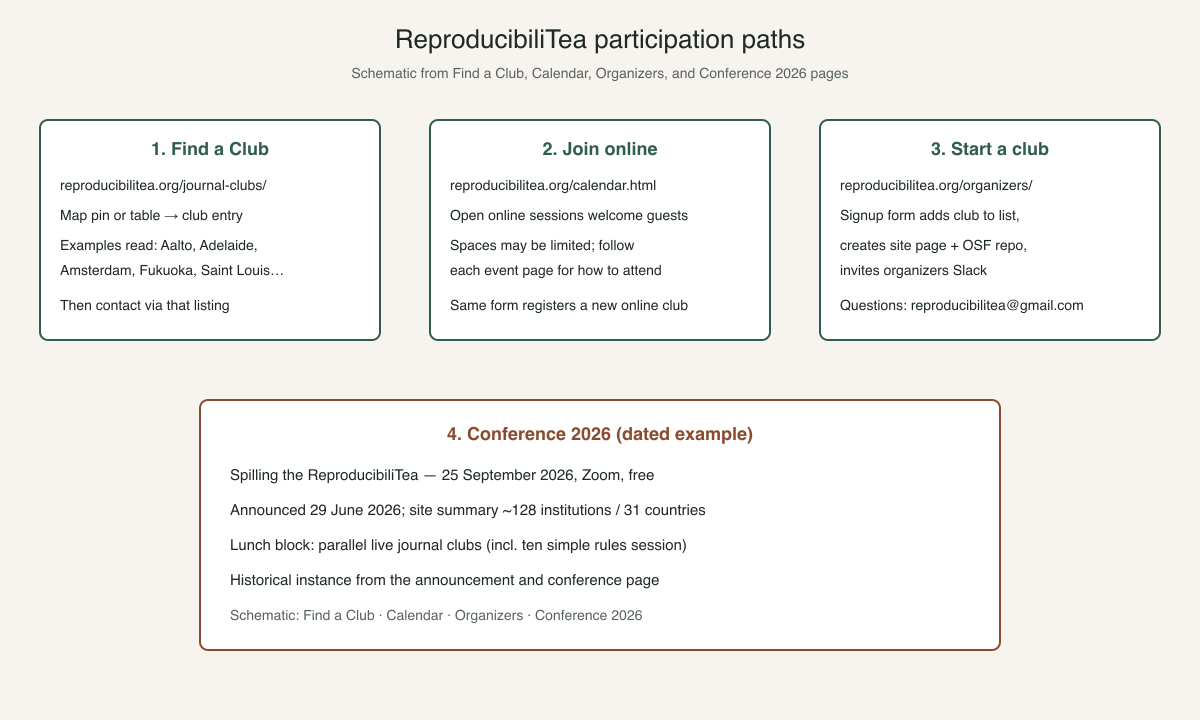
Figure: participation-path schematic. Find a Club map/table, calendar open online sessions, Organizers signup, and the 25 Sep 2026 online conference as a dated historical example. Based on public site pages.[3][4][5][1][7]
Find a local club, join online, or start one
Local clubs: the Find a Club page provides a map and table so you can search whether a club exists nearby; clicking a pin loads that club’s details, or you can browse by name, location, or topic.[3] The directory lists universities and institutes across many countries—examples include Aalto, Adelaide, Amsterdam, Fukuoka at Kyushu University, and a Saint Louis Area club—while contact paths remain those published on each entry.[1][3] Many clubs meet partly or fully online and welcome visitors. Check the calendar for open sessions and the event details for access and availability. Organisers may cap attendance.[4] Advice for moving a club online is linked there; starting a new online club uses the same registration form as an in-person club.[4]
Starting a club is framed as low-commitment, fun, and flexible: learn fundamentals with colleagues and make new practices easier to adopt; organisers also have an active Slack workspace for mutual support.[5] An OSF page hosts shareable materials—a welcome letter, logo, poster templates, a sample organising checklist, reading lists, and more.[5] Signing up automatically adds the club to the list, creates a website page, initialises an OSF repository, and invites you to Slack; questions can go to reproducibilitea@gmail.com first.[5] Organiser tools also cover online etiquette and hosting, shared Zotero access, edit requests for club details, meeting-card generation, and an optional local code-of-conduct template.[5] Network-wide conduct is linked from the Code of Conduct page, which also points to the optional local template.[6]
The 25 September 2026 online conference as a historical example
A 29 June 2026 announcement presented the first international conference, “Spilling the ReproducibiliTea: A Decade On & Decades Ahead,” for 25 September 2026 via Zoom, free and open to all.[7] Themes covered problems in research reproducibility, how the community had tackled them, grassroots initiatives still driving change, and live journal-club sessions so more voices could be heard.[7] Named speakers included Monya Baker (author of the Nature piece “1,500 scientists lift the lid on reproducibility”), Retraction Watch, and the African Reproducibility Network; the announcement said places were first-come, first-served and linked a registration form.[7] The scheduled hours were 10:00–18:45 UTC+1. Around the time of the event, the volunteer network counted about 128 institutions in 31 countries and focused on early-career researchers.[1] The tentative programme listed two parallel live journal clubs in the lunch block; one was Lianne Wolsink’s experience-sharing session on ten simple rules for running a ReproducibiliTea club, useful alongside the organiser signup path.[1] Those sessions were part of the tentative programme.[1] The September 2026 conference is an example of the network’s activities.[1][7]
In practice, check Find a Club for your institution or a nearby listing, then follow that entry’s contact path; if none exists, watch the calendar for open online sessions or register a new club and reuse the OSF pack. Discussion boundaries follow the site Code of Conduct and any local template a club adopts. The calendar and individual club listings are the places to look for upcoming sessions.
References
-
ReproducibiliTea. Home / Conference 2026. https://reproducibilitea.org/ ; https://reproducibilitea.org/conference2026
-
ReproducibiliTea Steering Committee. ReproducibiliTea in 2026. https://reproducibilitea.org/jc/2026/01/26/ReproducibiliTea-In-2026.html
-
ReproducibiliTea. Find a Club. https://reproducibilitea.org/journal-clubs/
-
ReproducibiliTea. Calendar / Online meetings. https://reproducibilitea.org/calendar.html
-
ReproducibiliTea. Organizers. https://reproducibilitea.org/organizers/
-
ReproducibiliTea. Code of Conduct. https://reproducibilitea.org/code-of-conduct/
-
ReproducibiliTea Steering Committee. ReproducibiliTea Conference — Free, Online, Sept 25. https://reproducibilitea.org/jc/2026/06/29/reproducibilitea-conference.html