Find the earlier conversation
Three short lines sit in the margin of an early printed book. An editor can see they were added later, but what should a reader be able to search for in a digital edition? How should the relationship to the main text be recorded? The Text Encoding Initiative Consortium develops and maintains guidelines for digital text encoding. Libraries, museums, publishers and scholars use them to represent manuscripts, archives, language corpora and critical editions. Start by looking for comparable editorial decisions and what each project wanted to preserve.[1][2]
The Consortium’s support page directs questions about the Guidelines and text encoding to TEI-L, a mailing list open to anyone. Open the LISTSERV archive hosted at Pennsylvania State University. Use Search Archives or browse a date range. Try several terms for marginal annotation as well as terminology encountered in the Guidelines. The archive includes a question and several replies about encoding the digital Dictionnaire de Trévoux. A whole exchange often reveals the extra conditions the questioner supplied after the initial message. Record the date and the Guidelines version being discussed. An old answer addresses a particular source. Before adopting it, check where the two sources and their editorial aims coincide.[1][3]
To join, use the web form linked on the support page or email TEI-L-subscribe-request@lists.psu.edu. To leave, email TEI-L-unsubscribe-request@lists.psu.edu. List-management addresses serve a different purpose from discussion mail, so check the recipient. Describe the physical object, the query a reader should be able to make and the relationship your present approach misses. An invented short transcription can illustrate the issue without putting a restricted page image in a public archive.[1][3]
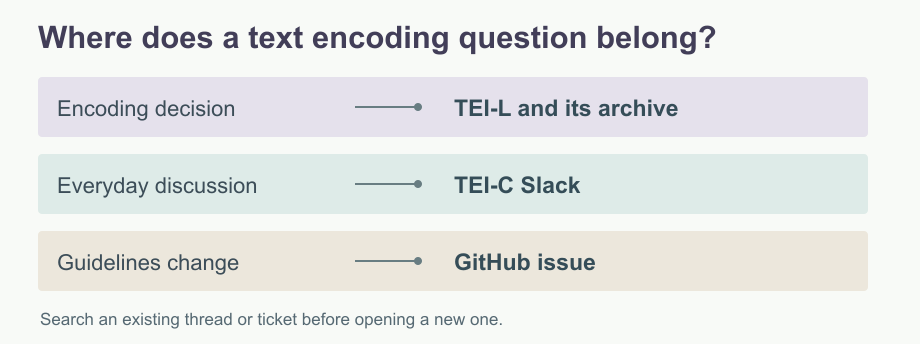
Figure: Three discussion routes in the TEI community.
Give maintainable changes a record
TEI-C Slack supports everyday asynchronous conversation. Follow the support page to the invitation form and wait for administrator review. Both paying members and other participants can apply. If a conversation clarifies which editorial layer the marginal writing belongs to, consider summarising the shareable reasoning in a focused email that another project can find later. Social media also carries event announcements. Finding a meeting and finding the rationale for an encoding decision call for different starting points.[1]
Sometimes a discussion reveals a specific inconsistency between a Guidelines example and its description. Follow the support page to TEI on GitHub, choose the relevant repository and look for an existing issue. A signed-in user can report a bug, request a feature or comment on an open ticket. Supply the version, exact page and smallest example, then explain what you observed and what should change. A maintainer can verify it, and a colleague can later check the fix. The list can preserve the editorial reasoning while the issue tracks a concrete change.[1][2]