Periodical stacks at Goa University Library, India, photographed 6 October 2017. Author: Velanky Dias; source: Wikimedia Commons; license: CC BY-SA 4.0.

Retraction Watch is a retractions news blog that launched in August 2010, run by the U.S. nonprofit The Center for Scientific Integrity; its comment threads and reader tips are a major part of how it works. The retraction database it compiled was acquired by Crossref in September 2023 and opened to the public—searchable online and downloadable in full for free. This article covers what both are for, how to take part and search, comment rules, and limits when using the data.
How the blog, the database, and Crossref relate
Retraction Watch went live in August 2010; co-founder Ivan Oransky is now executive director of the Center for Scientific Integrity. The center is a U.S. 501(c)(3) nonprofit; besides the blog, it maintains the Retraction Watch Database. Per the FAQ, a 2014 MacArthur Foundation grant enabled the team to build that database; in recent years the center has also run projects such as the Medical Evidence Project, launched in June 2025. A weekend roundup dated 17 October 2026 said the database held more than 67,000 retractions, plus a Hijacked Journal Checker with over 450 records and a COVID-19 retraction list. Those figures keep growing—cite the date you checked.
On 12 September 2023, Crossref announced it had acquired the database and opened it to the public. The announcement’s then scale: about 14,000 retractions registered by Crossref members, about 43,000 in the Retraction Watch database, overlapping, totaling roughly 50,000. Under the agreement, Crossref paid an initial US$175,000, then US$120,000 per year to Retraction Watch with 5% annual increases, for a five-year first contract; Retraction Watch continues to add data every business day. The announcement stresses that the deal covers only the database: the blog and the Center for Scientific Integrity remain independent of Crossref and continue investigative journalism; publishers are still seen as primary custodians of the scholarly record and should keep registering retractions in Crossref metadata.
From official descriptions, users fall roughly into four groups: researchers checking whether papers they cite or review have been retracted; scholars studying retractions and research integrity (the user guide publishes field-change logs precisely because the database is used in research); downstream services that rely on open retraction data (Crossref’s phrasing); and editors, journalists, and general readers who follow research integrity.
Two recent stories show what the blog covers. On 15 October 2026, Retraction Watch reported that Annals of Internal Medicine retracted a long-COVID treatment trial paper and published a new version the same day because the authors had not reported a mid-trial dose reduction of metformin; the new version changed the metformin conclusion from “no benefit” to “uncertain.” A 16 October follow-up said a brokerage site named Springer Journals Online, selling authorship slots, went offline four days after Retraction Watch’s investigation; Springer Nature told reporters it had no connection to that entity. The first is a retraction case; the second is a research-integrity issue beyond retractions—both are within the blog’s remit.
How to take part in comments and community rules
Every post is open to comments. The FAQ’s view of commenters: they expand posts, supply tips, and flag errors when editors get things wrong. There are three main ways to participate: comment under an article with background or challenges—for example, under the long-COVID piece readers asked why peer review had not caught the problem; tip the newsroom via the email on the About page; and, when the database has missed a retraction, submit it via the link in the user guide. Database additions accept only retractions that have already happened—“this paper should be retracted” tips go through the separate tip channel.
Comment policy is in the FAQ. First, no personal attacks, baseless accusations, or unverified claims, including speculation about how events unfolded or what parties intended; the FAQ’s sense is that if verifying a comment would require mind-reading or knowing motives, it likely will not be approved. Second, editors will not edit comments for you—if any part of a comment violates the rules, the whole comment is rejected; authors may rewrite and resubmit, or write to ask why. Third, Retraction Watch positions itself as a news organization: it does not advise on individual cases or advocate for or against a given retraction—the FAQ compares this to financial reporters who should not tip stocks. Fourth, with limited staff, the team generally does not investigate “this paper should be retracted” tips; it focuses on reporting retractions that have occurred and asking why.
The FAQ also acknowledges a life-sciences skew, for two reasons: the founders began as medical journalists, so sources and expertise concentrate there; and life sciences simply produce more papers. The newsroom publicly welcomes tips from readers in the physical sciences and other fields.
Web search, bulk download, and API for the database
For one-off lookups, use the web database (retractiondatabase.org). Since 23 October 2024, every search must fill at least one field: author, title, journal, publisher, institution, country, article type, date range for the original paper or the notice, or PMID and DOI for the original or the notice. The page shows at most 50 results; the total hit count appears in a yellow bar above the results. Multiple fields combine with AND by default; within a field you can use AND, OR, AND NOT, and * as a wildcard. For names, the user guide suggests forms like doe to catch variants such as “John P Doe Jr,” but check each result for the same person. Dates use MM/DD/YYYY. Results also mix in corrections and expressions of concern—filter yourself if you want retractions only.
For large searches or statistics, both the user guide and Crossref recommend the full dataset. Full data are CSV files in Crossref’s public GitLab repository, updated every business day; as of a check on 18 October 2026, the latest file was generated on 16 October. There are 20 fields, including RetractionNature (retraction, correction, expression of concern, or reinstatement), Reason (retraction reasons from Retraction Watch’s controlled vocabulary), OriginalPaperDOI, RetractionDate, Paywalled, and others; multiple values in one cell are semicolon-separated. Crossref’s REST API also surfaces retraction information: retraction records appear in the update-to field; source publisher means publisher registration, retraction-watch means Retraction Watch.
# Clone the full Retraction Watch dataset (CSV), then refresh it later
git clone https://gitlab.com/crossref/retraction-watch-data
cd retraction-watch-data && git pull

# Crossref REST API: list works with retraction updates
curl "https://api.crossref.org/v1/works?filter=update-type:retraction"
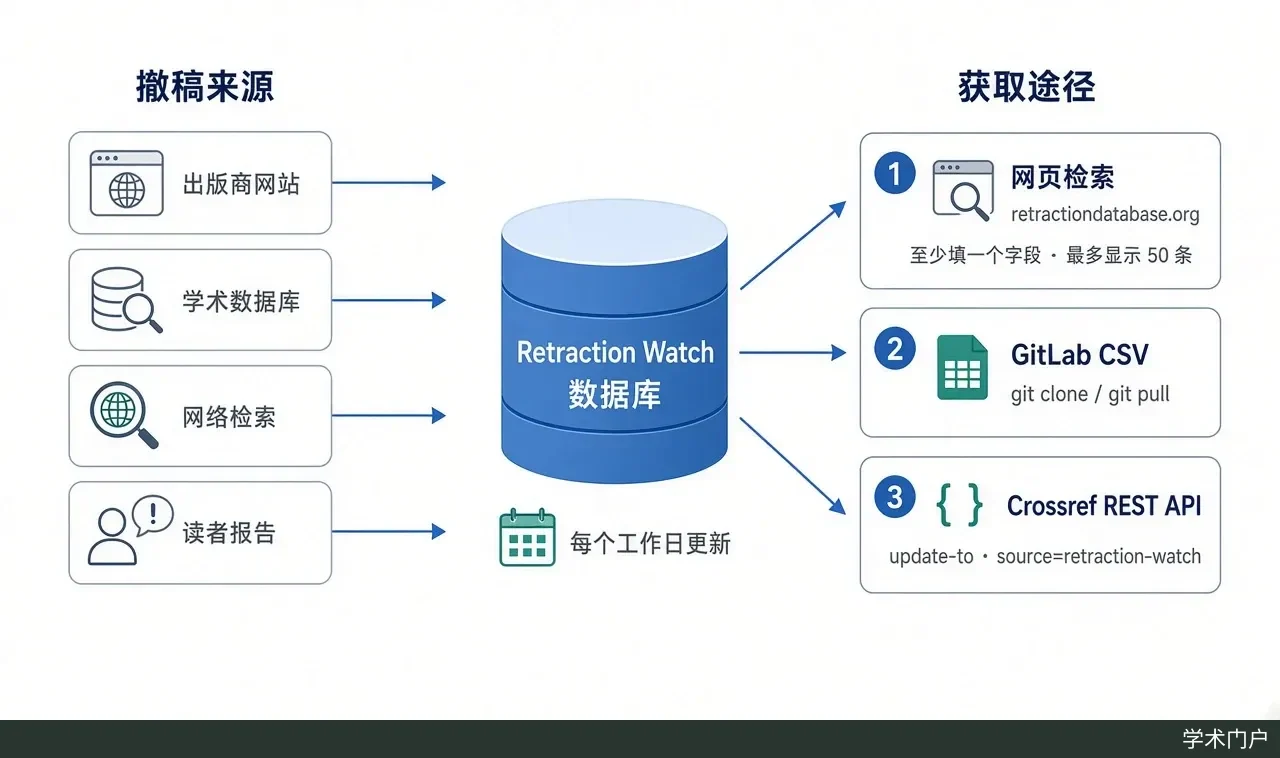
Sources that feed Retraction Watch retraction data and three ways to obtain them. AI-generated diagram based on Crossref official documentation and the Retraction Watch Database user guide.
The user guide’s basic citation format is: The Retraction Watch Database [Internet]. New York: The Center for Scientific Integrity. 2018. ISSN: 2692-4579. [Cited (applicable date)]. Available from: http://retractiondatabase.org/. Data keep growing and being revised, so record the citation date—or the CSV generation date you used—so others can reproduce your results.
Value and limits in use
For day-to-day research, three uses stand out. First, before submitting or reviewing, check references by DOI or PMID for retractions. Second, the database includes many retractions publishers never registered with Crossref; Crossref itself says this fills a critical gap in member data. Third, each retraction is tagged with reasons from a controlled vocabulary, and blog reporting often adds process detail that notices omit, helping researchers place cases in context.
Limits also come from official docs. First, uneven coverage: the database prioritizes retractions; corrections and expressions of concern are mainly added when they relate to existing retractions, blog posts, or high-attention research—officially those two classes are biased, so seek other databases for them. Second, date error: some publishers overwrite the original page with the notice, making original and retraction dates identical; month-only dates are recorded as the 1st of that month, and seasons and volume numbers have conversion rules—date-only analysis can go wrong. Third, classification is the database’s own: journals’ “Withdrawn” or “Removed” articles are counted as retractions; Partial Retractions count as corrections; DOI’d revisions are also stored separately and tagged “Revision,” which inflates counts if not filtered. Fourth, reasons combine the notice with newsroom or other credible investigation and are editorial judgments, not institutional findings.
Also, the blog and comments are news and discussion, not adjudication: coverage skews life sciences, and comment claims may be unverified. For research use, the user guide suggests contacting the team (team@retractionwatch.com) first to clarify what the data can and cannot support. The GitLab repository page we checked did not state a data license; confirm with Crossref before redistributing or embedding in a product.
References
-
Crossref. News: Crossref and Retraction Watch. 2023-09-12 (data-repository URL added 2024-10-10).
-
Crossref. Retraction Watch (Crossref documentation). Last updated 2025-01-19.
-
Retraction Watch. The Retraction Watch FAQ, including comments policy. No publication date on page; accessed 2026-10-18.
-
Retraction Watch. Retraction Watch Database User Guide. Updated 2024-10-23.
-
Crossref. crossref / retraction-watch-data (GitLab). Data generated 2026-10-16; accessed 2026-10-18.
-
Retraction Watch. Retraction Watch home. Weekend roundup 2026-10-17; accessed 2026-10-18.
-
Avery Orrall. Journal retracts, republishes paper on Long COVID treatment trial. Retraction Watch, 2026-10-15.
-
Madhulika Pathak. ‘Springer’ agency website offering authorship for sale goes down following Retraction Watch story. Retraction Watch, 2026-10-16.
-
Information compiled and published by the Scholay academic one-stop platform; report infringement for takedown.
-
Also published on Enter Scholar, a scholars’ community for the intelligent age