Systematic reviews often start from thousands of records. ASReview LAB is open-source software for that screening task: you mark records relevant or irrelevant, and it trains a model in the background to rerank unseen items so likelier relevant ones appear sooner.[1][2] Maintained in the Utrecht open-source ecosystem around ASReview, the GitHub repository licenses the software under Apache-2.0, requires Python 3.10+, and installs with pip install asreview; cite van de Schoot et al. (2021) in Nature Machine Intelligence for the methodology and the software release you used for the tool itself.[1][5] ASReview LAB 3.0.8 supports project setup, prior labels, record-by-record screening, and a configurable stopping prompt.[2][3][4]
Projects and prior knowledge
Create a project and load a dataset from your computer, Discovery, a URL, or a DOI, then check completeness charts so fields are fit for screening.[2] The default model is ELAS ultra (a fast model trained on SYNERGY); multilingual, heavy, or custom options exist—most users keep ultra; multilingual helps non-English sets.[2] You can also add tags and tag groups for later organisation or extraction; the current version uses checkboxes so a record can carry multiple tags that appear in the collection and on export.[2] Prior knowledge means records you already know are relevant or irrelevant; it seeds the active-learning ranking, and partially labeled data are used automatically.[2] To add priors: Search by author, keywords, or title (only the first 10 hits show, so keep queries precise), then label matches; Accurate prior labels can improve model performance.[2] If you cannot find priors yet, you can start screening and add known labels later, but the initial ranking will be weaker.[2]
Label, rerank, and decide when to stop
On the review screen each record shows a title and abstract; click relevant or irrelevant to advance, optionally adding a note.[3] Each labeling decision can start a new model when none is training, then update the rank order of unseen records asynchronously—fast models may finish before you finish the next abstract, while slower models keep training as you continue down the current queue.[3] Relevant hits usually thin out over time; decide when to stop based on the review’s scope and what remains to be screened.[3] Clear inclusion criteria and consistent labeling matter more than finishing the whole file—the tool reorders reading; it does not make inclusion decisions for you.[3]
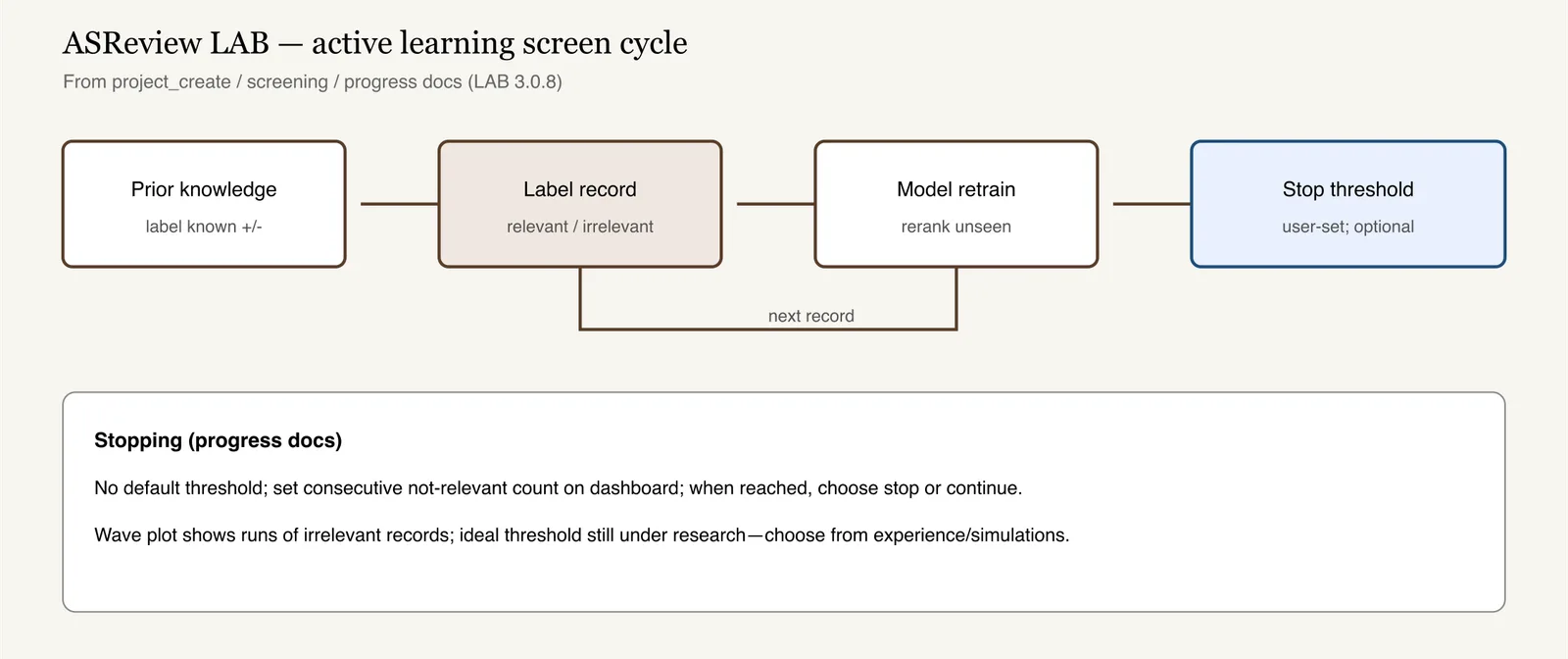
Figure: Schematic ASReview LAB active-learning screening cycle. Drawn by this publication, after Progress[4]
The dashboard can set a stopping criterion as a run of consecutive not-relevant records; no threshold is set by default, so you choose the number.[4] When it is reached you are asked to stop or continue—long screens naturally produce more not-relevant runs, so the threshold assists judgment rather than auto-closing the review.[4] Choose the threshold based on prior screening experience or simulations on similar topics. There is no universal best value.[4] Charts such as the irrelevant “wave” plot show runs of not-relevant records; the lamp icon explains each statistic, and questions can go to the project discussion forum.[4] You can change the threshold mid-review; that only shifts when you are prompted, not whether you actually stop.[4] At any time during screening you can export the dataset—including your labels, imported data, and some additional variables—to RIS, CSV, TSV, or Excel; the docs note that a RIS file can only be exported if a RIS file was imported.[4]
ASReview LAB frames screening as prior knowledge → label → retrain/rerank → consider stopping at a user-set threshold; the software does not pick the number for you. Cite van de Schoot et al. (2021) for the method and the release you ran for the software.[1][4][5] It addresses which records to read next; inclusion criteria and reporting standards remain methodological choices outside the tool.[2][3]
References
-
ASReview. asreview/asreview. GitHub.
-
ASReview LAB documentation. Create a project.
-
ASReview LAB documentation. Screening.
-
ASReview LAB documentation. Progress and results.
-
van de Schoot, R. et al. (2021). An open source machine learning framework for efficient and transparent systematic reviews. Nat Mach Intell.