A review asks how secondary-school students understand a passage. Typing reading into a search box may match a title, an incidental mention in an abstract or a subject assigned to the record. If the indexed subject matters, begin in the ERIC Thesaurus. Reading Comprehension offers a way to express the topic separately from education level and publication year, leaving each restriction available for revision.[3][4][6]
Separate the database from its vocabulary
ERIC is an education literature database supported by the US Department of Education's Institute of Education Sciences. Searching is free without a membership. Its core collection reaches back to 1964 and includes journals, books and grey literature such as reports and conference material. A programme report might describe implementation that a journal paper treats differently. Excluding non-journal records at the outset is a review decision, not evidence that no reports exist.[1][2]
Look up a familiar term in the Thesaurus, include synonyms if helpful, and inspect definitions and broader, narrower and related terms. ERIC describes a vocabulary of nearly 12,000 terms including over 4,500 descriptors and about 7,000 synonyms. Assigned descriptors bring together records written with different wording. Dead terms no longer index new material but can help find older records indexed under a previous term.[3]
Give each condition one job
Start with descriptorx:"Reading Comprehension", preserving the capitalization of the controlled term for exact, case-sensitive matching. Add an education-level condition such as educationlevel:"Secondary Education". This is less brittle than requiring both concepts in the title. A relevant study may describe its participants elsewhere.[3][4][6]
Proper-name identifiers cover locations, laws or programmes, and assessments or surveys. A descriptor can express the educational question while a law identifier selects the particular legislation. Exact fields include locationx and counterparts for laws and assessments. Not every record has an identifier. Fielded matching helps distinguish a location studied from one that an abstract merely mentions.[3][4]
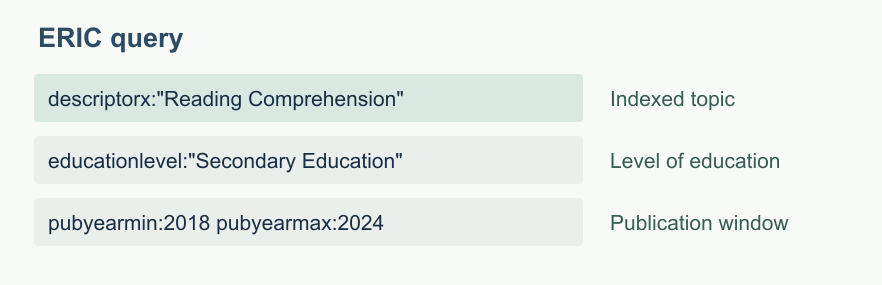
Figure: The parts of a reading-comprehension query.
Ordinary search combines words by default and quotation marks preserve phrases. OR expresses alternatives, a plus can require a term and a minus can exclude one. Add pubyearmin:2018 pubyearmax:2024 to an existing search to limit publication years. These filters must accompany other search terms and cannot be combined with Boolean and sign operators like ordinary terms. Add one restriction at a time and check whether a known eligible paper survives.[4][5]
Record why a paper falls outside the results
Peer reviewed only selects a record characteristic; Full text available on ERIC selects an access route. A paper may merit full-text screening even if its text is available only through a publisher or institutional repository. Checking both produces a subset satisfying both restrictions. Record those settings separately so a collaborator can distinguish a methodological exclusion from an access filter.[1][5]
Keep a positive and a negative test record and walk each through subject, level and dates. If the search is too narrow, relax the responsible condition. ERIC provides an API for larger record sets. Resolve the meaning of the fields in the web interface before translating the same question into a batch query.[1][4][5]