A journal asks for an ocean-observation table to be deposited somewhere it can be cited in the long term. You need a repository that accepts the material and a persistent link that will identify the particular dataset. re3data is a global registry of repositories. On 21 November 2026 its homepage listed 3,544 repositories. That figure counts registry entries, not downloadable datasets.[1][2]
Start with the material your discipline deposits
The Karlsruhe Institute of Technology and Purdue University Libraries operate re3data. Search for a discipline or known repository, or browse by subject or country and narrow by repository type. For an ocean-observation table, start with geosciences and examine disciplinary repositories. Check the responsible institution where a funder or an institutional agreement makes it relevant. An institution's country is a different field from the location where observations were taken.[1][2]
List the real requirements first. This table has times, coordinates and units. Readers should be able to access it and the journal wants a persistent dataset identifier. Those criteria are more informative than choosing the most familiar name in a broad search. Certification and metadata standards may matter under an agreement or existing project practices. The registry offers more than twenty filtering dimensions, only some of which bear on this decision.[2]
Distinguish reading from depositing
Consider the PANGAEA registry record. It identifies a disciplinary repository covering subjects including oceanography and geology, and describes georeferenced earth and environmental data. Repository access and data access are open. Upload is restricted by registration. These three fields coexist: finding and reading a record does not establish that a new depositor can upload immediately.[3]
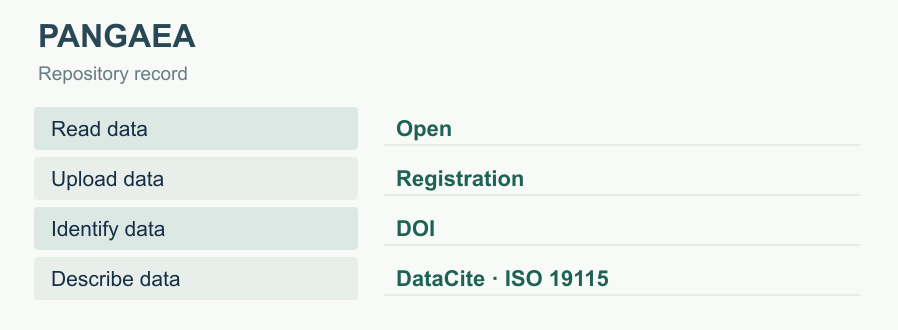
Figure: Four fields in the PANGAEA repository record.
PANGAEA lists DOI as a persistent identifier system, DataCite and ISO 19115 among metadata standards, and CoreTrustSeal certification. Cite the identifier for the individual dataset in the paper. The registry's description can document the choice of repository but cannot identify one cruise's measurements. The general CC label likewise calls for inspecting the license attached to the particular dataset before deciding how it may be adapted and credited.[3]
Take a shortlist into the deposit process
For each candidate, record disciplinary scope, who may deposit and read, the dataset identifier, license entry point and date checked. Add one sentence about why it fits the table. If two services both assign DOIs, compare how their metadata will help another researcher discover the coordinates and observation times. That comparison informs what documentation to prepare and preserves the rationale for the next data manager.[2][3]
For a larger repository directory, re3data exposes an open API and structured XML records. Registry metadata is available under CC0, enabling a team to reuse those fields in a periodically updated shortlist. Deposit terms and reuse of the underlying observations belong to the individual repository and dataset. The final reference in the paper should lead to the table itself.[2][3]