A minimum-wage researcher may have two questions. Which working papers in recent years directly examine wages and employment? What else appeared in labour economics this week? The first needs repeatable conditions; the second benefits from an editor scanning a field. Search IDEAS to define the first set, then decide whether to save that search or follow a NEP subject bulletin.[1][3][4]
Restrict the search to working papers
RePEc aggregates bibliographic metadata supplied by participating publishers. IDEAS is a service that searches and displays it. Records include working papers, journal articles, chapters and software. Choose Papers when tracking early research. Keep series, authors and dates so a later journal version with a changed title can be connected to the original.[1][2] Keep distinct records for distinct versions so a conclusion from an early draft is not inadvertently attributed to the final article.
Spaces normally mean AND, a vertical bar means OR and a tilde excludes a term. Quotes keep a phrase together. For instance, start with "minimum wage" (employment | labor) and inspect titles before excluding terms. The search handles stemming and some equivalent forms, including American and British spellings. Its documentation advises against wildcards. An asterisk pattern borrowed from another database is unnecessary here.[2][3]
Use the match location to interpret a result
Searching an entire record differs from searching only the title. An abstract may mention a policy while reviewing earlier work on a different subject. A title restriction improves directness but can lose papers whose title is conceptual and whose abstract names the institution. Inspect examples from both sets and test a known relevant paper. A missing seed may signal an overly narrow field rather than a missing synonym.[2]
Select years and sorting separately. Most recently published and most recently added are different: older research can enter the metadata feed today. For an institution-specific watch, search within its working-paper series. A JEL classification page can restrict a search to that class, optionally including subclasses. Record the scope with the query. Identical words run across the whole database and inside a single series do not describe the same search.[2][3]
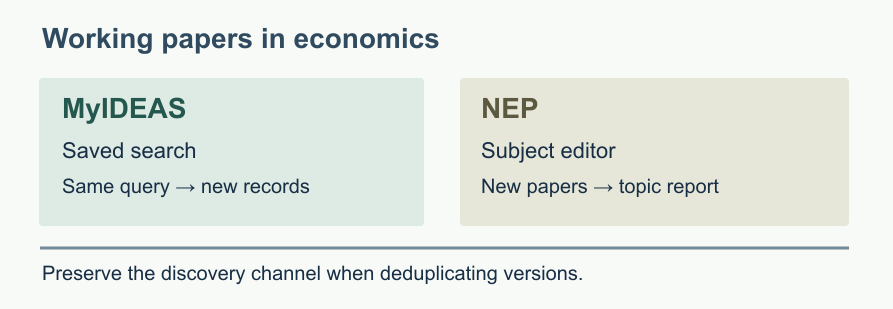
Figure: Two ways to follow new economics papers.
Keep a fixed question alongside an editorial watch
MyIDEAS can save the search, show additions since the previous check and provide a weekly email digest. It suits a defined question. Keep a dated version when a new paper prompts the addition of a term. That makes it possible to distinguish new records from older material admitted by a wider search.[3]
NEP, New Economics Papers, publishes subject reports prepared by editors, with email and RSS channels. Labour Economics and labour-market reports can surface work outside a researcher's established vocabulary. Conversely, a subject bulletin cannot stand in for a repeatable review query. Combine results in one reading table, preserve the discovery channel and reconcile versions by title, author and series. You can then say which papers met prespecified terms and which arrived through browsing.[1][3][4]