Project overview
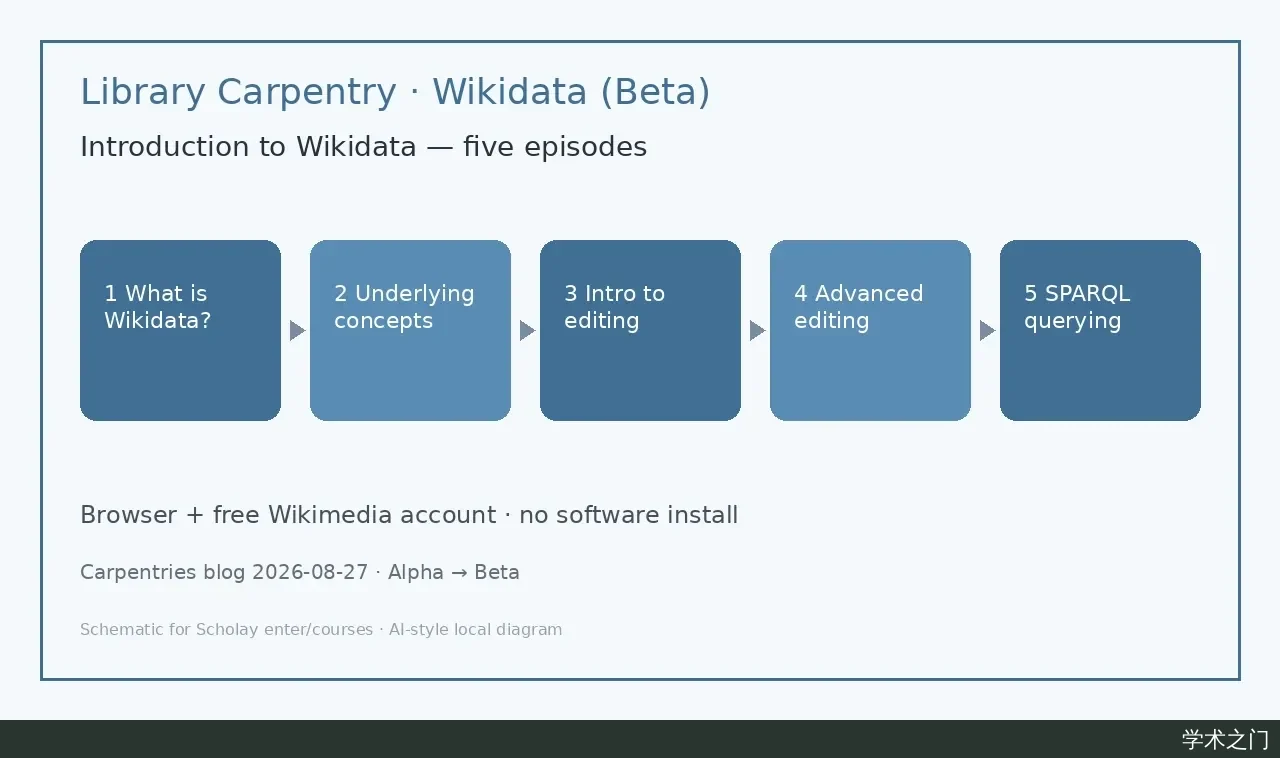
AI-generated schematic: overview of the Library Carpentry Wikidata (Beta) five-episode learning path.
On 27 August 2026, The Carpentries blog announced that the Library Carpentry Governance Committee had approved Library Carpentry Wikidata (Introduction to Wikidata) as an extended lesson and promoted it from Alpha to Beta: the original author team has developed and pilot-taught it, and other Carpentries Instructors may now teach it. The lesson site still marks beta / Under Design and welcomes feedback via repository Issues and PRs.[1][2]
This differs from this site’s existing Software Carpentry general-skills guides, Galaxy Training Academy event roundups, and similar “general data skills / activity week” resources: the focus here is an introductory linked open data course for librarians and information professionals, connecting cataloging and metadata experience to Wikidata—a global knowledge base that can be edited and queried immediately.
Why it helps
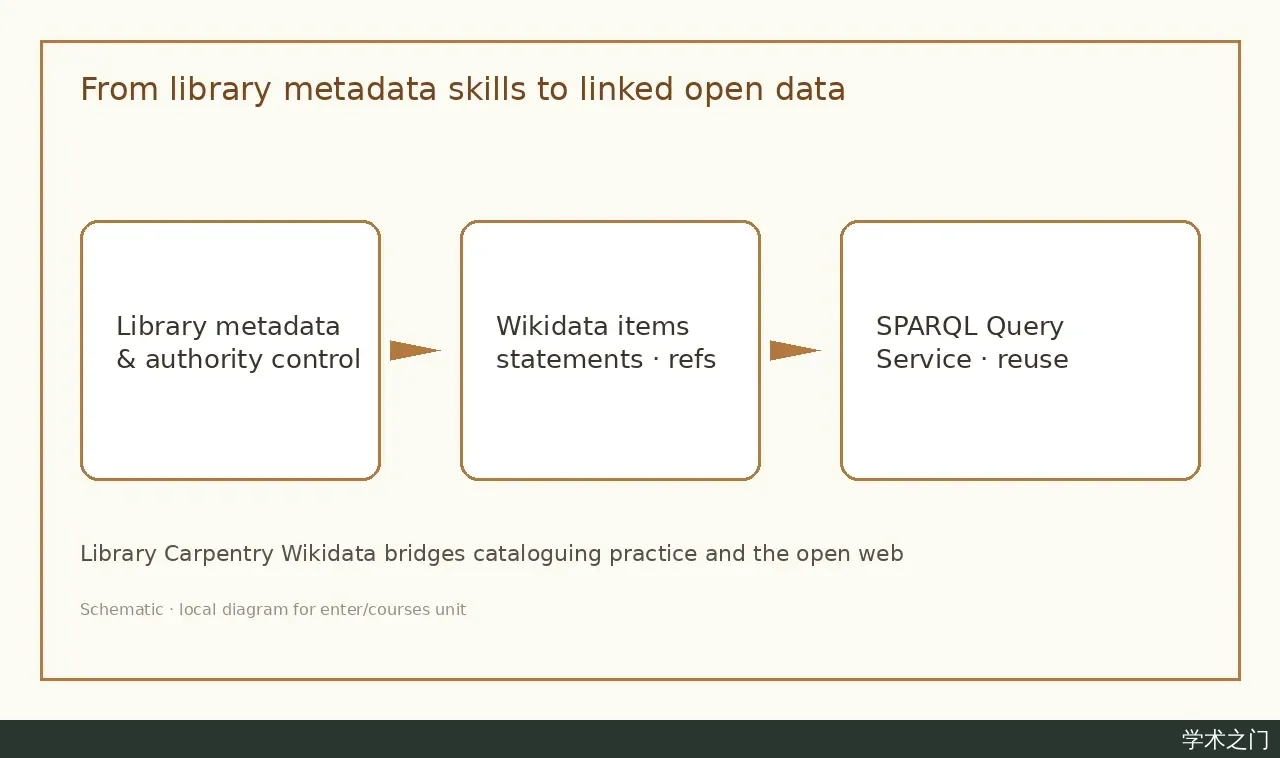
AI-generated schematic: path from librarian metadata practice to Wikidata query and reuse.
For readers who need linked open data in collection cataloging, authority control, or digital humanities projects, this Beta lesson offers a low-barrier path: no environment setup first—with a browser and a free Wikimedia account you can follow five episodes to create items, add references, and write a first set of SPARQL queries.[1][2][3]
What the five episodes cover
The lesson site and Instructor schedule outline five episodes:[2][3]
- What is Wikidata? — what the interface looks like, how it connects to other Wiki projects, and what Items and Statements are.
- Underlying concepts — underlying ideas such as RDF triples, plus tools and services built on Wikidata.
- Introduction to editing — hands-on creating and editing Wikidata items.
- Advanced editing — batch or semi-automatic statement addition in the spirit of sourcemd, QuickStatements, and similar (see the lesson pages for details).
- Introduction to querying — SPARQL basics using the Wikidata Query Service.
The Instructor timetable starts around 0h, with later episodes marked at about the 1h10m scale; actual workshop length is trimmed by the instructor.[3]
Barriers, settings, and limits
Prerequisites state: stable network, a browser, and a free Wikimedia account; no software pre-install.[2] Suitable as one Library Carpentry workshop session, a half- or full-day standalone training, or metadata-role onboarding and team professional development—online or in person. Metadata and authority control familiar to librarians map closely to Wikidata’s Item / Property / Statement / Qualifier / Reference model; the blog post also stresses that this is a hands-on entry to Linked Open Data, not an abstract concepts course.[1]
Limits should be stated plainly: the lesson is still Beta and will keep changing; batch tools and SPARQL exercises depend on accounts and community norms; this article verifies sources from the Carpentries blog post (2026-08-27), the lesson Setup/Instructor pages, and the GitHub repository—no account was opened for live editing, and no workshop was taught on site.[1][2][4]
Official suggested citation example: Konrad Förstner, Rabea Müller, Till Sauerwein (2018). Library Carpentry: Wikidata. https://librarycarpentry.github.io/lc-wikidata/[2] .[1]
References
-
Rabea Müller, Nicky Garland. New Library Carpentry Lesson: Introduction to Wikidata (The Carpentries, 2026-08-27)
-
Library Carpentry. Library Carpentry Wikidata: Summary and Setup
-
Library Carpentry. Library Carpentry Wikidata: Summary and Schedule (Instructor)
-
LibraryCarpentry/lc-wikidata. GitHub repository
-
The Carpentries. Lesson life cycle (explains what Beta means; consulted 2026-10-27)
-
Academic Gateway · a living guide for scholars in the intelligent age
-
Information compiled and published by the Scholay academic one-stop platform; report infringement for takedown.
-
Also published on Enter Scholar, a scholars’ community for the intelligent age