A search for a paper can return a workshop homepage, an entire proceedings volume and an individual contribution. All three links work, but only one identifies the cited work. ACL Anthology covers computational linguistics, speech and natural language processing, including ACL venues and publications from other organizations. Its paper identifier provides a stable route to the record, full text and citation.[1][2]
Distinguish a venue, a volume and a paper
Start at the venue or journal list, choose the year, and inspect the volume's contents. If a review covers main-conference papers, read the volume title before adding entries. An associated workshop can have its own proceedings. For example, the paper on editing dictionaries for Uralic languages online appears in the Sixth International Workshop on Computational Linguistics of Uralic Languages, by Khalid Alnajjar, Mika Hämäläinen and Jack Rueter, in that order.[1][3]
Its identifier is 2020.iwclul-1.4. The newer form, introduced in 2020, incorporates the year, collection or venue designator, volume and paper number. Earlier records can have a shorter identifier such as E91-1001. Preserve either form as displayed. A dedicated identifier column helps a team reconcile entries even when filenames, title capitalization or accented characters differ.[2][3]
Retrieve three objects from a single identifier
Append the identifier to the Anthology domain for the record page. Adding .pdf yields the full text and .bib the individual BibTeX entry. The .xml suffix supplies MODS metadata. Compare the title, author order and volume before importing. This matters when similar work was presented at both a workshop and a main conference. Keep the record link with the title actually read so another reviewer can identify the version.[2][3]
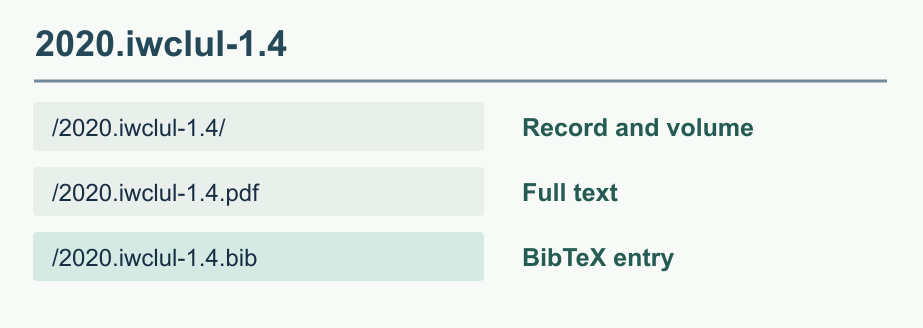
Figure: Three routes from one Anthology paper identifier.
For one or two references, use the individual pages. For a cross-year search the FAQ also offers full bibliographies with or without abstracts, and Overleaf-friendly shards below 50 MB each. Omit abstracts when only citation metadata is needed. Maintain the screening list separately. Possessing the complete bibliography says nothing about which records a review assessed.[2]
Track additions and check reuse conditions
An RSS feed covers the latest thousand papers added to the Anthology, and its communication channels include email. For periodic comparisons the official Python module provides structured data that can be filtered by venue, year and identifier. Keep the search date as well to explain why another record appears in a later snapshot. Additions follow ingestion order. Return to the volume for a final conference bibliography, especially when an older paper has only recently been included.[1][2]
The FAQ describes ACL materials before 2016 under CC BY-NC-SA 3.0 and subsequent ACL materials from 2016 under CC BY 4.0. The library also hosts other organizations' work, so inspect the applicable terms before reusing an illustration or a substantial passage. For ordinary citation, record the paper, correct author order and version read so a reference leads the next reader back to the same contribution.[1][2][3]