Project overview

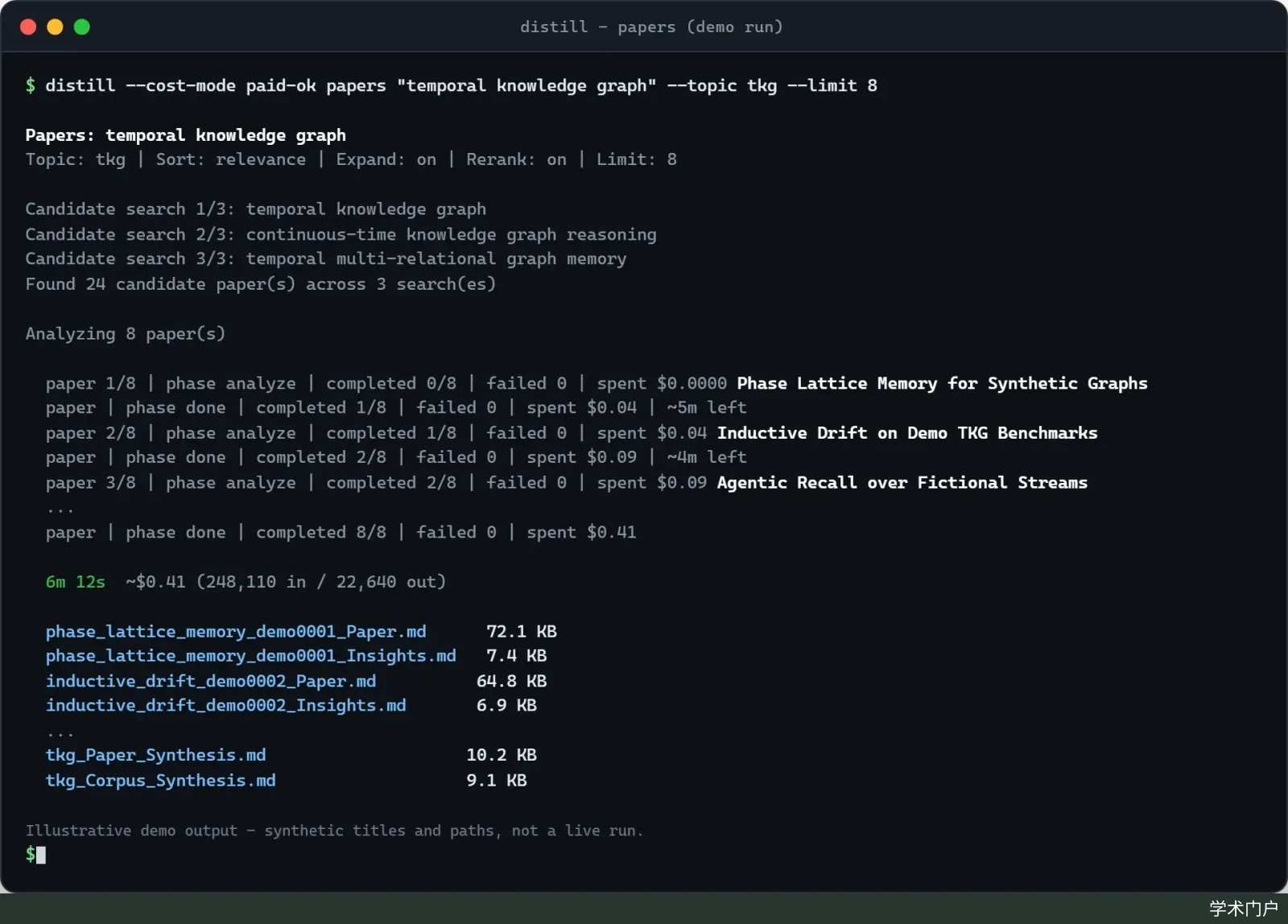
Distillr is an open-source command-line research tool (GitHub repository blisspixel/distillr, Apache-2.0 license). It can collect, analyze, and verify sources such as arXiv papers, web pages, YouTube videos, and local files, then organize them into a repeatedly updatable local Markdown library. Version 0.20.6 shipped on 13 October 2026 with improvements to paper shortlist reuse, local model selection, and web-capture fallback. This article is a source check; the software was not installed or tested hands-on.
Project position and requirements
- What it is: The README positions Distill as a tool that turns a research goal into “understanding backed by durable, verifiable evidence.” The PyPI package name is
distillr, the CLI entry point isdistill, and there is also an MCP service entrydistill-mcp.[1,3] - Pipeline: Every source follows the same path: capture → analysis → verification → synthesis, with a verification gate before writing to the library. Results live under a local
library/directory as ordinary Markdown files—no database and no cloud lock-in.[1] - Supported sources: YouTube (
distill latest,distill video,distill discover), websites (distill site,distill site-batch), arXiv (distill papers), plus X posts, code repositories, podcasts, newsletters, and local files (distill ingest). On top of the library,distill askproduces cited answers,distill auditproduces credibility review reports, anddistill reportproduces library-based reports.[1] - Models and cost: Models can run locally via Ollama or LM Studio. The README says verified local inference incurs no direct API cost; the trade-off is time—importing two papers on a laptop may take about an hour. You can switch to
paid-okmode to call metered cloud models and shorten runtime;no-meteredmode rejects every metered or unverified model route.[1] - Requirements and license: Python 3.12 or newer is required; the README recommends
uv tool install distillr. The repository is blisspixel/distillr at https://github.com/blisspixel/distillr[1]; the LICENSE file is Apache License 2.0 (Copyright 2026 Nick Seal).[1,2,3]
0.20.6 release notes
v0.20.6 was published on GitHub Releases on 13 October 2026; the CHANGELOG records the same date. All listed updates fall under “Fixed”:[4,5]
- Reusable paper shortlists:
distill papers --previewnow saves the previewed candidate list. Later imports with--from-shortlist(by list id) or--run-last-previewuse that same set of papers and skip re-search and re-ranking; new searches without a preview still rank as before. - Prefer local models at init:
distill --cost-mode no-metered initselects a local model provider, skips cloud API-key checks, and records the smallest installed model that local benchmarking (distill bench) judged runnable. In no-metered mode, if a configured model route would be metered, preview falls back to deterministic ranking. - Web-capture fallback: When Playwright’s bundled browser cannot be installed, a verified system Chromium is used; with no browser at all, a limited HTTPS request is used for the given page and the record is tagged
capture: http-static. - Other fixes: YouTube capture no longer fails when a reused connection hits a closed timed-out socket; with Ollama cloud features enabled,
distill benchstops before probing anddistill doctorreports that state; optional-dependency install hints distinguish uv vs pipx; configuration run outside the source tree writes a user-level env file so later commands can read it from any working directory. - Later versions: As of 21 October 2026, the latest GitHub Release was v0.20.7 from 18 October (CHANGELOG dated 17 October). That release continues to fix arXiv search-failure logging, paper-revision display, evidence verification and rejection handling, and related issues; see the release notes for details.[5,6]
Practical value
For research users, Distillr fits long-running topic tracking: retrieved papers, videos, and pages are not a one-shot report but settle into a local Markdown library with source records, so you can keep adding, asking, and auditing later. The following is drawn from the README, CHANGELOG, and release notes; it is a source check, not hands-on testing.
Suitable scenarios
- Tracking one research topic: Use
distill papers "topic terms" --previewto pull an arXiv shortlist, manually check relevance, then import the same set with--from-shortlist. From 0.20.6 the preview list can be saved, so filtering is not reshuffled by a fresh search. You can rerun later or usedistill profile refreshon a schedule so the library tracks the field.[1,4] - Ask and audit against collected sources:
distill askanswers from the library with citations;distill auditoutputs a credibility review so you can return to original sources.[1] - Mixing source types: Besides papers, you can bring in lecture videos, project sites, code repos, podcasts, and local files—useful for method surveys and tool comparisons that cross media.[1]
- Controlling cost and data path: no-metered mode uses only local models, with no direct API fees and no cloud-model hop for analysis—suited to tight budgets or sensitive material, at the cost of speed.[1,4]
- Connecting AI assistants: The project ships an MCP service (
distill-mcp) and an Agent Skill plugin pack so MCP-capable assistants can read the same library.[1]
Limitations and cautions
- Not hands-on tested: This article is a source check; content comes from the README, LICENSE, CHANGELOG, GitHub Releases, and the PyPI page.
- Still Beta: The README marks status as “active beta” and says 1.0 is a future stability promise with no fixed date; pin a version if you integrate MCP or file metadata formats.[1]
- Limited verification scope: Default verification checks numbers only; verifying prose needs an optional local checker. The README also notes that one successful limited search is not an exhaustive search.[1]
- Local runs are slow and setup-heavy: Importing two papers under local inference may take about an hour; with Ollama you must set
OLLAMA_NO_CLOUD=1in the daemon environment and install local models—setting it only in the client shell does not work.[1] - Cloud models incur fees: paid-ok mode calls metered models. The README says hard dollar budgets cover only registered, token-priced calls.[1]
- Frequent updates, small community: The repo was created in April 2026; the 0.20 series shipped eight releases from v0.20.0 on 9 September to v0.20.7 on 18 October. On 21 October 2026 GitHub showed 5 stars and 0 forks. Read the matching release notes before upgrading.[6,7]
- Source-use rules: When capturing pages, videos, and podcasts, follow each site’s terms and copyright; treat tool-generated syntheses and answers as drafts to check against primary literature before citing.
References
-
blisspixel/distillr. README (GitHub repository). https://github.com/blisspixel/distillr (accessed 2026-10-21)
-
blisspixel/distillr. LICENSE (GitHub repository license file). https://github.com/blisspixel/distillr/blob/main/LICENSE (accessed 2026-10-21)
-
distillr 0.20.6 (PyPI project page). https://pypi.org/project/distillr/0.20.6/ (accessed 2026-10-21)
-
blisspixel/distillr. v0.20.6 (GitHub Releases, 2026-10-13). https://github.com/blisspixel/distillr/releases/tag/v0.20.6 (accessed 2026-10-21)
-
blisspixel/distillr. CHANGELOG. https://github.com/blisspixel/distillr/blob/main/docs/CHANGELOG.md (accessed 2026-10-21)
-
blisspixel/distillr. Releases (GitHub release list). https://github.com/blisspixel/distillr/releases (accessed 2026-10-21)
-
blisspixel/distillr. Repository metadata (GitHub API). https://api.github.com/repos/blisspixel/distillr (accessed 2026-10-21)
-
Information compiled and published by the Scholay academic one-stop platform; report infringement for takedown.
-
Also published on Enter Scholar, a scholars’ community for the intelligent age