Start in the discussion area that fits
Combine a few sea temperature files and one date appears twice. You want to understand the time coordinate and run a twenty-year series on a computing cluster. That spans data, science and computing. Pangeo is a community for open, reproducible and scalable geoscience. Participants maintain documentation and software and develop infrastructure. NumFOCUS provides the sponsored project with fiscal, legal and administrative support. A forum preserves a searchable record, a meeting can clarify a decision and a working group can pursue a longer-lived problem.[1][2][3]
Check the forum categories. Data covers formats, metadata and catalogues. Science covers scientific applications. Cloud and HPC address distinct computing environments. Education, Open Science and Visualization have their own categories. For the temperature files, start in Data with the variable, calendar, file date ranges and repeated coordinate. If the question becomes whether monthly averages change the interpretation of seasonal variation, the scientific issue deserves its own discussion. Readers can then see whether they are being asked to explain an encoding or evaluate an interpretation.[3]
Search for the format, software and symptom before opening a topic. Check which dataset version previous contributors used. Share a small public slice with its units, missing-value convention, expected output and observed result. The guidelines encourage respectful disagreement and flagging misconduct, and discourage cross-posting. The About page maintains the staff roster. Add the eventual finding to the original thread, for example that the duplicate occurs at the boundary between two files.[4][5]
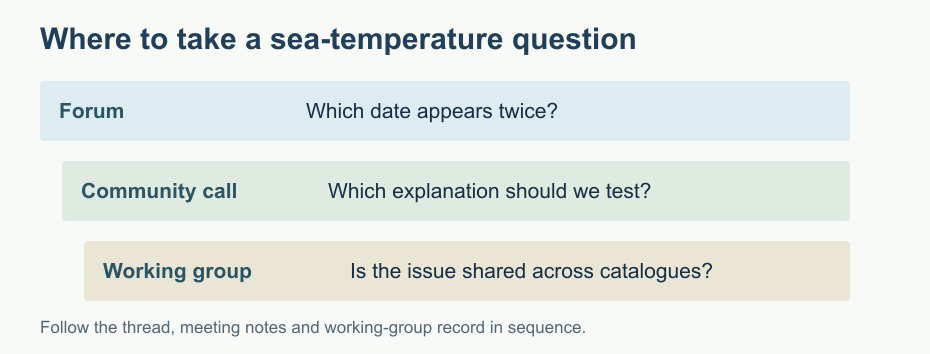
Figure: Three paths for a geoscience question in Pangeo.
Bring one unresolved decision to a meeting
The meetings page lists community calls open to anyone. The Americas meet on Wednesdays, alternating between 12pm ET and 4pm ET. Europe and Africa meet on Tuesdays, alternating between 9am CET and 4pm CET. Oceania meets on the third Friday of every month at 1pm Australian Eastern Time. These are the time zones printed by Pangeo. Check the current calendar for the specific event. Linked notes let you check earlier conversations and follow up if you cannot attend.[2]
Turn to a working group when the issue affects multiple datasets, teams or long-term tool behaviour. Distributed Array Computing explores parallel frameworks. Pangeo Forge coordinates data-production tooling. Machine Learning and VirtualiZarr also have meetings. The page distinguishes active and past groups. Past notes remain useful, while the active section guides attendance. A duplicate in one file pair may warrant a forum update. The same boundary error across several catalogues makes a concrete collaboration case.[2]
If the difficulty is learning chunked arrays, return to the software and education links. Xarray handles labelled multidimensional arrays, Dask supports parallel work and Zarr stores chunked, compressed arrays. Reproduce the issue on one small slice before estimating the cost of running everything. Take the last day of the earlier file and the first day of the next, show the two original coordinates and then show their merged order. People with different computing resources can locate the duplication without transferring an entire ocean grid. Project Pythia is Pangeo’s education and training hub. A question someone else can verify leads more readily to the right collaborators than a general request to choose a platform.[1][3]