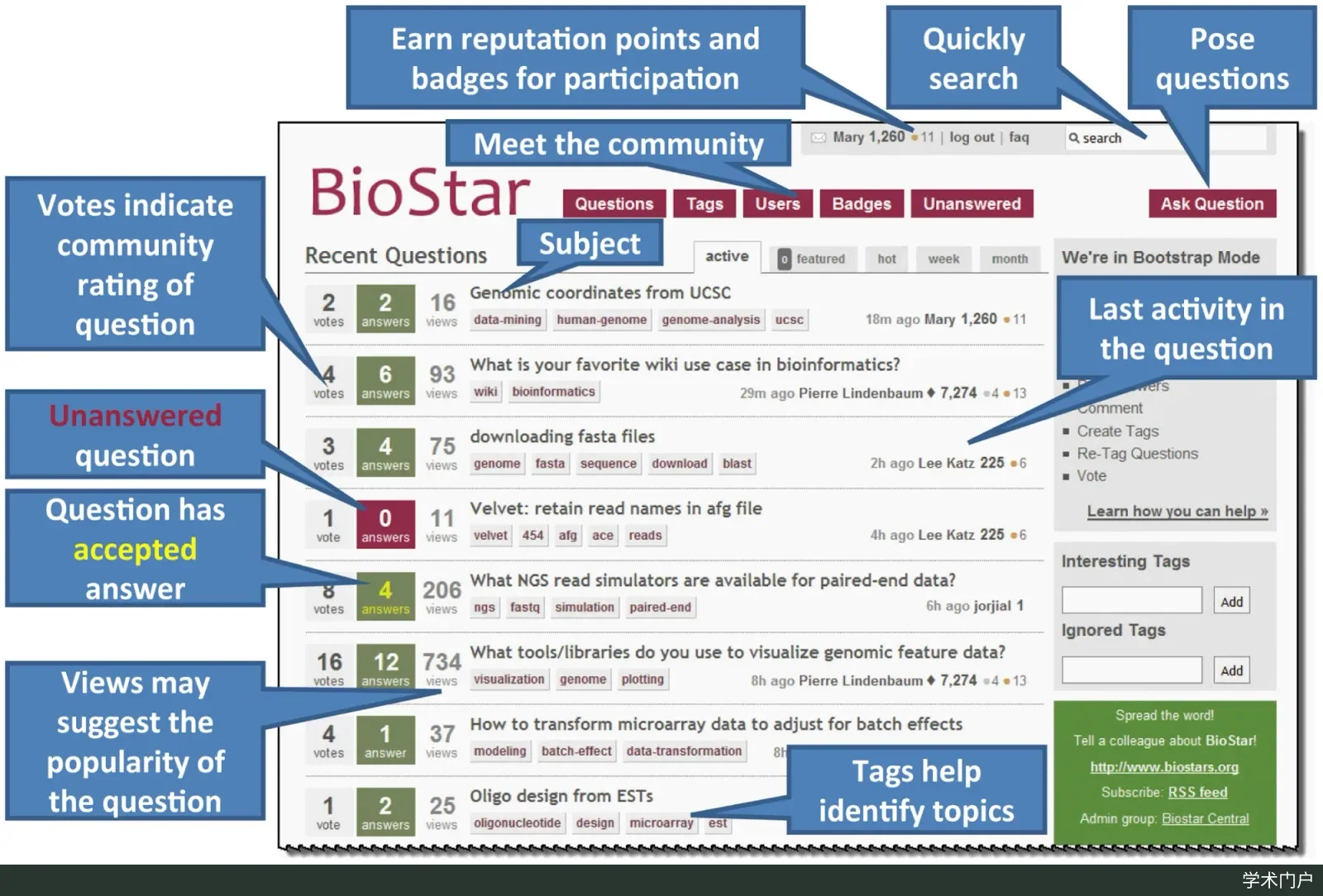
BioStar’s 2011 site UI: questions and answers can be voted on; view counts, search, and tags help locate topics. The interface differs from today’s site. Source: Parnell et al., PLOS Computational Biology (2011) Figure 1, CC0 public domain.
When sequencing analysis stalls on format conversion, software errors, or pipeline choice, many people find Biostars. This bioinformatics Q&A community, public since 2010, has accumulated a large open archive through voting, accepted answers, and tags. Drawing on official pages and the founders’ paper, this article covers its scope, posting norms, and search habits, plus how it divides labor with SEQanswers and the Bioconductor support site—and where its limits lie.
Community scope and who uses it
Biostars (often written Biostar on-site) is an English Q&A community. The about page limits topics to bioinformatics, computational genomics, and biological data analysis. Per the founders’ 2011 PLOS Computational Biology introduction, members of Penn State’s bioinformatics consulting center created it in late 2009; it went public on 18 January 2010, initially on Stack Exchange technology: one post per question, answers that can be voted, ranked, and accepted. The site now runs on the open-source Biostar Central project—a Python and Django stack with source on GitHub.
The about page states there is “no question too simple or too newbie.” The 2011 paper lists students, early-career researchers, and experts seeking advice among beneficiaries, and especially labs without dedicated bioinformatics staff. At the time the site had about 1,400 active registered users and more than 2,300 questions, spanning algorithm and database design, software choice, biological database lookup, result interpretation, and statistical methods, through literature leads and career advice. Reading the home page on 19 October 2026, recent posts covered RNA-seq, variant calling, single-cell, metagenomics, and pangenome-graph analysis, mixed with courses, tool announcements, and jobs. Official pages checked here give no current registered-user total, so none is estimated.
Posting norms and post types
The about page’s requirements are brief: posts should be detailed, specific, and clear; search first to see whether someone already asked, though true duplicates are fine—others will link related questions. Fuller norms appear in the on-site tutorial How To Ask Good Questions On Technical And Scientific Forums (Eric Normandeau et al.). It asks posters to search engines for error text, read manuals and FAQs, and try things themselves first, and lists common rules: stay polite, no off-topic posts, no homework dumps, and do not post the same question on multiple forums at once.
When writing a question, the tutorial stresses: put the problem in one sentence in the title; ask one question per post; give background and the end goal so others can suggest better routes; state OS and version, software and version, input files, parameters, and the full error; show what you already tried; paste commands in code format, and for programming problems include truncated input samples and expected output; keep tone direct and polite, avoiding words like “Urgent!” or “Help!” For example, a title like “software error help” says almost nothing; “samtools sort runs out of memory on a large BAM” tells people who know the tool whether they can help (this example is illustrative). If a post sits unanswered and you truly need another community, the tutorial suggests linking the original post in the new one and syncing the answer on both sides afterward.
On the answer side, the 2011 paper describes the Q&A mechanics: members vote on questions and answers; high-voted answers rise; authors accrue reputation and badges; askers can mark the most useful answer accepted; follow-ups and clarifications go in comments rather than new answers. The tutorial also notes moderators may edit titles or wording for clarity; after a fix, it helps to add a short closing note on how it was solved.
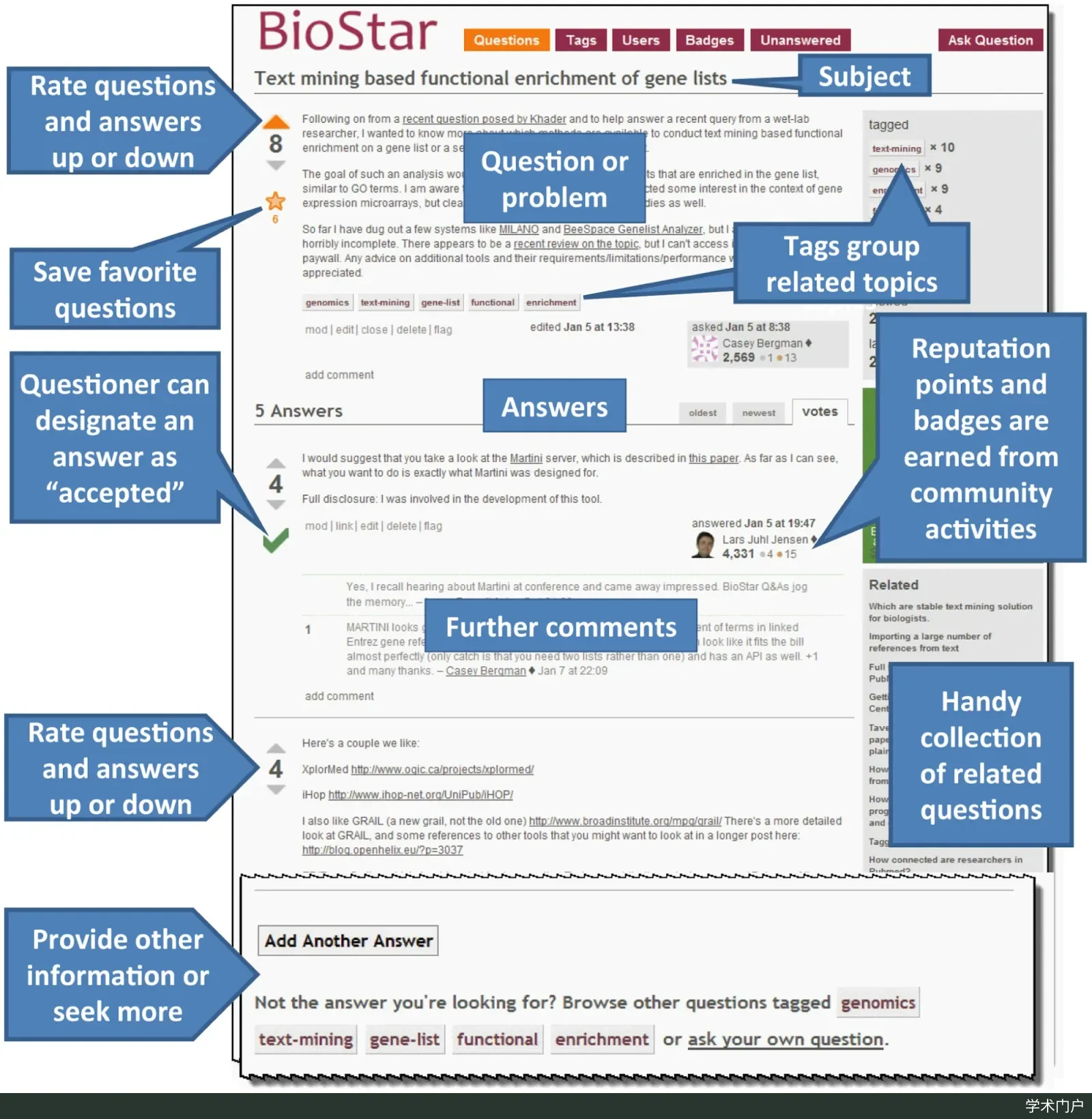
A typical BioStar discussion page: a question, then multiple answers and comments; votes order answers; tags and auto-related questions support further reading. Source: Parnell et al., PLOS Computational Biology (2011) Figure 2, CC0 public domain.
Not every Biostars post is a question. The tutorial How to Use Biostars, Part II lists types: Question (a concrete problem to solve), Forum (open discussion), News (news or articles of broad interest), Blog (personal views), Tool (announcing a tool you found or built), Job Ad (hiring), and Tutorial (how-to). It stresses that looking for a tool or struggling to use one is a Question, not a Tool; job posts should state the role and contact details and close when filled. Home-page posts prefixed “Tool:”, “News:”, “Job:”, or “Forum:” map to these types.
Tag search and neighboring communities
Each post can take keyword tags. The 2011 paper lists “tags plus search” as a main advantage over traditional forums. In practice tags are often tool names, file formats, or analysis types—e.g. recent home-page tags like bcftools, vcf, WGCNA, rna-seq. Site announcements also described “watched tags”: list tags in your profile and matching new posts trigger email, handy for authors following questions about their tools; that announcement is older, so current mail behavior follows on-site settings. For old problems, besides on-site search you can use site:biostars.org plus the error text or tool name in a general search engine (a common search tip, not an official instruction).
Two neighboring communities have different emphases. The Bioconductor support site (support.bioconductor.org) posting guide (revised 1 December 2023) is explicit: it mainly answers Bioconductor software usage; non-Bioconductor R packages or general stats belong on R-help or Stack Overflow; general bioinformatics unrelated to Bioconductor packages can go to Biostars; package development goes to the bioc-devel mailing list. Tag use is stricter there: posts should be tagged with the package name; correct spelling auto-emails maintainers. The guide also asks for full code and output, sessionInfo(), a minimal reproducible example when possible, and no private email to maintainers—keep discussion on the public, searchable site.
SEQanswers (seqanswers.com) centers on next-generation sequencing (NGS). Per a 27 April 2022 press release, Eric Olivares founded it in 2007; that year Biocompare, a life-science product information site, acquired it. Forums divide by sequencing platform (Illumina, Oxford Nanopore, PacBio, etc.), experimental applications (sample prep and library construction, RNA-seq, metagenomics, epigenetics, etc.), bioinformatics, core facilities, sequencing service providers, and jobs, plus sponsor commercial content and webinars. Reading the forum home on 19 October 2026, activity varied: bioinformatics and sample-prep boards still had 2026 posts, while the single-cell board’s latest sat in December 2024.
A rough division follows: if the issue is using a Bioconductor package (e.g. limma, DESeq2), go to Bioconductor support with the package-name tag; if it is more experimental—platform, library prep, or vendor choice—SEQanswers boards fit better; cross-tool analysis questions such as format conversion, pipeline choice, or command-line errors suit Biostars. The 2011 paper also noted topic overlap with SEQanswers and sometimes cross-posted to SEQanswers and Stack Overflow to widen reach. Wherever you choose, post once; if you must move, link the original.
Reference value and limits
For researchers, Biostars’s main value is a public, searchable experience archive. Common format conversions, gene-ID mapping, and software errors have often been asked before; high-voted answers and comment addenda help judge which approaches the community trusts. The 2011 paper also cites cases where on-site discussion helped finish projects and papers. Bioconductor’s official guide pointing general bioinformatics questions here underscores its role as a general Q&A hub in the ecosystem.
Limits are clear. First, answers come from volunteers, with no SLA and no peer review: high votes mean community endorsement, not that a method is correct on your data—key conclusions still need software docs and primary literature. Second, bioinformatics tools change fast; years-old high-voted answers may match old parameters—check post date and software version before relying on them. Third, it does not replace collaboration or local support; the founders already wrote in 2011 that Biostars was not meant to fix the bioinformatics talent shortage. Fourth, the tutorial notes that on many forums, questions solvable by a quick search may be closed or deleted, and homework is unwelcome. Finally, the about-page terms disallow using site content to train AI or machine-learning systems, among related activities, without Biostar’s prior written consent; researchers planning bulk collection or reuse of Q&A should contact the site per the original terms.
References
-
Biostar. About Biostar. https://www.biostars.org/info/about/ (accessed 2026-10-19)
-
Biostar. Biostars home. https://www.biostars.org/ (accessed 2026-10-19)
-
Parnell LD, Lindenbaum P, Shameer K, et al. BioStar: An Online Question & Answer Resource for the Bioinformatics Community. PLoS Computational Biology, 2011, 7(10): e1002216 (published 2011-10-27). https://doi.org/10.1371/journal.pcbi.1002216
-
Normandeau E, Dall'Olio GM, Pavey SA. How To Ask Good Questions On Technical And Scientific Forums. Biostars. https://www.biostars.org/p/75548/ (page gives no exact publication date)
-
Ram. How to Use Biostars, Part II: Post types, Deleting, (Un)Subscribing, Linking and Bookmarking. Biostars. https://www.biostars.org/p/180013/ (page gives no exact publication date)
-
Albert I. How to support bioinformatics tools via Biostars: prefill and watch tags, reply via email. Biostars. https://www.biostars.org/p/99811/ (page gives no exact publication date)
-
ialbert/biostar-central. README. GitHub. https://github.com/ialbert/biostar-central
-
Bioconductor. Posting guide (Revised: 1 Dec, 2023). https://bioconductor.org/help/support/posting-guide/
-
SEQanswers. Forum. https://www.seqanswers.com/forum (accessed 2026-10-19)
-
Biocompare. Biocompare, a Division of CompareNetworks, Acquires SEQanswers. PRWeb, 2022-04-27. https://www.prweb.com/releases/biocompare-a-division-of-comparenetworks-acquires-seqanswers-816058622.html
-
BioStar: An Online Question & Answer Resource for the Bioinformatics Community(PMC3203049)
-
Information compiled and published by the Scholay academic one-stop platform; report infringement for takedown.
-
Also published on Enter Scholar, a scholars’ community for the intelligent age