The same paper often reaches OpenAlex many times: a publisher record, a preprint, a PubMed entry, and copies in institutional repositories. Records that share a DOI or PubMed ID are easy to join. Everything else used to be joined mainly when the normalized title and first author's last name matched. That missed true copies with different spellings, name order, or title wording, and it wrongly joined different papers that share a generic title.[1] Blog examples include Lucie Adenaeuer in a journal versus Adenäuer, Lucie in a repository;[1] reversed name order for the same author; and PubMed versus repository rewrites of a subtitle.[1] From 3 November 2026, nightly intake uses a trained work matcher. The next day the project reported that running the same process over existing works merged 17,315,197 duplicate works.[1]
How the matcher decides
The matcher runs in a fixed order each night. Shared DOI, PubMed ID, or arXiv ID comes first, as do declared preprint or version links such as DataCite IsVersionOf and Crossref is-preprint-of; most records join here.[2] If not, pairs that must never be the same work are ruled out, then candidates are gathered by URL, identical title, same first author within two years, near-duplicate titles, and close title–abstract meaning. A ranking model with about ninety features scores them; a very low best score starts a new work. The top ten candidates go to a fine-tuned Qwen3.5 model (about nine billion parameters). A record joins a candidate only when the same-work probability is at least 0.91.[2] if several candidates are copies of one paper, their probabilities can be added. Otherwise OpenAlex keeps a new work. In one example, Crossref article 10.1162/imag.a.1455 from 2026 shared no identifier with its 2024 bioRxiv preprint 10.1101/2024.01.11.575231, yet the matcher joined them into work W4390839382 with PubMed and PMC copies.[2] Blog figures: the old rule was right about 76.9% of the time when it joined and found about 70.7% of copies; the new matcher is right about 99.1% when it joins and finds about 92.2%.[1] Code, models, and test sets are public in the openalex-work-matcher repository.[1][2]
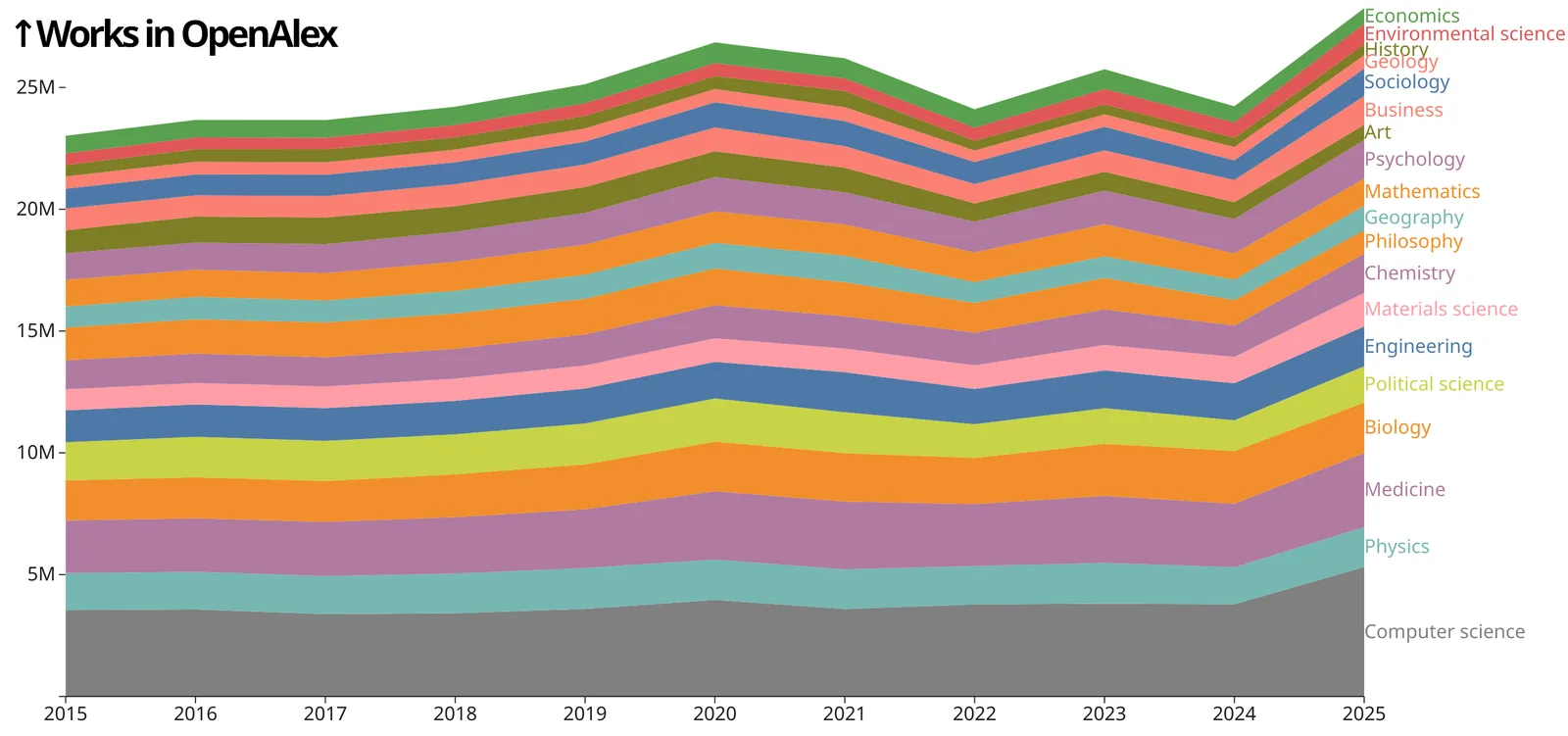
Figure: Scale of works in OpenAlex (counts by discipline over time). Wikimedia Commons[3]

What stays separate
The matcher does not collapse every thematically similar item. The matcher leaves several kinds of records separate: the same article published by another journal under its own DOI (including co-publications and translation journals; PRISMA 2020 in BMJ and in PLOS Medicine is the running example);[1][2] a conference version and the journal article even with the same title and authors; a thesis or technical report and the article drawn from it; a book chapter and a journal article; notices such as corrections, retraction notices, expressions of concern, comments, replies, and peer reviews; parts of a work (figures, tables, supplements, datasets) versus the main text; a new book edition or revised standard; multi-part articles; templated neighbours in a series; and versions that never declare IsVersionOf / HasVersion in DataCite (including some Kaggle dataset versions). Matching also trusts each record's declared type: an article does not join a book chapter, dataset, or dissertation; wrong types are fixed before rematching.[2] When unsure, OpenAlex starts a new work—leftover duplicates are easier to fix than a wrong merge.[2]
What changes for search and counts
Users see fewer works, not fewer papers: each copy becomes a location on the surviving work, and citations to the copies count toward it.[1] The blog also reports that about 870,000 articles that looked closed access are now open because a free repository copy joined the same work.[1] On the website, in the works API, or when re-downloading a snapshot, rely on the merged work ID, locations, and open-access fields; do not compare raw work counts from before and after 4 November as if nothing changed.[1] To see why a record stayed separate, use the Matching and merging steps and one-work / separate tables.[2] Training and evaluation design belong in methods writing, not this software note. To report a wrong merge or leftover duplicate, follow Fixing data errors with work IDs or the misplaced DOI.[2]
References
-
OpenAlex. 17 million duplicate works merged: a new matcher for OpenAlex. https://blog.openalex.org/17-million-duplicate-works-merged-a-new-matcher-for-openalex/
-
OpenAlex Help. Matching and merging. https://help.openalex.org/data/works/matching/
-
Wikimedia Commons. File:Academic works by discipline over time (visualization of studies data in OpenAlex).png. https://commons.wikimedia.org/wiki/File:Academic_works_by_discipline_over_time_(visualization_of_studies_data_in_OpenAlex).png