Project overview
On 27 October 2026, Johannes Keyser (JoKeyser) opened a thread in the PsychoPy Discourse “Online experiments” category seeking practical tips to prevent and detect AI bots posing as participants in Pavlovia surveys and PsychoPy online experiments. The post uses Westwood’s 2025 PNAS study to frame the threat, asks that each tip state what was done, why it works, whether it harms real people, and references, and suggests reporting platform vulnerabilities privately first.
Thread content and contribution format
In the original post, the author says their team is increasingly worried about LLM-driven “AI bots” joining online studies, and wants one thread to collect practical ways to prevent—or at least detect—such participation; they are willing to move the discussion if a better venue exists. To illustrate the threat, the post summarizes Westwood (2025): the author’s AI agents can complete surveys autonomously, pass nearly all standard attention checks, and give credible, consistent answers; they can also bias results toward a side on instruction, and sometimes guess the research hypothesis and answer accordingly. Westwood argues in-survey checks are a losing battle, partly because harder checks also exclude real participants. The poster does not simply accept that verdict, but asks whether the community agrees.
The call is limited to Pavlovia surveys and PsychoPy experiments. The poster wants each tip to include three parts: what was done—for example a question type, timing check, or data check; why it works against bots, and whether real participants may be misclassified as bots; and references if research or guidance exists. Experiences finding suspicious data and how they were handled are also welcome. That format turns scattered “I did this” notes into comparable entries—blocking effect, false-positive cost, and evidence source on the table together. The post also discusses concerns about publishing countermeasures and how to report platform vulnerabilities; that is covered separately below.
Background evidence: from surveys to reaction-time experiments
The cited paper is by Sean J. Westwood of Dartmouth’s Department of Government, published online 20 November 2025 in PNAS vol. 122 no. 47. He built an “autonomous synthetic respondent” in Python: one layer parses survey pages and mimics human input—calibrating reading time to a persona’s education, generating mouse trajectories, and typing open answers key by key with typos and corrections; another layer calls a large language model (the paper uses OpenAI’s o4-mini) to answer from a demographic persona and memory of prior answers. Across 20 classes of standard attention checks and 6,000 trials, it erred only 10 times—a 99.8% pass rate; on impossible-experience probes such as “have you been to the moon,” the error rate was 0; when asked to write FORTRAN or recite the U.S. Constitution—tasks meant to expose AI capability—it claimed inability in 97.7% of cases.
The paper also shows two kinds of bias. One is malicious manipulation: adding a partisan instruction to the prompt leaves the agent’s self-reported party ID unchanged while tipping evaluation items such as presidential approval toward the instructed side. The other is demand effects: re-running a classic democratic-peace experiment, the agent guessed the directional hypothesis in more than 84% of trials, and hypothesis-consistent answers exceeded the original experiment by 22.2 percentage points. The paper estimates about USD 0.05 per typical survey with commercial models. Westwood concludes that defenses based on user-behavior metrics or item design are losing, while ever-harder language or logic items may also screen out real participants with less education or non-English first languages—the view the PsychoPy post relays and asks the community to answer.
More directly relevant to PsychoPy users are two PNAS letters published 18 February 2026. Van der Stigchel, Strauch, de Zwart, and Van Maanen of Utrecht’s Experimental Psychology department report that in an online Posner cueing task with 39 Prolific recruits, some participants’ reaction-time profiles looked more like robot data simulated under a simple Gaussian assumption: near-perfect normality without the usual human right skew; no positive correlation between mean RT and SD across conditions; almost no autocorrelation between adjacent trials. They urge screening all online RT data (including published) for at least these three features, while warning that as models improve the same statistics may be imitated, so the field ultimately needs methods that verify a human is present.
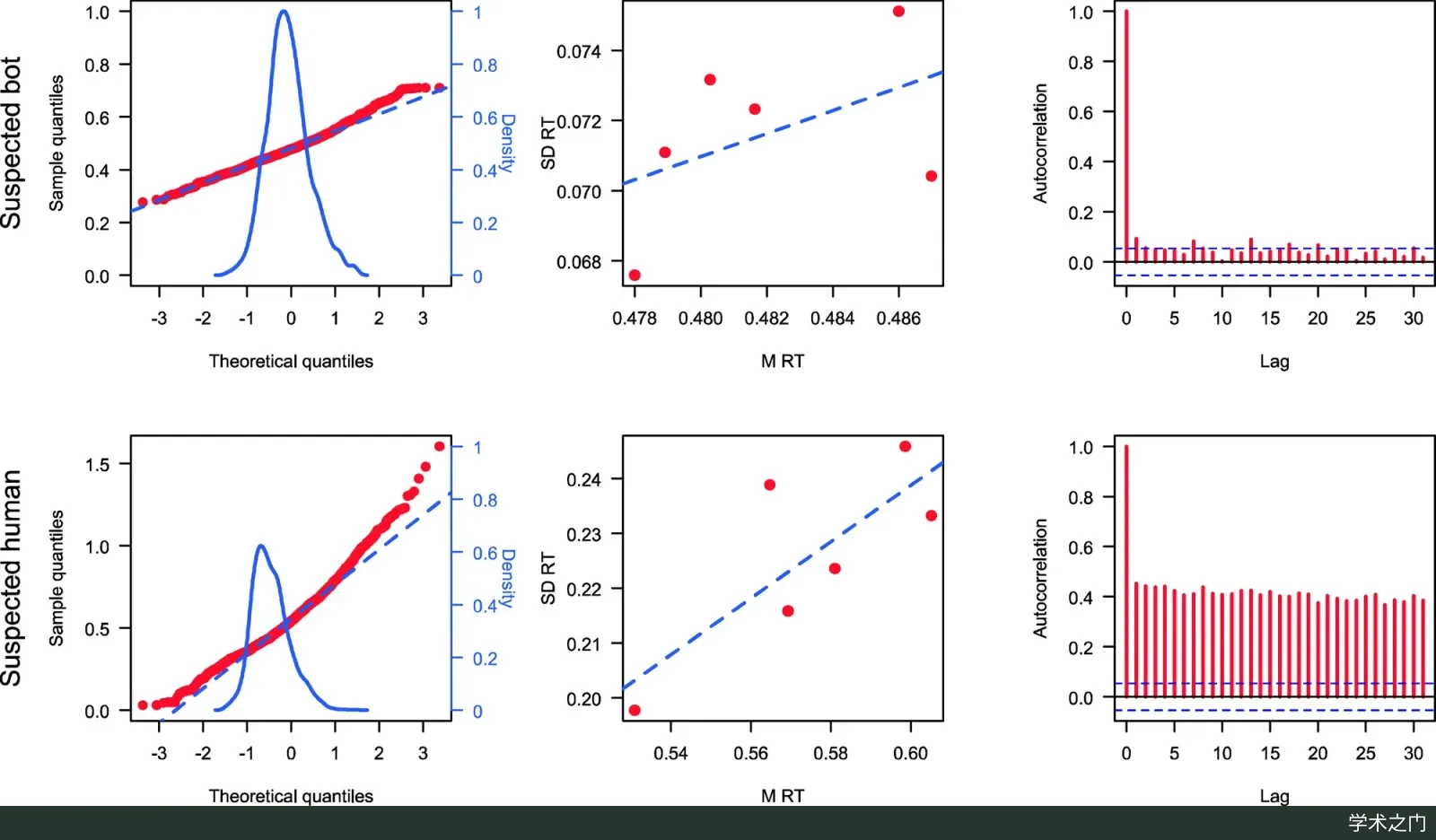
Figure: Reaction-time diagnostics for suspected bot participants (top) versus likely human participants (bottom): left, Q–Q plots against a normal distribution; middle, mean RT vs SD across six experimental conditions (vertical scales differ between the two people); right, autocorrelation within 30 trials, dashed lines as confidence intervals for uncorrelated series. Source: Van der Stigchel, Strauch, de Zwart & Van Maanen (2026), PNAS 123(8), e2535585123, Fig. 1; license: CC BY 4.0.
Westwood and Samuel Frederick of the University of Pennsylvania, in a same-issue reply, add a Prolific audit: they embedded keyboard monitoring in open items (n=2898) and flagged responses with copy-paste or typing faster than 800 characters per minute. Their method flagged 3.1%, Prolific’s built-in tools 3.0%, but only 41% of those flagged were caught by both; at least one method flagged 4.4% (128 people, 95% CI 3.7%–5.2%). The authors treat this as a lower bound on the crudest AI users, and note that mouse trajectories and browser fingerprints can be forged—once a behavioral tell is publicly documented, it can be simulated.
Practical value
For psychology, cognitive science, and social-science researchers who recruit online, the thread’s value is not that it already supplies answers, but that it puts a methodological threat in the place where tool users already ask for help, with a pre-agreed format for sharing experience. Pavlovia’s site lists PsychoPy Discourse’s online-experiments category as the place for Pavlovia questions; labs that write in PsychoPy, deploy on Pavlovia, and recruit via Sona or Prolific can track peers’ practices there and contribute detection experience in a common format.
Implications for online experiment design and recruitment
First, stop equating “passed attention checks” with “is a human.” PsychoPy Discourse already has related threads: in 2020 a user asked whether bots could finish an experiment and read the completion code shown at the end; a forum admin suggested ending the experiment if performance failed thresholds, or requiring a simple arithmetic item before showing the code; in 2023 a user asked about CAPTCHA on Pavlovia surveys, an admin said it was on the backlog but unlikely soon, and a January 2026 follow-up suggested catch trials to screen bots and careless responders. Those tactics target random-key scripts or inattentive people; Westwood’s agents can read items, reason, and completed Qualtrics pages that showed reCAPTCHA branding—similar defenses largely fail against them. The new thread’s point is shifting the object of discussion from “low-quality responding” to “agents that can read the questions.”
Second, treat checks from published work as a candidate list and log them in-lab with the post’s three-column format. For RT experiments, Van der Stigchel et al. recommend at least distribution shape, mean–SD relation, and inter-trial autocorrelation; for open items, Westwood and Frederick use keyboard monitoring to flag copy-paste and ultra-fast typing. For each, also write what it catches, whom it may harm, and how it is already known to be bypassed: the reply authors themselves note that keyboard monitoring misses purpose-built auto-responders, and mouse trajectories lose meaning when most people answer on phones.
Third, beyond detection there are recruitment choices. Westwood urges researchers to require panel vendors to disclose how they maintain sample quality: how often identity and participation status are re-verified, whether daily or weekly study caps apply, how many surveys a participant completed in the last 1, 7, and 30 days, how many quality checks they passed or failed and whether they were reported for AI use, and whether response location matches registration and whether a VPN was used. For studies that demand high data credibility, he suggests more controlled recruitment or long-managed fixed panels. The reply also proposes that papers using survey data should at least disclose which AI detections were run and what fraction was flagged.
Open discussion and responsible disclosure
Another model the post offers is facing the tension between publishing countermeasures and giving cheaters a playbook. Westwood’s data-availability statement says code needed to reproduce analyses and generate answers is on OSF, while the script that auto-submits answers to Qualtrics is withheld to prevent abuse and available on request. The poster borrows that approach and suggests that anyone who finds a concrete platform weakness report it privately to the platform team when a responsible-disclosure channel exists. For commenters, a safer split is: detection ideas, false-positive experience, and references discussed openly on the forum; reproducible bypass details go through the platform’s disclosure channel.
On present evidence, the right conclusion is “online data quality checks need updating,” not “online data is already worthless.” Westwood’s discussion says the aim is not to abandon online research but to adjust; Van der Stigchel et al. found several pattern-suspicious participants in a sample of 39; the Prolific audit’s 4.4% is the share flagged by at least one method, treated by the authors as a lower bound. As of 29 October 2026 the thread still had only the original post and no replies; concrete tips await community contributions. Labs running online experiments should watch follow-ups—and can join with their own data experience.
References
-
Keyser, J. [JoKeyser]. (2026, October 27). Sharing tips for preventing and detecting AI bot participation in surveys and experiments? PsychoPy Discourse, Online experiments. https://discourse.psychopy.org/t/sharing-tips-for-preventing-and-detecting-ai-bot-participation-in-surveys-and-experiments/48285
-
Westwood, S. J. (2025). The potential existential threat of large language models to online survey research. Proceedings of the National Academy of Sciences, 122(47), e2518075122. https://doi.org/10.1073/pnas.2518075122
-
Van der Stigchel, S., Strauch, C., de Zwart, B., & Van Maanen, L. (2026). Will online behavioral research follow the fate of online survey research? Proceedings of the National Academy of Sciences, 123(8), e2535585123. https://doi.org/10.1073/pnas.2535585123
-
Westwood, S. J., & Frederick, S. (2026). Reply to Van der Stigchel et al.: Empirical evidence that AI survey contamination is real and substantial. Proceedings of the National Academy of Sciences, 123(8), e2537420123. https://doi.org/10.1073/pnas.2537420123
-
KatrinR et al. (2020, July 22). Pavlovia-PsychoPy: Can Bots read displayed text? PsychoPy Discourse. https://discourse.psychopy.org/t/pavlovia-psychopy-can-bots-read-displayed-text/15227
-
paulinaluz et al. (2023, March 25). Is it possible to add CAPTCHA to a Pavlovia survey? PsychoPy Discourse, Pavlovia Surveys. https://discourse.psychopy.org/t/is-it-possible-to-add-captcha-to-a-pavlovia-survey/34045
-
Open Science Tools. Pavlovia. https://pavlovia.org/
-
Academic Gateway · A life guide for scholars in the intelligent age
-
Information compiled and published by the Scholay academic one-stop platform; report infringement for takedown.
-
Also published on Enter Scholar, a scholars’ community for the intelligent age