Project overview
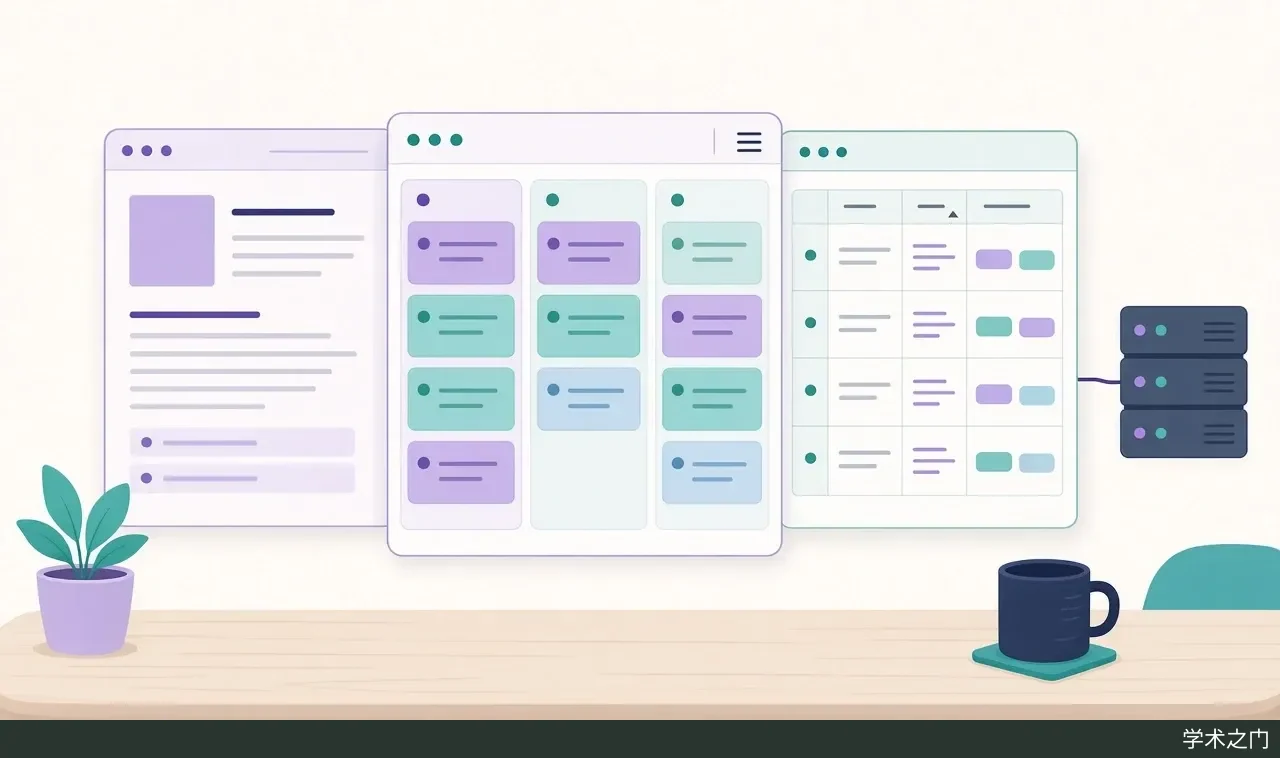
AI-generated schematic: documents, boards, and databases share one workspace and can connect to a self-hosted server. Not an AppFlowy UI screenshot.
AppFlowy is an AGPL-3.0 open-source collaborative workspace that puts documents, boards, databases, and optional AI features in one app, with self-hosting available. Version 0.14.11, released 26 October 2026, adds relative date filters and direct YouTube caption import, reducing manual steps when researchers maintain progress boards or organize lecture videos; self-hosted instances still require AppFlowy Cloud v0.19.10 or newer.
Project positioning and license
AppFlowy is developed by the AppFlowy-IO team. The repo README positions it as an “open-source alternative to Notion”; the client is written in Flutter and Rust. One workspace can mix document pages, wiki-style page trees, and databases; databases can switch among board, calendar, gallery, Feed, chart, and other views, with AI writing, AI meeting transcription, and similar features as optional modules. Desktop covers macOS, Windows, and Linux, with iOS, Android, and web as well; multi-device sync depends on officially hosted AppFlowy Cloud or a self-hosted server of the same name.
The code is released under GNU Affero General Public License v3 (AGPL-3.0). The website leads with a “self-hosted AI workspace,” stressing deployment on your own servers, private cloud, or even air-gapped environments. For teams that must keep project data on institutional servers, that is its most practical difference from closed-source cloud notes.
Main changes in 0.14.11
0.14.11 shipped on GitHub Releases on 26 October 2026 (UTC), only three days after 0.14.10 (23 October). This release does not overhaul the UI; changes cluster on database filters, AI transcript blocks, and view display.
First is relative date comparison. Date-filter conditions such as before, after, on or before, and on or after can now take Today, Yesterday, or Tomorrow as the comparison target, so results advance with the calendar day without re-picking dates by hand. For example, in a submission-and-grant progress database, set “deadline on or before Tomorrow” and each day’s view shows items due today or tomorrow plus overdue ones; in a reading-notes library, set “entry date after Yesterday” and the view stays fixed on literature entered that day.
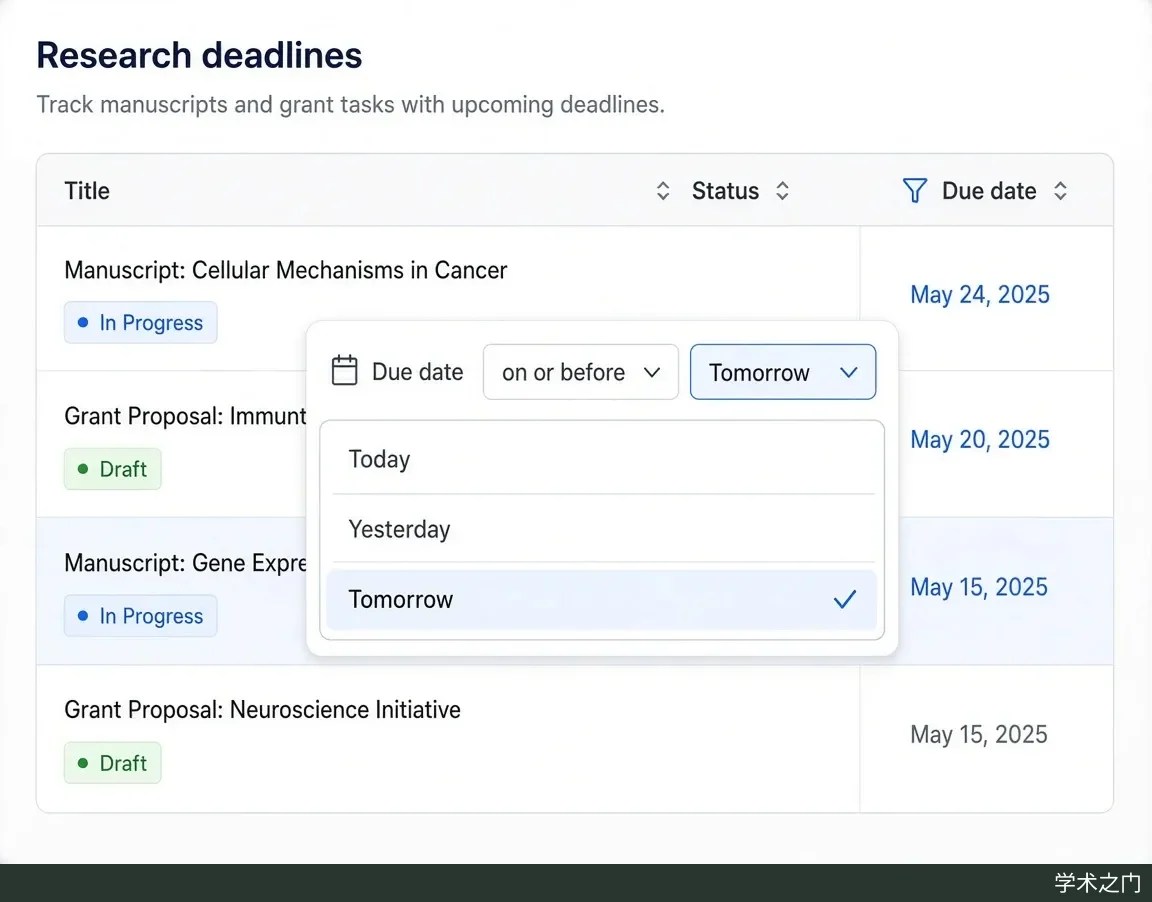
AI-generated schematic: filtering deadlines with relative date Tomorrow; table rows and dates are fictional. Not an AppFlowy UI screenshot.
Second is YouTube caption import. When a video has usable timestamped captions, you can import them straight into an AI transcript block—no audio download and no transcription quota; videos without captions can still use audio transcription or file upload. For subtitled academic lectures and conference recordings, the path from video to timestamped transcript to excerpt notes skips a round of waiting for transcription.
Third is handling missing row pages. When a supporting server reports that a database row’s page document is unavailable, the client offers “Create empty page,” with a warning and explicit confirmation; readable content and local cache still take priority over rebuilding. Creating a blank page is a last resort only when content truly cannot be read.
On views, Gallery gains grouped card layout, configurable preview content and card size, image fit, and cover-position controls; Feed updates card preview, quick actions, emoji reactions, and comment threads, with long content expandable to full-page reading. Users who build literature card walls or figure asset libraries in Gallery will use these directly. This release also fixes database links under incomplete sync data, selecting formula properties in filters and sorts, and rollup errors when reading other rollup fields.
Practical value
For researchers, AppFlowy fits three scenes: a shared project wiki for a lab, collecting protocols, meeting notes, and data notes in one place; a personal reading-notes library with one row per paper, attributes for reading status, tags, and dates, browsed as board or gallery; and progress boards for papers and grant applications. Versus closed-source cloud notes, the core advantage is self-hosting and deciding where data lives—especially important for projects bound by data-management plans or institutional data policy. Relative date filters in 0.14.11 cut daily board maintenance; caption import makes it easier to fold video lectures into the same notes library.
How to get it and self-hosting requirements
Individuals can download the 0.14.11 desktop installers for their platform (macOS, Windows, Linux) from GitHub Releases; Linux users can also install via Flathub or Snapcraft. Mobile apps are on the App Store and Google Play; Android requires version 10 or newer and does not support ARMv7 devices. The client supports offline local sessions that load the local database without remote requests; multi-device sync or multi-user collaboration then connects to officially hosted AppFlowy Cloud or a self-hosted server.
Self-hosting requires client and server versions to align. 0.14.11 still needs AppFlowy Cloud v0.19.10 or newer; 0.14.10 release notes explicitly say upgrade the server before the desktop client. To enable missing-row page recovery, deploy the matching server support on every node that handles live editing, or the client will not show “Create empty page.”
Barriers and license constraints
Breadth of features is both strength and barrier. Documents, many database views, formulas, relation and rollup fields, and AI blocks stacked together mean the first build of a project space needs time to design database structure; users who only want plain-text notes may find it heavy. Full sync and collaboration depend on AppFlowy Cloud; choosing self-hosting means maintaining the server yourself and upgrading with the client cadence—both 0.14.10 and 0.14.11 list server version requirements under “Action Required.”
AGPL-3.0 is a strong copyleft license: using an unmodified build personally or within a lab does not create extra obligations; but if you modify the code and distribute it, or offer the modified version as a network service to others, you must publish the corresponding source under the same license. AI transcription is metered by transcript duration; hosted-plan upgrades live in Plan settings; Cloud billing is not offered in local or self-hosted sessions.
References
-
AppFlowy-IO. v0.14.11 Release Notes. GitHub, 2026-10-26.
-
AppFlowy-IO. v0.14.10 Release Notes. GitHub, 2026-10-23.
-
AppFlowy-IO. AppFlowy source repository and README. GitHub.
-
AppFlowy-IO. LICENSE (GNU Affero General Public License v3). GitHub.
-
AppFlowy. AppFlowy website.
-
Academic Gateway · A life guide for scholars in the intelligent age
-
Information compiled and published by the Scholay academic one-stop platform; report infringement for takedown.
-
Also published on Enter Scholar, a scholars’ community for the intelligent age