A review can start with a misread observation
Imagine a Python package that reads field instrument tables. Installation is straightforward and the first example runs, yet it never explains whether blank precipitation and a measured zero are distinguishable. A domain user may spot this immediately without ever maintaining a build system. pyOpenSci invites that kind of volunteer into scientific software peer review. The community aims to make open scientific Python tools easier to find, install and use. Accepted packages may also follow its partnership route to submit a software paper to the Journal of Open Source Software, JOSS.[1][3][5]
Read the scope before volunteering. Tools for extraction, cleaning, retrieval, visualisation and applying established methods may qualify. Pure Python and packages with compiled extensions can fit its technical scope, which also discusses community distribution channels. The team cannot validate previously unvetted scientific methods in place of a research journal. If a credible journal has accepted a novel method, an author can make a pre-submission inquiry about a software-quality fast track. This is distinct from submitting a JOSS paper following a regular software review.[1][4]
Editors usually match two reviewers, one closer to the scientific domain, the other to packaging, usability or software quality. Python experience, reading user documentation and evaluating package structure can all contribute. For the observation reader, say which instruments you know, whether you can test a clean installation and when you can revisit revisions. New reviewers can request an experienced mentor. Register interest using the form, or check the filtered GitHub submissions view, identify the assigned editor and introduce yourself on Slack. Editors also recruit in the software-review channel.[2][5]
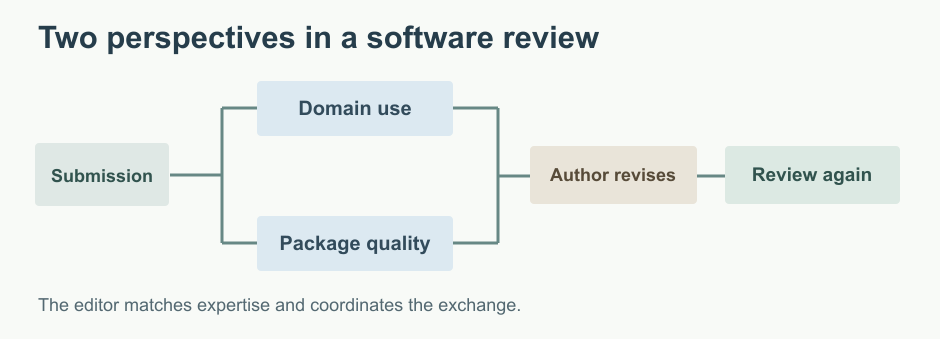
Figure: The exchange in a standard pyOpenSci review.
Write a point a maintainer can retest
Reduce the input to one blank value and one zero. Record the version, read operation and both outputs. If documentation omits the distinction, ask for an explanation or a test that preserves the intended behaviour. Separate issues affecting interpretation from wording suggestions. After a revision, rerun those two rows and record what has been resolved in the review thread. Identify the affected file or function and leave room for the author to choose an implementation.[3][5]
The volunteer page estimates one or two reviews per year for most reviewers, roughly three to ten hours each depending on complexity. The guide asks for an initial review within three weeks of acceptance and asks authors to respond within two weeks. Effort and elapsed time describe different things. Schedule installation, reading, testing and a second pass, and tell the editor early if delayed. Editors match reviewers and coordinate follow-up. Triage volunteers maintain submission metadata, acceptance dates and publication identifiers, at an estimated one to four hours per month.[2][5]
Authors enter through the submissions guide and decisions remain traceable in the review discussion. The code of conduct covers project Slack, GitHub and relevant in-person settings and is enforced by the executive director and conduct stewardship committee. A first reviewer can learn to distinguish an observable problem from a preferred implementation. Catching the difference between a missing observation and a measured zero already makes a tangible contribution to the next scientist who uses the software.[3][5][6]