Forum focus and entry
If health or biomedical research keeps stalling on study design, measurement, analysis, or interpretation of results, the Datamethods Discussion Forum (Datamethods) is worth checking early. The forum covers quantitative methods in health and biomedicine, including study design, data analysis, and interpretation.[1] Statisticians, epidemiologists, informaticists, machine learning practitioners, and other research methodologists talk with one another and with clinical, translational, and health services researchers, on topics that extend to clinical trials, statistical graphics, causal inference, and medical decision making.[2]
Entry is straightforward: open https://discourse.datamethods.org/[1] to browse public topics. To post, you must register and provide your real first and last names. General, non-health-related statistics questions are redirected to Cross Validated (stats.stackexchange.com).[2] The site is sponsored by Frank Harrell Consulting and runs on Discourse. The About section identifies the forum’s administrators and moderators, including Frank Harrell in both roles.[2][3][6]
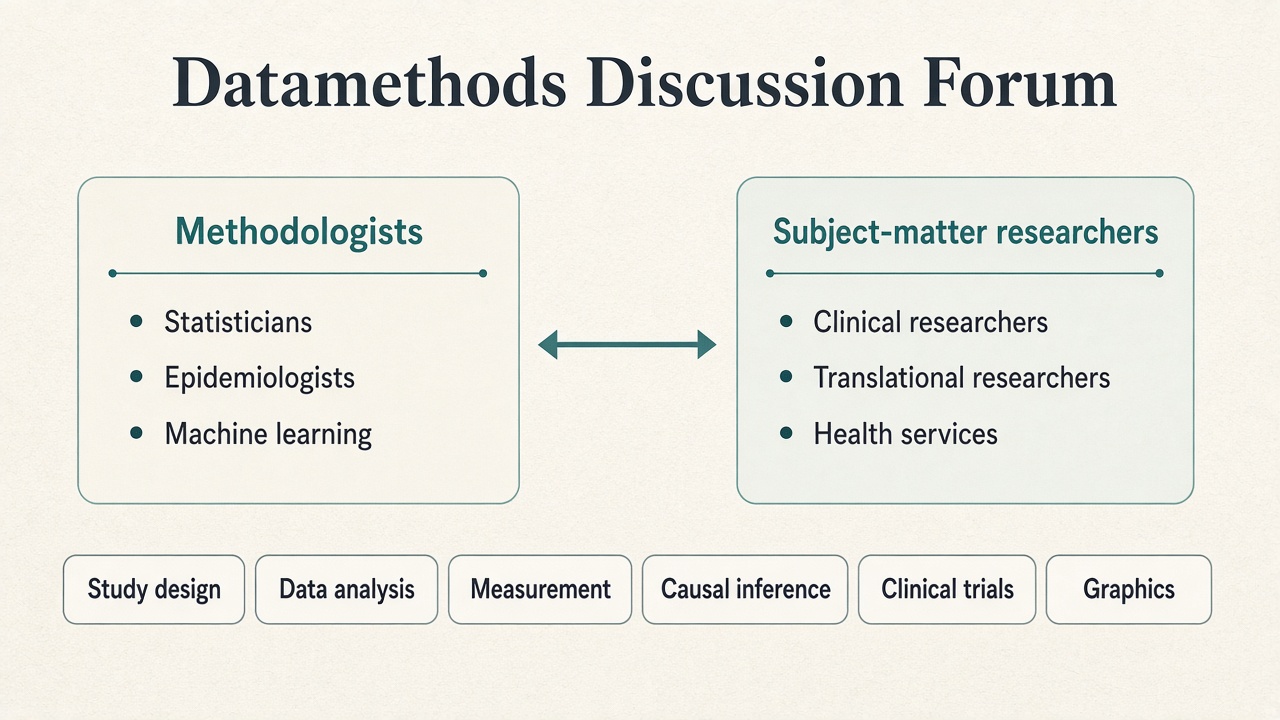
Figure: Both participant sides and common method topics on Datamethods.
Which researchers fit
The core fit can be stated in one line: people who need both methodological depth and an applied research context. On one side are quantitative and data-methods scholars; on the other are clinical, translational, and health services researchers bringing real study problems. Both sides discuss design, analysis, and interpretation in the same threads rather than talking past each other.[2][5][6] In the founding note, Frank Harrell framed the global emphasis as fostering communication between quantitatively skilled people and researchers who do not specialize on the mathematical side, while also raising numeracy among non-math participants.[5]
For methodologists, the forum is a strong match when daily work sits in biostatistics, epidemiologic methods, clinical study design, prediction models, causal inference, measurement and outcome choice, survival analysis, Bayes, or machine learning in medical settings. Discussions centre on how to design a study, measure outcomes, analyse data, interpret published results, and choose statistical graphics.[2][5] The categories page splits discussion into data analysis, research methods, treatment comparison, graphics, computing, education, journal club, topical areas, news, and related boards, so you can find threads by task instead of only scrolling a timeline.[7]
For clinical and translational researchers, the better use case is arriving with a concrete task: whether an outcome carries enough information, whether a continuous variable should not be arbitrarily cut, whether a parallel-group trial misuses change scores, whether repeated measures are treated as independent samples, whether useful confidence intervals are missing from a report, or how to state a target trial emulation, generalizability, or estimand. Those themes show up repeatedly among recent homepage topics and in long-lived, heavily read resource threads. Frank Harrell’s Author Checklist (Statistical Problems to Document and to Avoid) turns common design, analysis, and reporting failures into a checklist and stresses finishing a statistical analysis plan before any data analysis that reveals patterns tied to the hypotheses, ideally in close collaboration with a statistician.[1][8]
Conversely, if the question never touches a health or biomedical context and is only a generic probability exercise, homework item, or pure software error, the welcome post already routes that traffic to Cross Validated. Treating Datamethods as an anonymous chat room is also a poor fit: posting requires a real name, and discussions are indexed by search engines.[2][4] If you want a one-line answer about which test is most significant, while refusing to state design, measurement, and aims, expect follow-up questions. That pressure is part of the forum’s value.
How to take part
A workable path is: read existing topics on the homepage and categories page to see whether the question is already covered; open Guidelines (/faq) for community norms; register with a real name; start a post in the right category with the research question, design background, data structure, and analyses already tried; and reply by criticizing ideas rather than people, offering checks that others can evaluate when you disagree.[2][4][7] Guidelines ask participants to browse before posting, avoid no-content replies and topic derailment, use likes instead of “+1,” and flag problems instead of escalating into personal conflict.[4] User contributions are licensed under Creative Commons Attribution-NonCommercial-ShareAlike 3.0 Unported and that the site is available to individuals who are at least 13 years old.[9]
The exchange value comes from three features. First, methodologists and subject-matter researchers share the same thread, which pushes discussion back from “which algorithm is available” toward “is the research question posed correctly.”[2][5] Second, Discourse archives by topic, so design and interpretation debates that need more than 280 characters can be revisited; Harrell’s founding post contrasted Twitter’s short-lived threads with a discussion board’s lasting memory and argued that deeper exchanges needing moderation and context belong on a board.[5] Third, the site accumulates reusable methods resources and case discussions—Author Checklist among them, along with continuing threads on regression modeling strategy, clinical trial design, diagnostic metrics, and machine learning for medicine—so later readers do not have to rebuild the same argument from scratch.[1][8]
So fitness for Datamethods is not first a question of whether you count as a statistics star. Ask instead whether your question sits in health or biomedical data methods, whether you are willing to use your real name and open the design and analysis details, and whether you will accept follow-up driven by evidence and model assumptions. If those three hold, browse the homepage, read by category, then register and post.[1][2][4]
References
-
[1] Datamethods Discussion Forum. Datamethods Discussion Forum - Data-related methods. https://discourse.datamethods.org/
-
[2] Datamethods Discussion Forum. Welcome to datamethods. https://discourse.datamethods.org/t/welcome-to-datamethods/8
-
[3] Datamethods Discussion Forum. About. https://discourse.datamethods.org/about
-
[4] Datamethods Discussion Forum. Guidelines (FAQ). https://discourse.datamethods.org/faq
-
[5] Harrell F. Data Methods Discussion Site. Statistical Thinking. 2018-06-19. https://www.fharrell.com/post/disc/
-
[6] Harrell F. Datamethods. Statistical Thinking. 2019-01-20. https://www.fharrell.com/datamethods
-
[7] Datamethods Discussion Forum. Categories. https://discourse.datamethods.org/categories
-
[8] Harrell F. Author Checklist. Datamethods Discussion Forum. 2020-06-04. https://discourse.datamethods.org/t/author-checklist/3407
-
[9] Datamethods Discussion Forum. Terms of Service. https://discourse.datamethods.org/tos