A search for the 2030 Agenda for Sustainable Development can return UN topic pages, news stories and texts in several languages. To lead a reader back to the action adopted by the General Assembly, keep A/RES/70/1 with the citation. The title tells the reader the subject. The symbol identifies the formal document and remains the same across language versions.[2][4]
Recover the issuing body from the symbol
UN document symbols use letters, numbers and separators. They generally do not encode the topic. A commonly identifies the General Assembly, S the Security Council and E the Economic and Social Council. In this example RES marks a resolution, 70 the Assembly session and 1 the resolution number. Other bodies use different series conventions; consult the symbol guide before applying the Assembly pattern elsewhere.[2][3]
Retain suffixes for addenda, revisions and corrigenda. A correction can apply to a particular language. Omitting a suffix in a study of changed wording may send the reader to a version without the change. Record the body, complete symbol, date, paragraph and language together. A slightly different translated title will then cause little difficulty.[2]
Distinguish bibliographic coverage from full text
The UN Digital Library brings together documents, voting data, speeches, maps and open publications. It also provides bibliographic records for print documents starting in 1979. The Official Document System is an important full-text source for documents since 1993, with older material including principal-organ resolutions from 1946. Interpret a date range together with the document type. A catalogue record for an early item does not establish complete digitization of every series.[1]
Search by the full symbol, compare body, title and date, then select the language needed. A member state's speech or vote may belong in a separate Digital Library record. A meeting record mentioning a resolution does not supply its adopted operative wording. Keep the meeting symbol separately when it helps explain how a passage developed.[1][2][3]
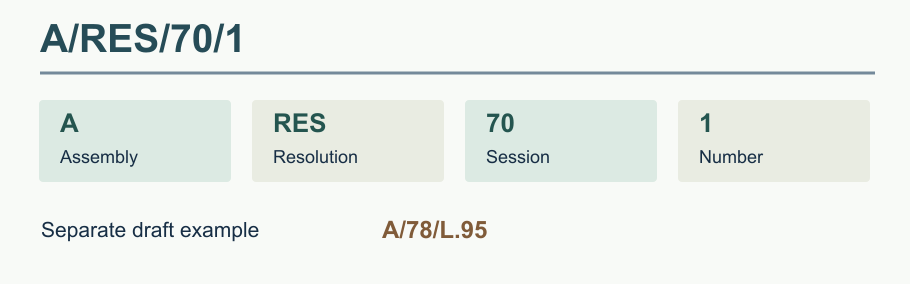
Figure: A General Assembly resolution symbol and a draft.
A draft establishes what was proposed
The library gives A/78/L.95 and S/2024/528 as examples of draft documents. Drafts circulate separately, and symbols differ by body. Preserve a draft and an adopted text as distinct items, linking them from the proceedings rather than pairing similar titles across years. A claim about action requested by the Assembly needs the corresponding adopted text.[3]
Within a resolution, the preamble sets out background or motivation. Operative paragraphs contain decisions, requests or other actions. An annex may hold a convention or programme, so a target drawn from an annex should carry a precise location. Decisions are another form of action and frequently address procedural matters such as appointments, elections or meeting dates. Importance alone does not determine the document type.[3][4]
For a series of documents, use the library's guides to resolutions and decisions for the Assembly, Security Council or other body. Keep each symbol. As a handover check, give it to a colleague who reads a different UN language and ask whether it identifies the same document and paragraph. A successful citation locates both the wording and the official action behind it.[1][2][3]