Once a search has returned enough, how do you keep only the works that are in a named list of journals? OpenAlex’s listed_in filter turns DOAJ, MEDLINE, and several national or regional lists into conditions on the website and in the API. This article says how to filter works by a list, look up journals, and combine levels, and how to tell “the journal is on the list” from “the article is indexed.” It is a reference for literature search and for the first screen of a review.

What a list means, and what it covers
This site’s 2026-10-20 article, a practical account of OpenAlex web search and API calls, was about coverage and quotas. This one goes on to how a journal list draws the boundary of a search.
Jason published the official introduction on 2026-10-15, but the post says the feature had already started in September with 22 lists. The date of the article cannot be taken directly as the day the function first went live. The blog and the help page read this round both show 61 lists. The number will change. The list catalogue at the time of use is the one to follow. [1][2]
listed_in records which external lists a journal appears on. The official account uses the experience of Beall’s list to explain why it chose an allow list: the reader actively chooses a maintainer to trust, rather than the platform issuing one list of “bad journals.” This is only membership. It does not mean OpenAlex endorses a list, and it does not mean a journal that is not on a list has a problem. [1]
A list can be chosen by purpose. DOAJ is for fully open-access journals that have been reviewed. MEDLINE corresponds to journals currently included in that system. JUFO and the Norwegian register keep their own levels. Latindex corresponds to Catálogo 2.0. SciELO corresponds to the network’s current journals. JPPS is split by star ratings from an assessment of publishing practice. Their objects and the purpose of the evaluation differ. Levels cannot be swapped for one another directly. [1][2]
Filtering on the website, and the API
Scope: the Source lists document updated on 2026-10-15, and the OpenAlex web notes that could be read this round. The premise is that a list and a search question have been chosen first. This section arranges the official syntax. The command examples do not mean they have been run. [2]
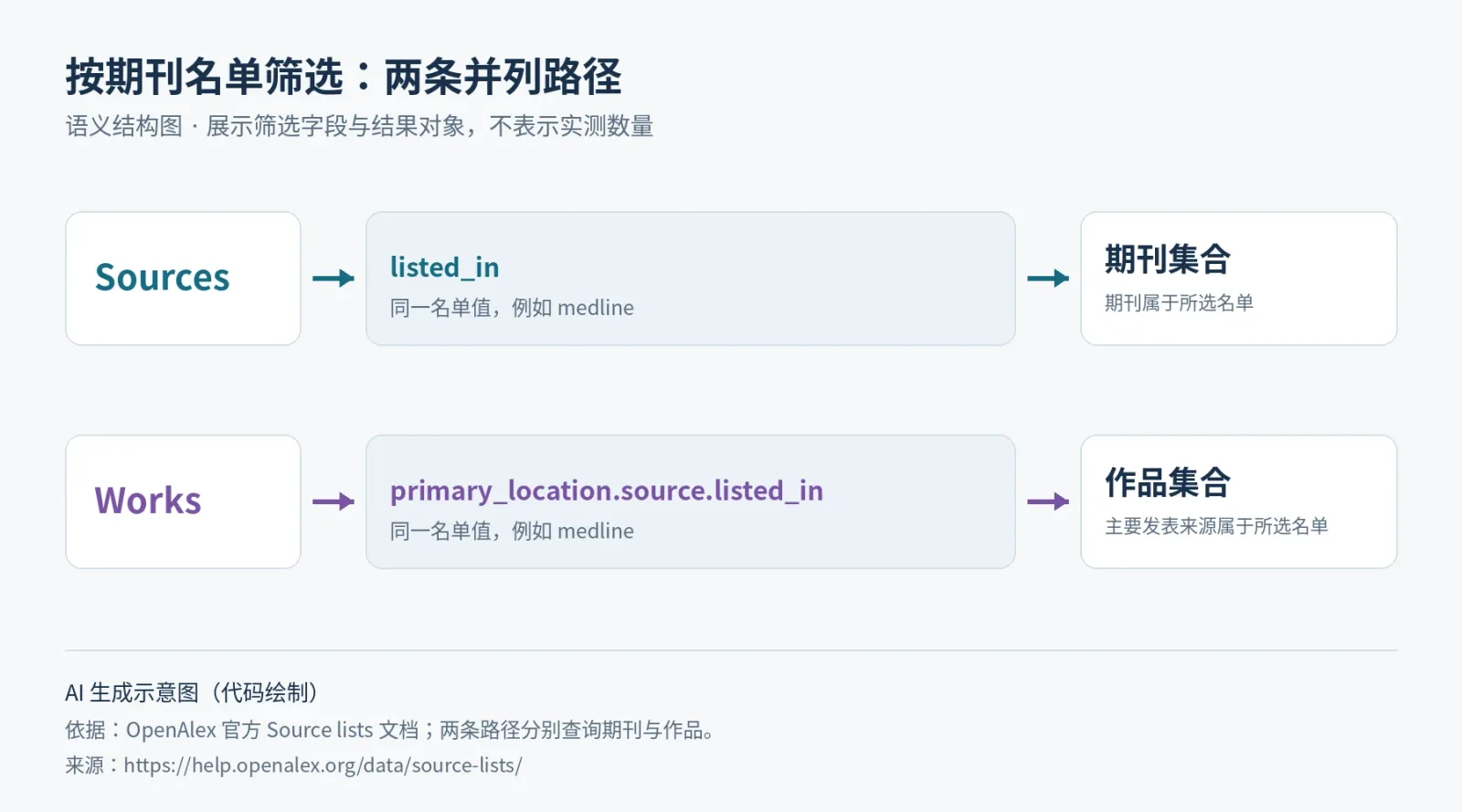
- To filter journals, open Sources, find the
listed infilter, and choose a list, for example MEDLINE. - To filter works, open Works, use the
source listed infilter, and then add conditions such as a research topic. - To check a list, open Source lists and look at the maintainer, the coverage note, and the loaded version. Do not judge fitness from the abbreviation alone. [1][2]
In the API, filter journals with listed_in. Filter works whose primary publication source belongs to a list with primary_location.source.listed_in:
https://api.openalex.org/works?filter=primary_location.source.listed_in:doaj
https://api.openalex.org/sources?filter=listed_in:medline
https://api.openalex.org/source-lists
https://api.openalex.org/source-lists/medline
Each level is its own list, for example norway-2, jufo-3, and jpps-1. To keep any JUFO level, use a vertical bar for OR. Do not select only the highest level and then call it the whole of JUFO:
https://api.openalex.org/sources?filter=listed_in:jufo-1|jufo-2|jufo-3
In a program or a client, encode URL parameters by that client’s rules. The example above keeps the vertical bar so it can be read. [2]
A search example, and where use stops
A reproducible example: if a review protocol expressly requires only MEDLINE journals, the query below can be run first to take a small page of candidate works, and topic and date conditions can then be added according to the protocol. Filtering by a list cannot by itself finish a systematic review:
https://api.openalex.org/works?filter=primary_location.source.listed_in:medline&per-page=5
When checking, open source-lists/medline and record the maintainer and list_version. Then check whether a returned work’s primary_location.source.listed_in contains medline, and compare it with the journal record. Save the query, the query date, and the list version, so a later change in the results can be explained. Source lists are matched to OpenAlex journals by ISSN, and only the maintainer’s current members are counted. An empty version field may also mean the list comes from a continuously updated data stream. [2]
The two questions have to be kept apart. listed_in asks whether the journal is on the list. indexed_in asks whether this article is included in an index. A MEDLINE journal filter cannot be read directly as saying that every returned article has been indexed by MEDLINE. Current membership of a list is also not the same as membership in the year the article was published. [2]
The check this round is a check of documents. The official blog and the help page were read. A work query and a full-list trial were not completed. The task material mentions that the API returned 62 lists on 2026-10-26, but reading the interface failed this round, so that number is not written as an independently verified result. The reason for a difference between the page and the interface was not judged from it either. An actual search should read the catalogue again and record the value returned then. Both list updates and the range of matching can change the results. A list condition cannot be taken as sufficient proof of an article’s quality.
References
-
Jason. Trusted journal lists come to OpenAlex. OpenAlex blog, 2026-10-15.
-
OpenAlex. Source lists. Help document. The page marks a last update of 2026-10-15. The check this round was 2026-10-26.
-
Compiled and published by Scholay. For a takedown request, send feedback.
-
Also published at Enter Scholar.