Tracing a life-science paper back to a specific award needs a checkable funding identifier and landing page, not only an acknowledgement sentence. Europe PMC holds both literature and grant records for its funders. Local grant numbers remain in use, but different funders can share the same digit string. The official blog gives local ID 207467 as an example: Wellcome and the European Research Council each have a record with that number in Europe PMC, so the local ID alone does not disambiguate.[1] Open global grant identifiers take the form of DOIs—unique, persistent, and easy to embed in publishing and repository systems. Funders that want such DOIs join Crossref, register metadata such as title, amount, and dates, and provide a public landing page for resolution.[1] From September 2019, Wellcome became the first funder to register open global grant DOIs with Crossref; Europe PMC supplied the metadata, and each DOI resolves to a grant landing page on Europe PMC, putting “which award” and “which paper” on one clickable path.[1]
Paths from a paper to a grant record
On the website, open the Europe PMC article and check whether Funding fields show a local grant number or a Crossref grant DOI; a DOI should open the matching grant page with title, amount, dates, and investigator details for comparison with the article’s funding statement.[1] In the blog’s pilot, PLOS ONE worked with Wellcome-funded authors to put newly registered global grant IDs into publication Funding metadata so readers could move from the article to the Europe PMC grant record and see linked outputs.[1] For Wellcome and other Europe PMC funders, grantees must select a grant identifier when depositing accepted manuscripts, which is why Europe PMC can assemble funding metadata for Crossref and why paper–grant links need not rely only on later free-text acknowledgements.[2] To list outputs under an award, prefer the literature already linked on the grant landing page and results from Europe PMC’s public APIs; Wellcome likewise frames checking those links on the Europe PMC grant record as the basis for programmatic reporting.[2]
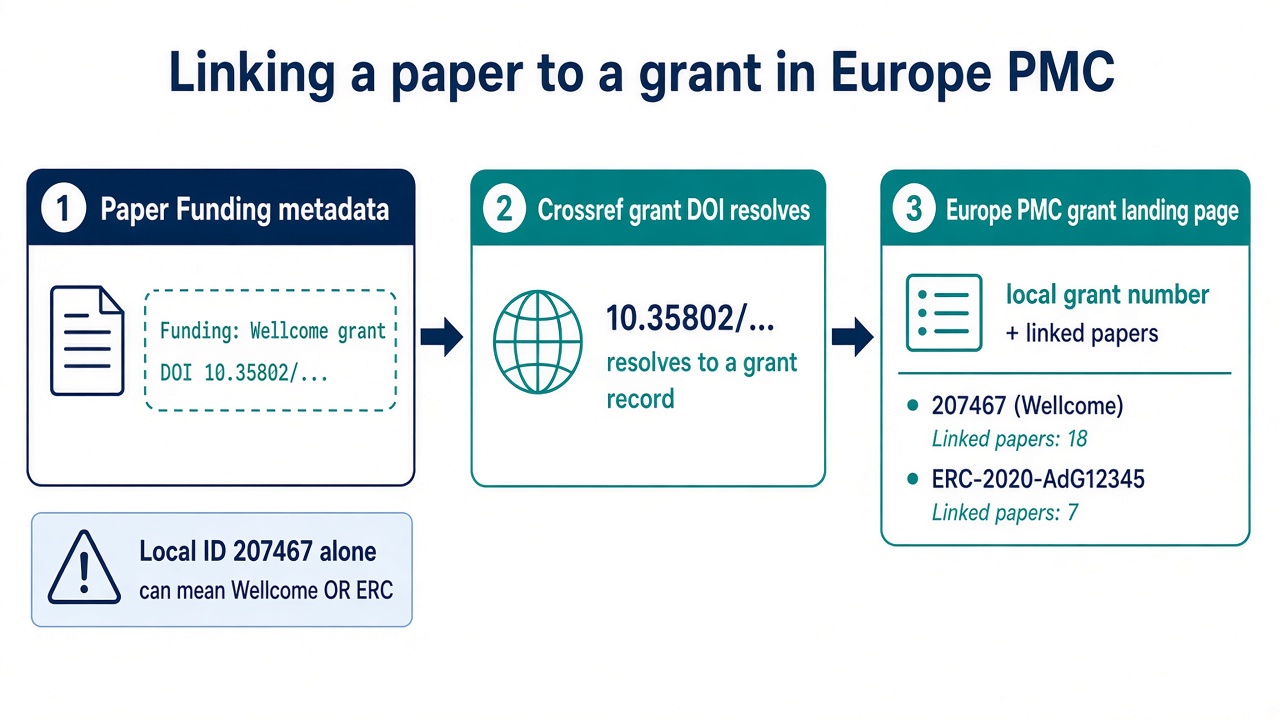
Figure: Schematic of grant–paper linking (not a screenshot or site logo). Based on Europe PMC’s blog and the PLOS ONE pilot Funding field: article 10.1371/journal.pone.0222922 carries Wellcome grant DOI 10.35802/207522, resolving to a Europe PMC grant page; local numbers can collide across funders (blog example 207467). Explanatory diagram only.[1][4]
Searching grant fields with GRIST
The programmatic path is the Grants RESTful (GRIST) API at https://www.ebi.ac.uk/europepmc/GristAPI/rest/get/, with a required query parameter over grants awarded by Europe PMC funders.[3] Fielded searches commonly use ga: / grant_agency for funder names, abbreviations, or FundRef IDs; gid: / gr: / grant_id for local grant numbers; pi: for a principal investigator’s last name (optional initials); plus title:, abstract:, and date: / active_date. Separate terms with spaces for AND; do not put & inside query, or it becomes a keyword—the documentation’s Wellcome Trust plus pi:smith counter-example makes that failure mode explicit.[3] resultType=lite returns key metadata; core adds abstracts, start/end dates, and institution detail. format may be XML (default), JSON, or CERIF, with up to 25 grants per page starting at page 1.[3] The 2020 blog states that the new global grant ID and the local number both appear in the API response, so callers can store both and cross-check Funding fields on the literature side.[1]
Coverage and a search gap that remains
Global grant DOIs require the funder to join Crossref, deposit metadata, and provide a public landing page. Europe PMC already maintained an open grants database for all 31 Europe PMC funders and first registered DOIs for Wellcome, while keeping the infrastructure available to other funders.[1][2] The blog reports 237 Wellcome grant DOIs for 2019 awards and plans to assign IDs retrospectively to about 13,500 earlier Wellcome grants in GRIST, aiming for publishers and repositories to collect grant DOIs at submission and feed assessment workflows automatically.[1] In a December 2025 Crossref interview, Europe PMC said Grant Finder still cannot retrieve a specific grant by Crossref grant DOI, as of that December 2025 interview; this note does not treat later plans as features already live in 2026.[2] Wellcome also plans to stop asking researchers to list publications directly in progress and end-of-grant reports, and instead to have them check that written outputs are linked on the Europe PMC grant record so reporting can use open metadata—unlinked papers will not be seen on the funder side.[2] Day-to-day checks should therefore ask whether the local grant number is unique across funders, whether a global DOI resolves to Europe PMC, whether the article metadata carries that DOI, and whether Finder/API DOI lookup is still limited. Dynamic interface fields follow current official documentation; this note does not invent unchecked query parameters.
References
-
Europe PMC News Blog. Global grant IDs in Europe PMC. https://blog.europepmc.org/2020/06/global-grant-ids-in-europe-pmc.html
-
Crossref. Wellcome and Europe PMC: supporting Open Research through open metadata. https://www.crossref.org/blog/wellcome-and-europe-pmc-supporting-open-research-through-open-metadata/
-
Europe PMC. Grants RESTful (Grist) API. https://europepmc.org/GristAPI/
-
Maina et al. Assessing the effect of WASH and IPC interventions in Kenya. PLOS ONE. https://doi.org/10.1371/journal.pone.0222922