A researcher can fit a regression and draw a figure but still produce a script that knows where the data live only on its author's computer. A changed directory breaks the run, and a slowdown has no obvious location. MIT's Missing Semester focuses on these everyday computational skills. One small research script can connect the lectures to an actual handover.[1]
Put nine sessions back into one workflow
The 2026 edition ran from January 12 to 23 and was co-taught by Anish, Jon and Jose. The opening sessions cover the shell, command-line environment, and development environments and tools. Take a non-sensitive table and the script that reads it. Specify the working directory, input and output. Repeat from a different directory using only your notes. Having to ask where a file lives identifies an immediate gap in the instructions.[1]
The January 15 lecture separates debugging from profiling. An incorrect result calls for locating the first stage at which a value goes wrong; a correct but slow result calls for measuring where execution time is spent. Keep outputs from the same input before and after an optimization so a faster calculation does not quietly become a different one. Searchable notes complement the lecture recording when only a particular technique is needed.[1][2]
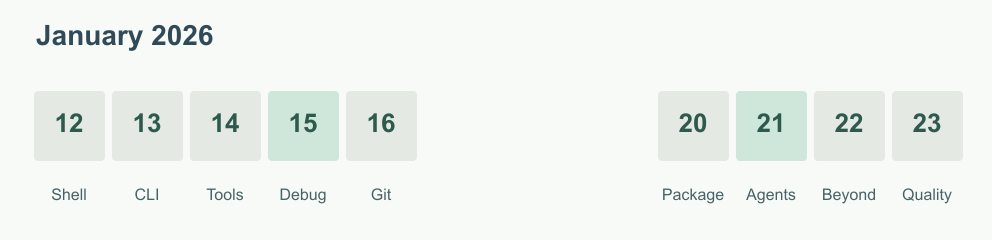
Figure: The nine teaching dates in the 2026 edition.
Version control and Git follow on January 16, and packaging and shipping on January 20. Record the version that first worked for a colleague, along with the example input and expected result. Then try the instructions in a clean environment. A usable history and an installable environment answer different questions about the same delivery.[1]
Read the AI material in context
January 21 covers Agentic Coding, followed by Beyond the Code and Code Quality. Applicable AI tools also appear throughout the other sessions. Choose a bounded exercise such as making a figure's output path configurable. Inspect the proposed change, rerun the original case and compare the outputs. This tests the resulting work rather than the plausibility of an assistant's explanation.[1][3]
Leave a handover someone can use
The syllabus links notes, videos and previous editions. Older special topics need not share the numbering of the current course. An experienced researcher can begin at a recurring bottleneck, while a beginner can take the first three sessions in sequence. The material carries a Creative Commons attribution, noncommercial and share-alike license. For a research-group exercise, share the course link and bring different real scripts. The final check is whether a colleague can find the inputs, run the specified version, compare the result and notice a subsequent regression.[1][2]