Graduate students with Python programming and basic math who want to learn deep learning systematically often ask how to pair the book Dive into Deep Learning (the Chinese edition is 《动手学深度学习》) with Mu Li's companion course. This article is for readers of the Chinese edition and follows the Chinese online book and the course page, book first and videos second, accessed on 25 November 2026; I have not studied the book or the course, so what follows is not a learning experience, only what the pages say.
What the book is
The online book's page is titled as the second edition, with a subtitle calling it a deep learning textbook for Chinese readers that runs and can be discussed, with PyTorch, NumPy/MXNet, TensorFlow and PaddlePaddle implementations.[1] The author section lists four authors, Aston Zhang, Zachary C. Lipton, Mu Li and Alexander J. Smola; the page says every section is a runnable Jupyter notebook that can be run locally, in Amazon SageMaker Studio Lab, in Amazon SageMaker or in Google Colab, and that you can join community discussion through the links at the end of each chapter.[1] It says the book is used for teaching at more than 500 universities in more than 70 countries, and thanks more than 200 community contributors.[1] The English-edition citation on the page gives Dive into Deep Learning as published by Cambridge University Press in 2023.[1] By my count the contents have 15 chapters and an appendix: introduction, preliminaries, linear neural networks, multilayer perceptrons, deep learning computation, convolutional neural networks, modern convolutional neural networks, recurrent neural networks, modern recurrent neural networks, attention mechanisms, optimization algorithms, computational performance, computer vision, and two chapters on natural language processing.[1]
The companion course
The course page summary says the course began on 20 March 2021, with live sessions on Saturdays and Sundays from 1:00 to 2:30 pm Beijing time, follows the second edition of the book closely, and is taught by Mu Li.[2] The only requirements are basic Python programming and basic math, and learners need no registration or payment; it covers four model families, multilayer perceptrons, convolutional networks, recurrent networks and attention, plus typical tasks in computer vision and natural language processing, shows how to implement every detail in PyTorch, and runs four course competitions.[2] The course has ended: the updates section says week 24 is "course over, thanks for learning" and that all videos are uploaded to Bilibili.[2] So it is a 2021 course and not currently running; the page also says the schedule was provisional and some content then linked to the English version.[2] The summary expects it to end in July while the schedule runs to 21 August, and the page does not explain the difference.[2] The course page says the book is used by nearly 200 universities, while the book page says more than 500 universities in more than 70 countries; they come from pages written at different times, and this article attributes each.[1][2] The book page adds that teaching videos based on the PyTorch edition are on Bilibili, and videos based on an earlier draft are on Bilibili and YouTube.[1]
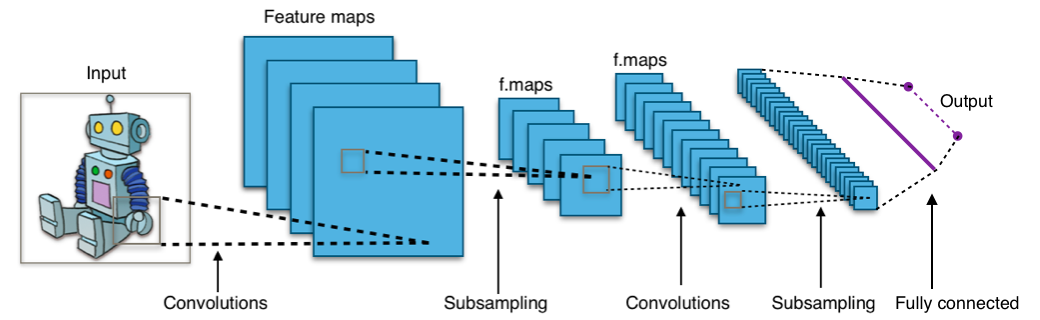
Figure: A generic diagram of a convolutional neural network with convolution, subsampling and fully connected stages, not an illustration from the book. Aphex34, Wikimedia Commons[3]

A route that pairs the book with the course
The pages give no pairing method; the route below matches the course's parts to book chapters in my own arrangement, by the topics of the sessions, without checking the videos session by session. Part one is the deep learning basics: the schedule runs from the introduction, installation and data manipulation through linear regression, softmax regression, multilayer perceptrons, weight decay, dropout and numerical stability, matching Chapters 1 to 4, and ends with the Kaggle competition on house price prediction, which is Section 4.10 in the book.[1][2] Part two is convolutional networks: from model construction and parameter management through convolution, padding and stride, LeNet, AlexNet, VGG, NiN, GoogLeNet, batch normalization and ResNet, followed by the image classification competition, matching Chapters 5 to 7.[1][2] Part three is computer vision: hardware and multi-GPU training, image augmentation, fine-tuning, object detection, semantic segmentation and style transfer, with the leaf classification and object detection competitions, matching Chapters 12 and 13.[1][2] Part four is recurrent networks, from sequence models and language models to GRU, LSTM and seq2seq, matching Chapters 8 and 9; part five is attention, from attention scores and self-attention to the Transformer and BERT, matching Chapter 10 and Chapters 14 and 15; and the last session day covers optimization algorithms and a course summary, matching Chapter 11.[1][2] Doing the matching competition exercise after each part is the idea; the pages do not detail the data or how to submit, and I did not try them.[2]
How to get the materials
The book can be read directly on the web, with its code run in the environments the page lists.[1] For paper copies, the page says the black-and-white paperback of the second edition, Dive into Deep Learning (PyTorch edition), is on sale at JD.com and Dangdang, with content largely the same as the online version but with style, terminology, wording, punctuation and the indexes of figures, tables and sections brought to publishing standards; the first edition is sold in full-colour hardcover and black-and-white paperback at JD.com, Dangdang and Tmall.[1] The page gives no prices for these editions.[1] Under the Free resources heading, the page says slides, assignments and teaching videos can be found through the links in the syllabus of Berkeley's Introduction to Deep Learning, which has Chinese slides.[1] The course page states no license for the course materials and the book page states none for the book, so this article makes no judgement on it.[1][2] After the course, the course page points to Stanford's Practical Machine Learning from autumn 2021, which is the page's recommendation and a course I have not seen.[2]
References
- Aston Zhang, Zachary C. Lipton, Mu Li and Alexander J. Smola. Dive into Deep Learning, Chinese edition, accessed 25 November 2026.
- Mu Li. Dive into Deep Learning online course, schedule, accessed 25 November 2026.
- Aphex34. Typical cnn.png, Wikimedia Commons, CC BY-SA 4.0.