Project overview
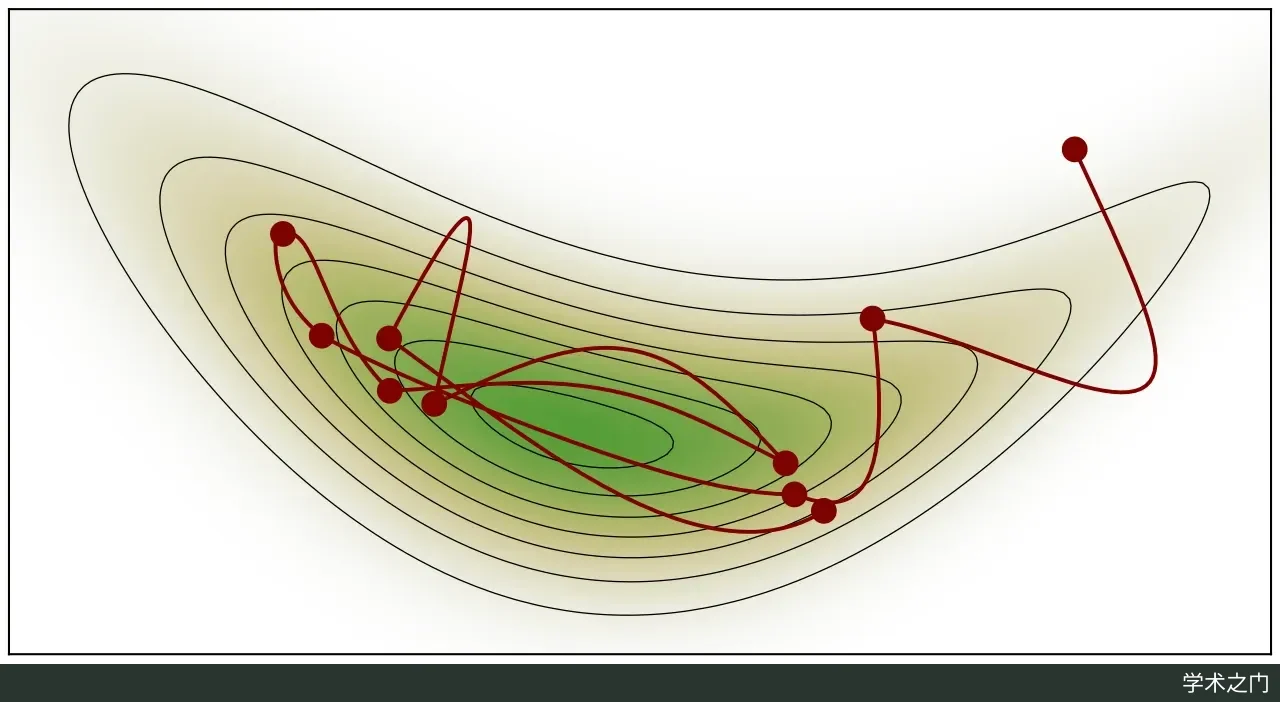
Hamiltonian Monte Carlo (HMC) sampling example in a two-dimensional parameter space: shading and contours show the posterior probability distribution (higher in green); the simulation starts from an arbitrary initial value and randomly walks to many possible parameter points. The NUTS sampler used by Stan is a variant of HMC. Figure: Justinkunimune, source Wikimedia Commons, CC0 1.0.

Stan Forums (discourse.mc-stan.org) is the official forum for the Stan project, where users and developers discuss Stan modeling, installing and using language interfaces, sampling diagnostics, and runtime performance. Before posting, check the docs, pick the right category, and include a minimal reproducible example plus the full warning text. This article explains what the forum covers, how to ask questions, and how it divides labor with Cross Validated, PyMC Discourse, and the official documentation.
Scope and categories
Per the Stan project community page, Stan Forums is a message board for users and developers for Stan-related questions, discussion, and announcements; developers also have Stan Slack for real-time chat, and confirmed software bugs and feature requests should go to issues in the relevant GitHub repositories. The forum is organized by category: Modeling covers writing models as Stan programs and problems fitting them with Stan, and has the most topics (about 7,762 when checked on 23 October 2026); Interfaces covers installing and using interfaces—questions about CmdStanR, CmdStanPy, RStan, PyStan, and higher-level packages such as brms often land here; Algorithms discusses the algorithms Stan uses and how to use them; Developers is for Stan’s own development. There are also Publicity (sharing papers, blogs, and case studies done with Stan), Announcements (official releases and events), General, Jobs, Meetings, and others.[3,4]
Interface choice also shapes how you should describe the problem. The official tools page currently recommends CmdStanR for R users and CmdStanPy for Python users; both build on the command-line interface CmdStan. RStan is still listed as an R interface; PyStan is marked as a legacy Python interface. For beginners, the project recommends trying models first in the browser-based Stan Playground.[5]
Before you post
Forum guidelines require checking the docs (especially the user’s guide and case studies) and searching old threads, then posting in the right category—do not post the same content in multiple topics. The pinned welcome post advises simplifying the problem as much as possible: a small program with clear variable names that keeps only the failing part is easier to understand than a large, structurally unrelated program. Category posting templates spell this out further:[1,2,3]
- Modeling: Attach the Stan program and data when possible; put code in a block marked
stanand keep indentation; write math in LaTeX wrapped in double$; tag the topic with the application domain or model class. - Interfaces: Start with a one-sentence summary, paste the code that runs the model, ideally also provide code that simulates data or a data subset, and state the OS, interface version, and compiler/toolchain.
- Diagnostic questions: Paste the warning verbatim—for example
There were 15 divergent transitions after warmup—plus R-hat, bulk-ESS, and tail-ESS values and the number of chains used. The official diagnostics page’s reference is: run at least 4 chains by default; final results should have R-hat below 1.01 and bulk-ESS greater than 100 times the number of chains; max-treedepth warnings are efficiency issues, while divergent transitions, high R-hat, and low ESS affect whether results are trustworthy.[6]
The official diagnostics page also recommends writing the model as a standalone .stan file, because only then do line numbers in errors and warnings make sense; keep the model, initial values, and calling commands in a script, and track changes with git or similar version control. In rstan, some sampling-time warnings may only show when you set chains = 1. If you suspect a software bug, the official community page lists what to report: what you intended to do, the exact call that triggered the problem, the full error message (attach the Stan program when line numbers are involved), Stan core and interface versions, plus OS and C++ compiler.[4,6]
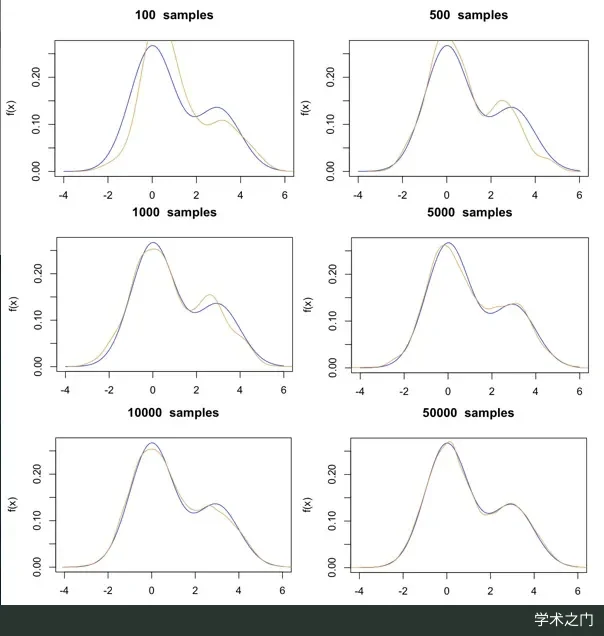
Metropolis–Hastings algorithm convergence example: orange is the distribution from MCMC sampling; blue is the target distribution it is approaching. When asking on the Stan forums, whether sampling has converged is communicated with diagnostic numbers such as R-hat and ESS and the full warning text. Figure: Chdrappi (drawn in R), source Wikimedia Commons, CC BY-SA 3.0.

Why they help
For researchers doing Bayesian modeling with Stan, the forum’s value is direct help from Stan developers and experienced users, from install errors through to model reparameterization. The official diagnostics page also says that warnings you cannot resolve or understand are welcome on the forum. Its boundaries are equally clear: it is not a general statistics Q&A site, and it does not cover the specific usage of other probabilistic programming frameworks; confirmed software bugs should move to GitHub issues.[2,4,6]
Division of labor with Cross Validated and PyMC Discourse
The three communities can be separated by “which layer the problem is on.” Cross Validated’s help center lists statistical analysis, experimental design, probability, mathematical statistics, and statistical computing as on-topic, while noting that programming questions should go to Stack Overflow and software bugs to the software authors; if the question is whether a model or prior is statistically sensible and is unrelated to Stan code, Cross Validated is a better fit. PyMC Discourse is the PyMC project forum; its Questions category is for improving PyMC models or discussing migration from other Bayesian software—if the model is implemented in PyMC, ask there. Problems involving Stan program writing, sampling warnings from Stan, or Stan interface install/runtime speed belong on Stan Forums.[9,11]
All three discourage duplicate posting: Cross Validated discourages asking the same question across Stack Exchange sites, and Stan and PyMC forum guidelines also require not posting the same content in multiple topics. When you truly need to ask elsewhere, include a link to the original post in the new one.[1,9,10]
How official docs and the forum work together
Official documentation and the forum are sequential. The Stan docs site currently corresponds to Stan 2.40 and includes the User’s Guide (example models and programming techniques), the Reference Manual (language specification and inference algorithms), the Functions Reference (built-in functions), and getting-started install guides for CmdStan and the R, Python, and Julia interfaces. A time-saving order is: when you hit a sampling warning, first read the official page How to Diagnose and Resolve Convergence Problems, try shrinking the model, switching to simulated data, using stronger priors, or reparameterizing by warning type; if still unresolved, write the steps you already tried into the forum post. That diagnostics page itself cites several forum threads as examples.[6,7]
Releases and new features are announced in the Announcements category—for example the CmdStan 2.40.0 release post on 16 September 2026. When republishing or citing, note licenses: Stan code uses the BSD 3-clause license (some interfaces are GPLv3); documentation and other text use CC BY-ND 4.0.[4,8]
References
-
Welcome to the Stan Forums! (2016-08-06)
-
Stan Documentation (Stan 2.40)
-
Release of CmdStan 2.40.0 (2026-09-16)
-
Academic Gateway · a living guide for scholars in the intelligent age
-
Information compiled and published by the Scholay academic one-stop platform; report infringement for takedown.
-
Also published on Enter Scholar, a scholars’ community for the intelligent age