A beginner can reproduce a plot from someone else's R script while remaining unsure what a row means or whether a missing value entered the denominator. Harvard's CS50R takes those questions in sequence. Carter Zenke and David J. Malan's R-focused course uses RStudio. Its seven weeks of OpenCourseWare are available to non-Harvard learners for free, and CS50R may be taken before, during or after CS50x.[1]
Carry one table through seven weeks
Invent three observations with values four, missing and eight, plus a sample identifier for each. This is a personal exercise, not an official assignment. In Representing Data, distinguish a vector from a data frame and a label from a numeric value. In Transforming Data, name the condition that selects rows. The denominator of an eventual average is then a visible decision.[1]
Applying Functions lets you express the summary as a function. Tidying Data turns related measurements into consistent rows and columns. In Visualizing Data, use the grammar of graphics to explain which variable maps to position or colour. The course introduces the tidyverse. If a point disappears, identify its missing observation before adjusting the appearance of the plot.[1]
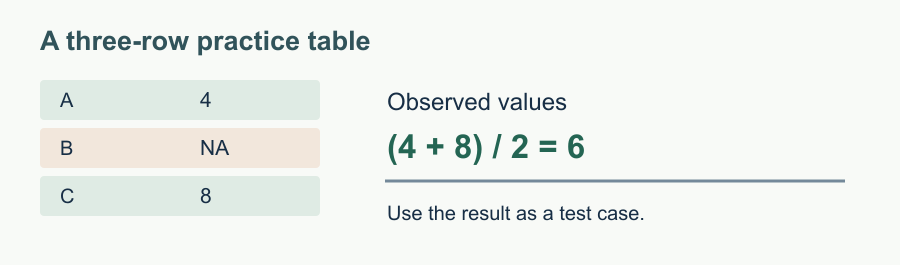
Figure: A small table carried through the learning sequence.
Testing Programs and Packaging Programs complete the sequence. Write a check that the two observed values average six. Decide what should happen when every value is missing. Give the same function to a colleague for a different table. For the final project, retaining a minimal input and an expected output lets someone independently check what the program promises to do.[1]
Use the assignment as the week's check
The published workflow is lecture, recommended short videos, then the problem set, followed eventually by the final project. Use a short video to revisit a specific operation. Try rebuilding the analysis from a blank script before looking at the example. To submit problem sets and the final project for feedback, the course asks learners to create an edX account.[1]
Choose the recognition appropriate to the goal
OpenCourseWare supports independent study. For an edX verified certificate, register through the separate course link. Harvard Extension School and Harvard Summer School list separate registration routes for credit and accreditation. Watching the free lectures does not award transfer credit; it does let an independent learner start the same material immediately.[1]
The course materials use CC BY-NC-SA 4.0. A research group can share the course link and practise with its own table. If redistributing adapted course materials, retain attribution and follow the license conditions. Then replace the toy rows with your research data and ask who each row represents, where its value came from and what the program should do on a different input.[1][2]