Biology researchers who have sequencing data but no programming background often ask how the open courses of the Harvard Chan Bioinformatics Core (HBC) take a learner from R basics to differential expression analysis. This article follows the pages of the training overview, the Introduction to R course and the differential expression course, accessed on 25 November 2026; I have not taken these courses, so what follows is not a learning experience, only what the pages say.
The provider and the course structure
The training overview comes from the training team at the Harvard Chan Bioinformatics Core, with the contact email hbctraining@hsph.harvard.edu.[1] It says the training falls into two broad groups, an introductory high-throughput sequencing data analysis series and a current topics in bioinformatics series; the current workshops and courses are designed to help biologists become comfortable using tools to analyse high-throughput data, and are slowly expanding to researchers with more advanced skills.[1] The introductory series is split into basic data skills and advanced topics: the basic courses have no prerequisites and need no programming experience, and are listed as Shell for Bioinformatics (O2 cluster), Introduction to R and the video tutorials of Introduction to R; the advanced courses require one or more basic courses, and by my count eight are listed, such as bulk RNA-seq from reads to count matrix (O2 cluster, prerequisite Shell), Introduction to Differential Gene Expression Analysis (prerequisite Introduction to R), ChIP-seq and CUT&RUN (O2 cluster, prerequisite Shell) and single-cell RNA-seq (prerequisite Introduction to R).[1] The current topics series has three tables, short R workshops, short shell workshops and other short workshops, and the page gives each workshop's prerequisites.[1] The page also says you are free to take a workshop or work through the lessons yourself at your own pace.[1]
Step one: Introduction to R
The Introduction to R course home page says the workshop is for biologists, needs no computational skills, and is a 4-session online workshop with about 8 hours of trainer-led time, with a schedule that assumes learners spend 2 to 3 hours between classes reading lessons and doing exercises.[2] The learning objectives are R syntax and the use of RStudio, frequently used data types and data structures, inspecting and subsetting data with functions and indices, and making plots with ggplot2.[3] The installation requirements on the lesson page are R (version 4.4.0 or later) and RStudio.[3] By my count the lesson list has 18 lessons, from R and RStudio basics, syntax and data structures, functions and arguments, and reading in and inspecting data, to ggplot2 plotting, exporting plots, finding help and the tidyverse, plus a set of final exercises with an answer key.[3] The home page offers two entry points, a trainer-led schedule and self-learning, says the files used in the lessons are linked within them, and links to a dataset that can be downloaded at once.[2] The lesson page's "Building on the basic R knowledge" section puts the differential expression workshop first, followed by single-cell RNA-seq, RMarkdown and Quarto, among others.[3]
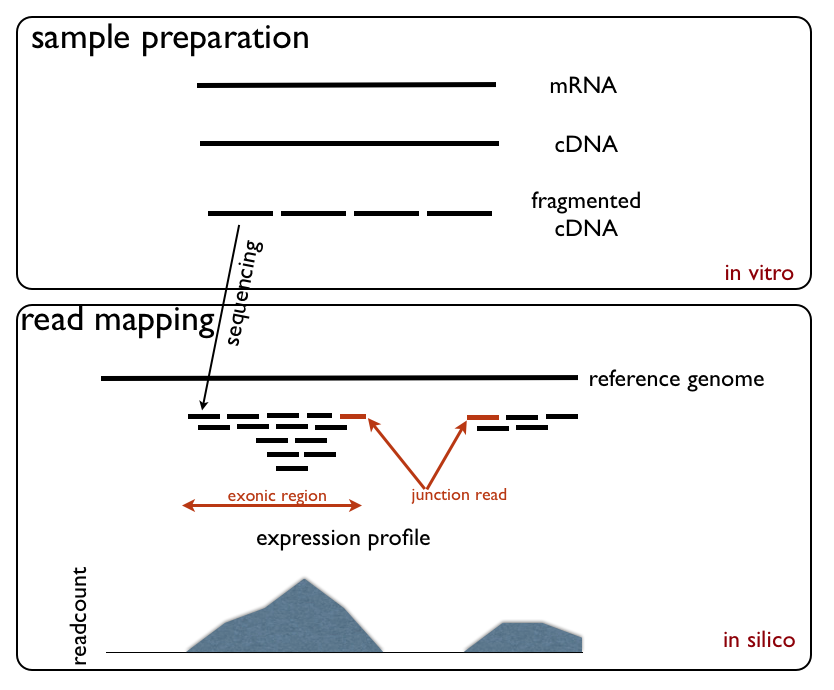
Figure: An RNA-seq experiment diagram, the upper half showing sample preparation and the lower half showing sequencing reads mapped to a reference genome and turned into read counts, not a screenshot of the HBC course pages or materials. Boraas, Wikimedia Commons[7]

Step two: differential expression analysis
The differential expression course is for biologists and requires R skills first; the page asks for working knowledge of R or completion of the Introduction to R workshop. It is also a 4-session online workshop with about 8 hours of trainer-led time, and its schedule assumes 3 to 4 hours between classes of reading lessons and doing exercises.[4] The learning objectives are quality control of count data using principal component analysis (PCA) and hierarchical clustering, using DESeq2 to obtain a list of significantly different genes, visualizing the expression patterns of differentially expressed genes, and functional analysis of gene lists with R-based tools.[4] The page asks you to install R and RStudio on your own laptop, then install BiocManager, tidyverse, RColorBrewer, pheatmap, ggrepel and cowplot from CRAN, then DESeq2, clusterProfiler, DOSE, org.Hs.eg.db, pathview, DEGreport, tximport, AnnotationHub, ensembldb and apeglm with BiocManager, and finally load each package and run sessionInfo() to check; on a Mac with an Apple M1 chip, a gfortran tool linked on the page must be installed before the packages, and for organisms other than human the annotation package must be swapped, for example org.Mm.eg.db for mouse.[4] The pages disagree with themselves in two places: the Bioconductor step says to run install() 12 times for 12 packages but lists only 10, and the R version requirement here is 4.0.0 or above while the Introduction to R lesson page says 4.4.0 or later; I report each as the page writes it.[3][4] The self-learning entry divides the lessons into four parts and, by my count, 17 lessons: 3 on getting started, 5 on QC and setting up for DESeq2, 6 on DESeq2 and 3 on functional analysis, which covers gene annotation, over-representation analysis and GSEA.[5] In the trainer-led schedule, each class assigns lessons and exercises to work through beforehand, the solutions after the first two classes are copied into a Google Form, and there is no assignment submission before the last class, only a form for questions; these arrangements are for workshop participants.[6]
Limits of the path, the license and citation
This laptop path starts from a count matrix: the differential expression course analyses RNA-seq count data, and getting from sequencing reads to a count matrix belongs to a separate advanced course, Introduction to bulk RNA-seq: From reads to count matrix (O2 cluster, prerequisite Shell), while the first self-learning lesson, Workflow (raw data to counts), is only pre-reading in the trainer-led schedule.[1][5][6] Courses marked O2 use Harvard's O2 cluster, and the page does not say whether outsiders can use it, so a reader who has only raw reads and no count matrix yet cannot treat this laptop path as a complete workflow, and this article does not claim anyone can follow it end to end.[1] The pages say nothing about credits, certificates or fees, and for workshop dates and registration the overview only points to the training website's schedule, so this article does not describe them and does not present these as Harvard credit courses.[1] On license, the overview and both pages of the differential expression course say the materials are distributed under the Creative Commons Attribution license (CC BY 4.0), which permits unrestricted use, distribution and reproduction in any medium provided the original author and source are credited.[1][4][5] The pages also ask readers to cite the corresponding course if it helped their data analysis: the differential expression course gives a citation to a Zenodo version by Mistry and colleagues (23 November 2026, DOI 10.5281/zenodo.24484892), and the Introduction to R course gives a version of 24 November 2026 (DOI 10.5281/zenodo.24506178).[2][4]
References
- Harvard Chan Bioinformatics Core. Bioinformatics Training at the Harvard Chan Bioinformatics Core, accessed 25 November 2026.
- Harvard Chan Bioinformatics Core. Introduction to R, accessed 25 November 2026.
- Harvard Chan Bioinformatics Core. Introduction to R: lesson list, accessed 25 November 2026.
- Harvard Chan Bioinformatics Core. Introduction to Differential Gene Expression Analysis, accessed 25 November 2026.
- Harvard Chan Bioinformatics Core. Introduction to DGE: self-learning lessons, accessed 25 November 2026.
- Harvard Chan Bioinformatics Core. Introduction to DGE: workshop schedule, accessed 25 November 2026.
- Boraas. RNA Seq Experiment.png, Wikimedia Commons, public domain.