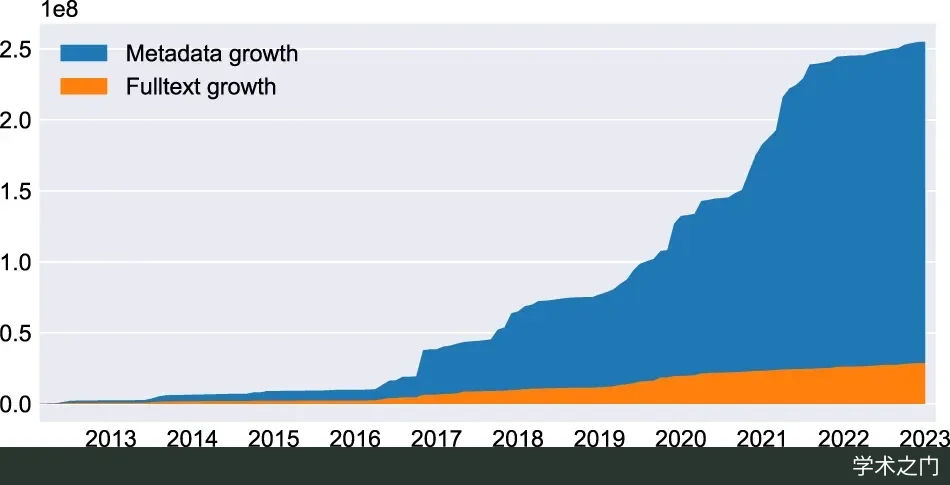
Month-by-month growth in CORE records since February 2012. The “full text” and “metadata only” record categories do not overlap and are shown stacked (data up to 2023). Figure: Knoth et al., Scientific Data 10:366 (2023), Figure 3, CC BY 4.0.
CORE (core.ac.uk) is a non-profit open access aggregation service operated by the Open University in the UK. It harvests metadata and full texts from institutional repositories, subject repositories, preprint servers and open access journals, and its website currently states that 452 million records are searchable, with more than 57 million full texts. Based on the official API v3 documentation, terms and FAQ page, this article explains how CORE's role differs from that of Google Scholar and Unpaywall, provides reusable search queries, and sets out the compliant ways to retrieve data in bulk and the key points for interpreting results.
Coverage and How CORE Differs from Similar Tools
CORE's data comes from institutional repositories, subject repositories, preprint servers, and open access and hybrid journals. New sources are added mainly on the basis of registries such as OpenDOAR and DOAJ. Technically, they are harvested via the OAI-PMH protocol, with oai_dc as the main metadata format, and RIOXX, which is commonly used by UK repositories, is also supported. For full text, only PDFs are currently processed. When citing figures on CORE's size, state which page they come from: the homepage and the API service page give 452 million searchable papers, more than 57 million full texts, more than 16,000 data providers, and coverage of more than 150 countries, while the 15th-anniversary paragraph on the “About” page says “more than 400 million records and more than 40 million machine-accessible full texts”. A paper published by the CORE team in Scientific Data in 2023 gives a more detailed breakdown: as of February 2023 there were 291 million metadata records, about 13% of which had full texts that CORE had successfully downloaded and converted to text, and an estimated further 48% or so of records pointed to free-to-read full-text links hosted by third parties.
The FAQ page states the difference between CORE and Google Scholar quite directly: Google Scholar crawls the web and indexes the full texts of papers, while CORE also indexes the metadata provided by repository and journal systems. CORE's value lies in making research information machine-readable and making it available for others to build on through its API and datasets. The paper mentioned above also points out that Google Scholar provides no API and does not allow its website to be crawled. On this basis, the two tools can be used for different jobs: to cover subscription journals and track citations, general-purpose engines such as Google Scholar remain the main choice; to stay within open access and retrieve metadata or full text programmatically, use CORE.
The difference between CORE and Unpaywall is that one “looks up links” while the other “stores full texts”. According to the comparison in the Scientific Data paper, Unpaywall's API mainly answers whether a given article has a free-to-read version and where it is, and does not collect full texts. CORE downloads, extracts and hosts full texts, and its API returns complete records with enriched fields. CORE also has a tool that serves a purpose similar to the Unpaywall extension: the CORE Discovery browser extension (supporting Chrome, Firefox and Opera) points out free copies on paywalled pages. According to the official description, it gives priority to open content from CORE's approved data providers and, when none is found, turns to external services beyond CORE. The corresponding API endpoint is POST /v3/discover, which looks up full-text links by DOI. If you only have a list of DOIs and just want to know whether they can be read for free, Unpaywall or CORE Discovery is enough; you only need CORE's API or datasets if you want the full text for text mining.
Web Search and the API Query Language
The web entry point is core.ac.uk/search. The left side of the results page lets you filter by author, publication venue, publication date and field of study. Each result is marked either “Get PDF” or “Full text link”: the former usually gives direct access to the PDF stored by CORE, while the latter redirects to the source site. This article did not find an official syntax guide published separately for the web search box. The field syntax below follows the API documentation; on the website, you can start by narrowing the scope with keywords plus filters. The website has human verification enabled for automated access, so bulk collection should go through the API instead.
The API v3 search endpoint is GET https://api.core.ac.uk/v3/search/{entityType}/, where entityType can be works, outputs, data-providers or journals. Here, works are deduplicated and enriched “works”, with copies of the same paper held in multiple repositories merged into a single record; outputs are individual records harvested as-is from each data provider, neither deduplicated nor enriched. Common parameters are q (the search query), limit (results per page, default 10), offset (starting position) and stats. When the query is too long, you can instead send a POST request to the same path with the parameters in a JSON request body. When you only want to see distributions rather than individual records, use POST /v3/search/{entityType}/aggregate to get counts by fields such as year, author, document type, language and publisher.
The query language has five key points. First, a field name followed by a colon performs a field search, for example title:, abstract:, fullText:, authors:, doi:, documentType:, dataProviders: and yearPublished:. Second, multiple unquoted words match any or all of the words, while double quotes perform a phrase match in the original word order. Third, use AND and OR to combine conditions, and parentheses to control precedence. Fourth, expressions such as yearPublished>2018 perform range searches. Fifth, exists:fullText requires a record to have full text, and substituting another field name checks whether that field exists. If no field name is given, search terms are matched across all searchable fields.
Example 1: Look up a work by DOI and see how many sources it merges (tested without a key on October 23, 2026; returned 1 work)
https://api.core.ac.uk/v3/search/works/?q=doi:"10.1038/s41597-023-02208-w"&limit=1
Example 2: Title contains either of two topic terms, published 2015–2024, with full text (example from the official documentation)
curl -G "https://api.core.ac.uk/v3/search/works/" \
  -H "Authorization: Bearer $CORE_API_KEY" \
  --data-urlencode 'q=(title:"machine learning" OR title:"artificial intelligence") AND yearPublished>="2015" AND yearPublished<="2024" AND _exists_:fullText' \
  --data-urlencode 'limit=5'
Example 3: Find research papers with license information among source records (example from the official documentation; topic terms can be added)
https://api.core.ac.uk/v3/search/outputs/?q=documentType:"research" AND _exists_:license&limit=25
Example 4: Check the distribution by year and document type before deciding whether to download in bulk (aggregate endpoint; request body format taken from the official documentation)
curl -X POST "https://api.core.ac.uk/v3/search/works/aggregate" \
  -H "Authorization: Bearer $CORE_API_KEY" \
  -H "Content-Type: application/json" \
  -d '{"q": "title:\"open access\" AND yearPublished>=2020", "aggregations": ["yearPublished", "documentType"]}'
Examples 1 and 3 can be pasted directly into the browser's address bar. When calling the API with curl or from a program, the spaces, quotation marks and parentheses in the query must be URL-encoded, which curl -G --data-urlencode handles automatically.
Bulk Retrieval of Metadata and Full Text
You can call the API without registering, but there are two differences: first, the rate limit is lower; second, you cannot get full text. Without a key, the fullText field only returns “Not available for public API users.” The documentation states that full text is not available to unauthenticated users, and this article's test confirmed this. After applying for a personal API key through the registration form on the website, the preferred approach is to send it in the request header Authorization: Bearer <API_KEY>; only use the api_key parameter if you cannot set request headers. Do not let your key leak. Rate limiting is measured in tokens: the documentation says a simple query costs about 1 token and a complex query 3–5, while recommendations, scroll searches and batch queries cost more. These costs are adjusted according to server load, so rely on the rate-limit HTTP headers returned with each response. The API service page additionally states “one batch request or five single requests every 10 seconds”. The specific quotas for each type of user are listed on the Rate limits page of the documentation. Higher rates for registered institutional users usually require payment, though CORE's Supporting and Sustaining members get them for free.
Pagination uses offset together with limit. The OpenAPI specification notes, on the data provider search endpoint, that a regular search can retrieve at most 10,000 results, with at most 100 per request. Beyond that range, the official example notebook uses “scan and scroll” searches to export all record identifiers for a given data provider; such queries consume more tokens and are subject to stricter limits. For even larger volumes, the official recommendation is to use the CORE datasets directly rather than forcing your way through the API page by page.
Full-text PDFs have a dedicated download policy: use the original link given in the record's downloadUrl first. If the original link is inaccessible, you can download the file from CORE with GET /v3/outputs/{id}/download, which counts against your tokens at a higher cost. Bypassing the API to bulk-scrape PDFs directly from CORE's file servers is explicitly prohibited: such access will be blocked and the associated API key deactivated. If you need structured text, GET /v3/works/tei/{id} returns TEI structured data parsed from the PDF.
For data covering the whole database, use the CORE datasets. Older data snapshots are free under the ODC-By license and can be used for both commercial and non-commercial purposes, but CORE must be acknowledged. Newer snapshots require institutional registration and the purchase of a license, and are free for Sustaining members. The terms also state that dataset downloads are currently available only to registered institutions in non-sanctioned countries, and that individual users should use the API instead; the FAQ page says the public dataset aims to be updated at least once a year. Use of the API and of non-ODC-By datasets both require a license, but the following two cases are usually free: individuals using CORE in a private capacity and acknowledging CORE; and public research institutions carrying out research to produce papers or public reports. If a product may be monetized, serves only your own institution, or overlaps with the functions of CORE's existing services such as its API, recommender or search, contact CORE first. Note also that CORE does not own the rights to the works it aggregates; the datasets are intended only for machine processing, not for reading the original texts, and users are responsible for making sure they do not infringe third-party rights. The terms also mention that CORE is revising its licensing framework: future versions plan to release factual metadata under CC0 or ODC-0, while abstracts and full texts will only be provided conditionally for lawful text and data mining. Check the original terms again before use.
Interpreting Results and Limitations
Before interpreting results, distinguish between works and outputs. On October 23, 2026, the same DOI (the CORE team's 2023 Scientific Data paper) was searched in each: works returned 1 work, merging two sources, DOAJ and the Open University's repository Open Research Online, while outputs returned 4 source records. Use works when counting “how many publications there are”; use outputs when tracing which repository a copy came from or checking the original metadata.
The same work record also reveals common problems with aggregated metadata. In the author list, the same person appears twice, once as “Knoth, Petr” and once as “Petr Knoth”; documentType is empty; and publishedDate is recorded as 2023-01-01, whereas the paper was actually published on June 7, 2023. The documentation explains that this field takes the earlier of the dates from Crossref and OAI-PMH; in this case the source very likely provided only the year, so it is better to use yearPublished when filtering by date. Document types are inferred by a machine learning classifier or from fields such as dc.type, and may likewise be misclassified. citationCount, fieldOfStudy and magId come from Microsoft Academic Graph; the documentation marks them as deprecated and no longer updated. This record's citationCount is 0, for instance, so these fields cannot be used for citation analysis.
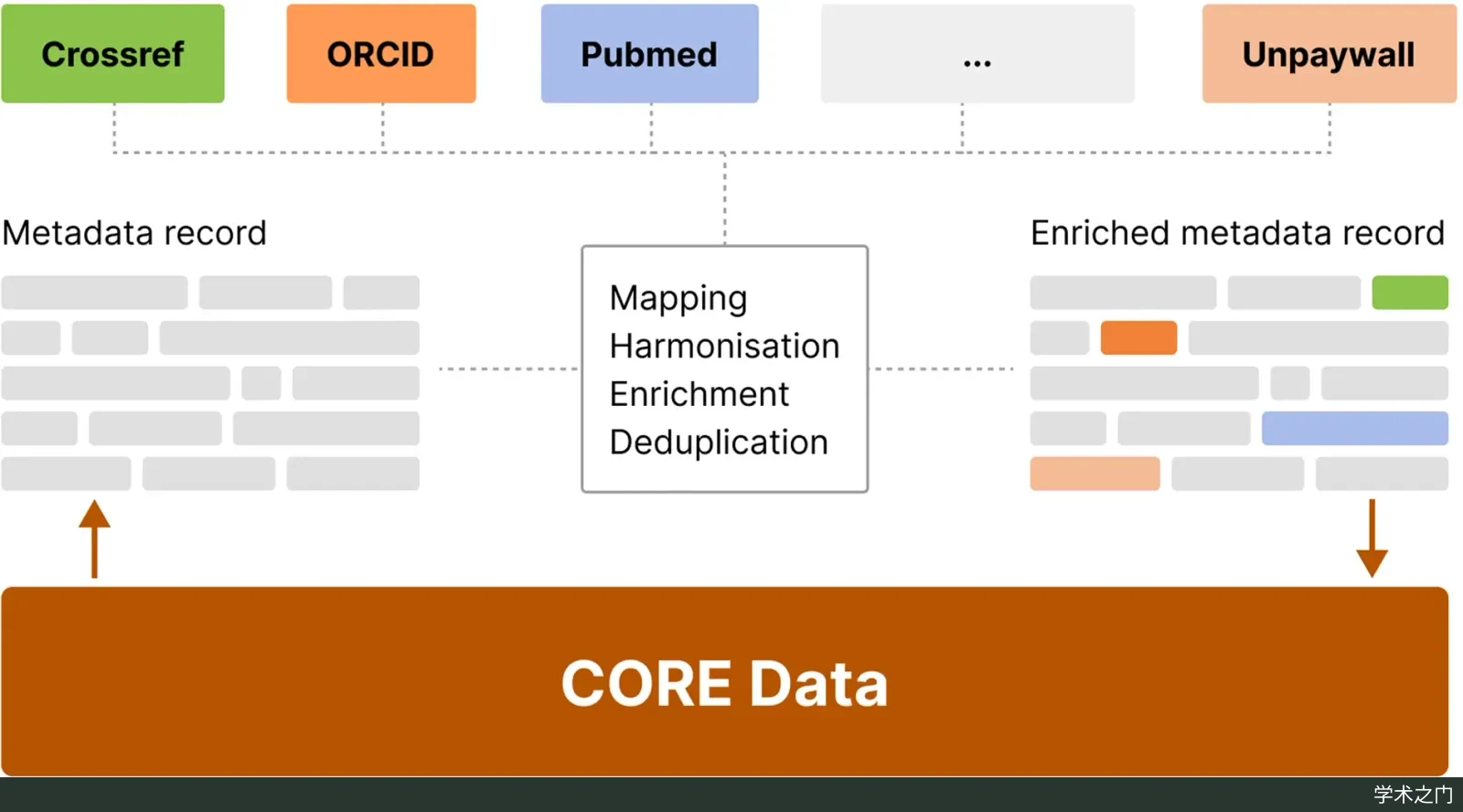
CORE's offline enrichment process: records are first matched with Crossref by DOI, or by title, authors and year when there is no DOI, and fields such as ORCID, citations and subjects are then added from external databases. Figure: Knoth et al., Scientific Data 10:366 (2023), Figure 10, CC BY 4.0.
Full-text coverage should be understood as “PDFs that CORE can download and extract text from”. The FAQ page explains that only PDFs that can be publicly downloaded and whose text can be extracted without OCR count as full texts, so exists:fullText will miss open copies that only have external links or only exist as HTML. License information is often not provided in machine-readable form, and the license field is frequently empty (as it was for the source records above), so check the license on the source page before reusing full texts. Repositories also contain grey literature that has not been peer reviewed, and journal articles, theses and preprints are mixed together in the same results, so you need to check the source and type of each item.
There are also limits on timeliness and error correction. The re-indexing of each repository is scheduled by a scheduler, and indexing a single repository can take anywhere from a few hours to a few weeks, so the newest papers will appear with a delay. CORE does not modify individual records: errors in metadata must be corrected at the original repository or journal, and the corrections take effect after the next synchronization. A full-text link that returns 404 means the full text has been removed from CORE, although the metadata is usually still retained.
References
-
CORE. About CORE. Accessed 2026-10-23.
-
CORE. CORE API v3 documentation (including the query language, Rate limits, PDF download policy and other pages). Accessed 2026-10-23.
-
CORE. CORE API v3 OpenAPI specification (version 3.0.0). Accessed 2026-10-23.
-
CORE. CORE API. Accessed 2026-10-23.
-
CORE. CORE Dataset. Accessed 2026-10-23.
-
CORE. Terms & Conditions. Accessed 2026-10-23.
-
CORE. FAQs (page marked as updated 2026-03-23). Accessed 2026-10-23.
-
CORE. CORE Discovery. Accessed 2026-10-23.
-
Knoth P, Herrmannova D, Cancellieri M, et al. CORE: A Global Aggregation Service for Open Access Papers. Scientific Data, 2023, 10: 366. Published 2023-06-07.
-
Gateway to Scholarship · A guide to scholarly life in the age of intelligence
-
This information was compiled and published by Scholay, the one-stop academic platform. If it infringes any rights, please let us know and it will be taken down.
-
This information is also published on Enter Scholar, a community for scholars in the age of intelligence