Suppose a high-energy physics review seeks 2016 records authored by Gaiotto or containing defect in the title. It is tempting to type author, title and year in their spoken order. In a real query to INSPIRE's literature API, attaching the year only to the title returned 203 records. Grouping author and title first and then applying the year returned 58. The difference is the scope of a date condition.[2]
Choose the collection and the author condition
INSPIRE grew out of SPIRES and is operated collaboratively by CERN, DESY, Fermilab, IHEP, IN2P3 and SLAC. It interlinks literature, conferences, institutions, journals, researchers, experiments, jobs and data. Begin a paper trail in the literature collection and follow people or meeting links as needed. Finding a researcher profile identifies a person, not the subset of papers meeting a date condition.[1][2]
Free text is useful for exploring vocabulary. Fielded terms are clearer once an author and title criterion are known. Ordinary author searching allows variants such as abbreviated names. Use fa for the first author and ea for the exact name as recorded, including the documented comma between surname and given name. Broad matching can recover variants; exact matching can miss a different abbreviation. First-author searching also drops eligible coauthored papers when authorship in any position is the real question.[2][3]
Give the date an explicit scope
Mixed logical operations are grouped from the right. In a gaiotto or (t defect and date 2016), every match on the author branch survives. Only title matches need the year. In (a gaiotto or t defect) and date 2016, the year applies to both. The two queries returned 203 and 58 records on 21 November 2026. A shared high-ranking result would not reveal the difference in eligibility.[2]
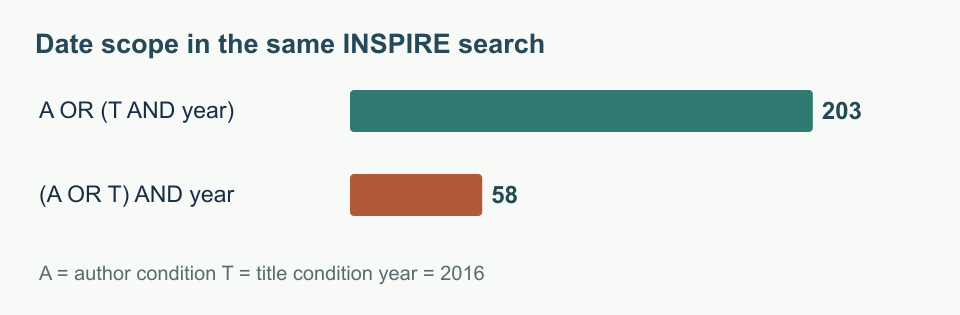
Figure: Retrieved counts for the two date groupings.
Test a query with one author match outside the year and a second paper in the year with the right title but another author. Keep these boundary cases in a search log for the next revision. Date fields matter independently of parentheses. Use de for the earliest date on a record and jy for the journal publication year. A preprint and its eventual journal article can belong to different annual reviews depending on which date the protocol means.[2] For a study of publication lag, retain both dates in separate columns and calculate the interval instead of asking one field to do both jobs.
An asterisk can truncate terms, including within a term. Inspect unexpected matches when using it broadly. Document types answer a different question: r identifies reviews, t theses, c conference papers and p material published in a refereed journal. Record such restrictions. Limiting a historical search to journal papers from the outset can hide work first encountered through a conference or preprint.[2]
Follow citations from an identified seed
The query refersto:recid:1262571 finds papers citing that record; it returned 403 in our check. With several seed papers, an article citing two seeds still appears once. The result is a list of following papers rather than the sum of all citations to the seed set. Opening a result's references is a practical check on the direction of the operator.[2]
The documented syntax topcite 60->173 restricts citation counts to a range. Citation Summary provides statistics including the h-index for the current records. Its population changes with name matching, dates, document types and parentheses. Save the query, search date and record identifiers alongside the count so a colleague can understand what the reported 58 records represent.[2][3]