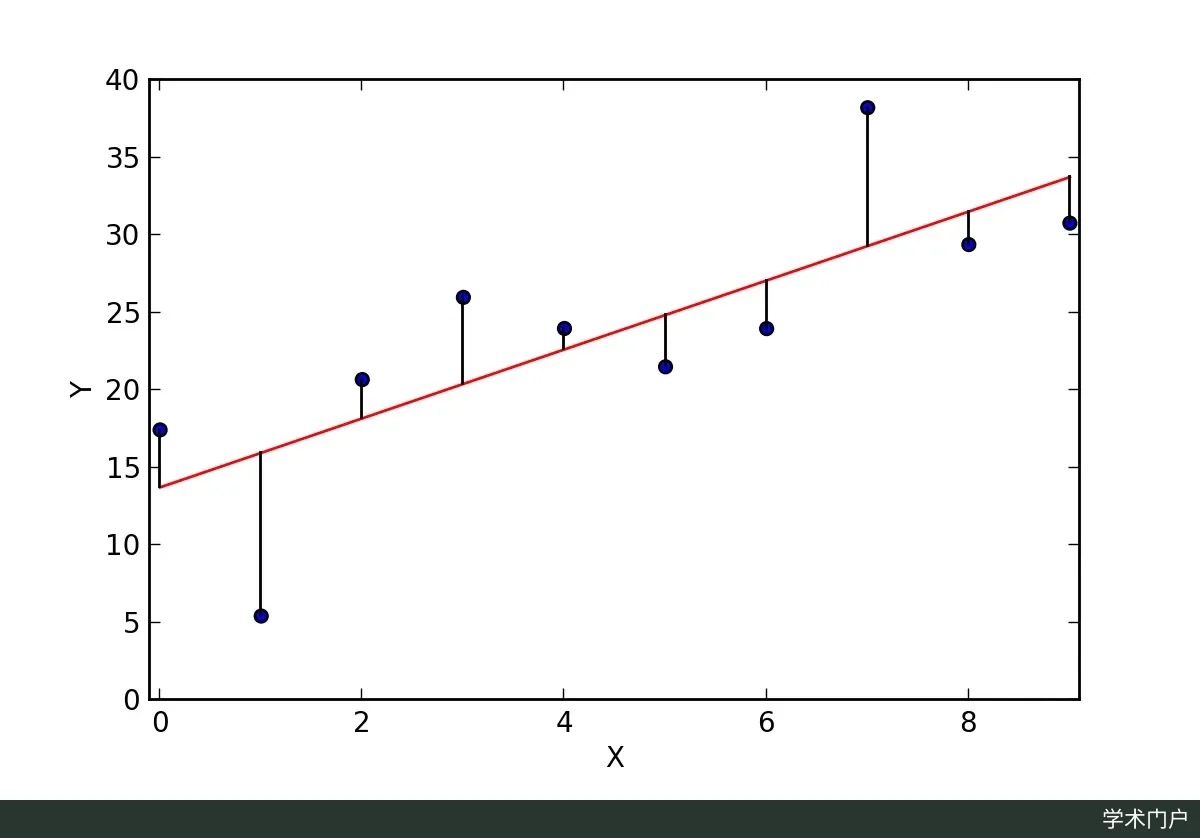
Schematic of a linear regression fit and residuals. Figure: Thomas.haslwanter, source: Wikimedia Commons, license: CC BY-SA 3.0.
Cross Validated (stats.stackexchange.com) is the statistics Q&A site in the Stack Exchange network, covering statistical analysis, experimental design, machine learning, data visualization, and probability. It is not a chat forum: answers are ranked by voting, with the aim of leaving a long-lived, searchable knowledge base. Drawing on official help pages and Meta discussions, this article covers who uses the site, how to write questions, rules and etiquette, and the value and limits for scholars.
Community focus and who uses it
The official help page describes Cross Validated’s audience as “people interested in statistics, machine learning, data analysis, data mining, and data visualization.” On-topic questions include applied or theoretical statistical analysis, experimental design, data collection, data mining, machine learning, data visualization, probability, mathematical statistics, and statistical and data-driven computation. The same page states that anyone may ask, regardless of skill or experience, but some questions are simply better than others.
The site tour defines itself as a place “only for getting answers,” and says outright “this is not a discussion forum” and that there is “no chit-chat.” Good answers rise by voting; askers can mark one answer as accepted, but the tour notes that acceptance does not mean it is the best answer—only that it worked for the asker. Per Stack Exchange’s official API on 17 October 2026, the site had about 219,700 questions, 220,100 answers, and 438,000 registered accounts, of which about 68,000 questions were counted as “unanswered.” These are live cumulative figures and change over time.
Users are not limited to statistics majors. The community FAQ thread How to ask a "good" question on CrossValidated? was started by user posdef in November 2012; he wrote that he was not trained as a statistician and often felt out of sync with community members. In a highly voted answer, naught101 replied “Do you need to be a statistician? Of course not”: the site is for anyone interested in statistical practice or theory who is willing to learn. That captures a typical tension: askers come from many fields, while answerers tend to probe details by rigorous statistical standards.
How to write questions—and where the line is
The first step is search. The official How do I ask a good question? page requires a thorough search first, and asking you to say in the question what you found and why it was not enough—showing homework and avoiding answers that restate the obvious. Each question may have up to five tags; in the FAQ thread above, Stephan Kolassa suggests picking tags, then—before posting—searching the site with those tags in square brackets (e.g. [regression]), because someone has often asked already.
For the body, naught101’s order in the FAQ thread is a useful template: state what you want to achieve; say whether it is homework, work, or self-study; briefly describe the data and each variable, ideally with a few rows of example data, and name the programming language; then state only one core question, marking side questions as secondary. He also suggests writing down “known knowns” and “known unknowns”—what you already know, and which methods you suspect you need but do not yet know; define terms and symbols, expand abbreviations on first use, and write math in TeX between dollar signs; drop apologies and thanks that add no information. The official help page is shorter: be specific, and explain why the question is useful to more people than you.
The title decides whether others click. Andre Silva’s tips in the same thread include: put topic keywords where they stand out, keep it short, put important words first, be concrete; avoid starting with “How do I...”; do not beg or stress urgency in the title. His example turns the vague “Business Forecasting” into “How to incorporate seasonal patterns in forecasts?”. These are community experience, not hard rules.
Narrow the scope. What types of questions should I avoid asking? says: if you can imagine a whole book answering your question, you asked too much; “what’s your favorite,” “I use this, what do you use” questions are easy to flag or delete. In February 2025, Rick Hass discussed “help me with my data” questions on Meta; Nick Cox’s accepted answer notes that such posts often feel like “how should I do my project,” and are often closed as needing details/clarity or needing more focus—yet he also argues that questions with complete or example data are often good, because answerers can analyze on the spot, discuss limits, and help readers in other fields.
Software questions have a bright line. Per the help page, when R, SAS, Stata, SPSS, or similar is involved, ask here if statistical expertise is needed to understand or answer; send algorithm implementation, routine data wrangling, or language details to Stack Overflow; pure math to Mathematics; software bugs to the vendor. Requests for a specific dataset are off topic. The help page also discourages posting the same question on multiple Stack Exchange sites: pick the best site, and let migration handle the rest if needed.
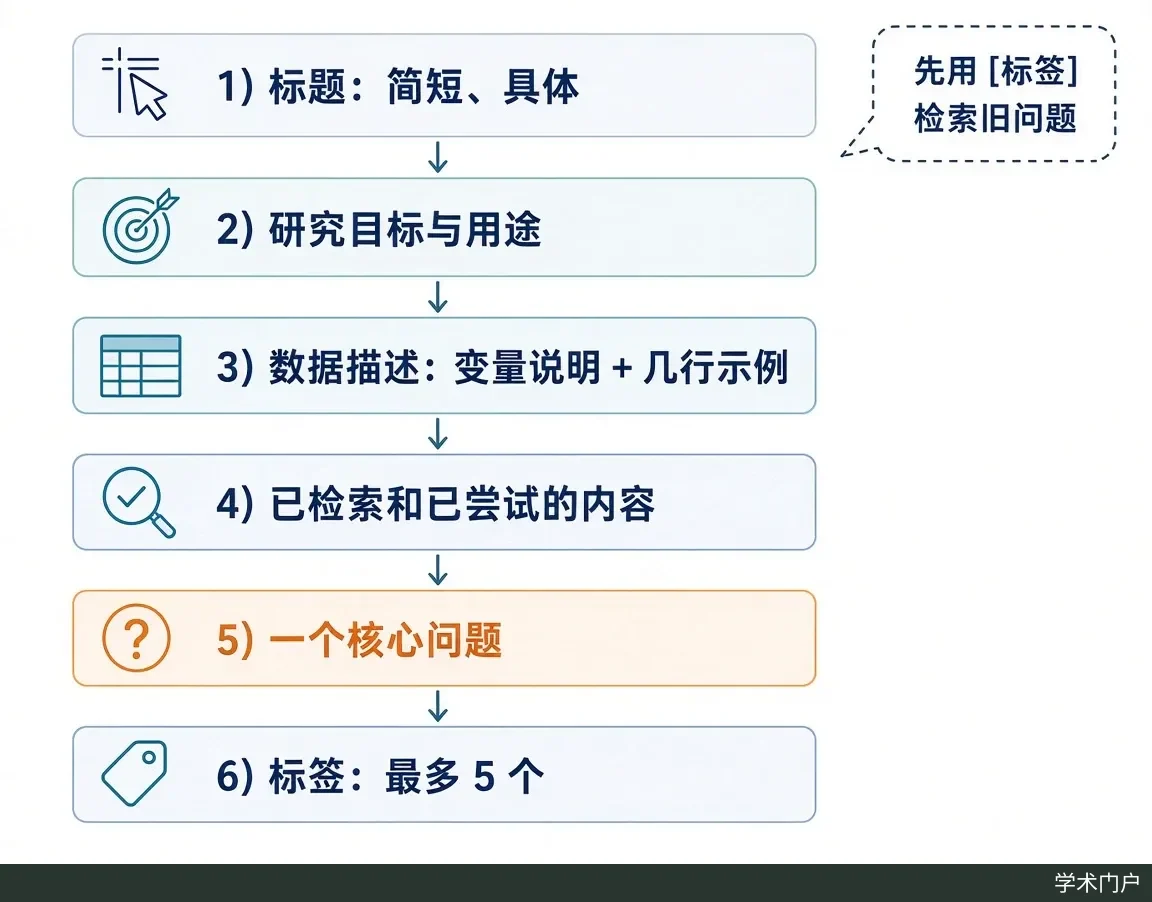
Parts of a good question, drawn from Cross Validated’s official asking guide and the Meta FAQ thread. AI-generated schematic.
Participation rules and community etiquette
Privileges unlock with reputation. Thresholds listed on the tour include: 15 to upvote, 50 to comment on others’ posts, 125 to downvote (downvoting an answer costs you 1 point), 2000 to edit others’ posts, 3000 to vote to close, reopen, or migrate, 10000 for moderator tools. You may always comment on your own questions and answers. The Code of Conduct says comments are for requesting clarification, constructive criticism, or minor extras; they are usually temporary and may be deleted when no longer needed.
Homework is welcome if it follows the self-study rules. The help page requires a self-study tag on homework-style questions; the tag wiki further says: try seriously yourself and show what you tried, ask about the specific sticking point, say honestly whether it is coursework and cite the textbook or materials, quote the problem verbatim rather than paraphrasing, and know your school’s rules on outside help and plagiarism before asking. Community practice is to give useful hints, not a full solution; only the asker should add the tag.
Generative AI may be used, but must be disclosed. Under Cross Validated’s generative AI policy, AI-generated content must clearly mark which parts came from AI and name the tool; undisclosed content may be deleted, reputation from it revoked, with possible moderator warnings and suspensions for repeat offenders. The policy also stresses that posting an answer means standing behind its relevance and accuracy—if you cannot, do not post. The help page notes that site policies differ; some sites ban AI-generated content entirely.
On etiquette, the Code of Conduct asks for friendliness and respect, and using flags so moderators handle harmful content; community tips in the FAQ thread also include: do not leave names or emails in posts, and do not ask for private replies, because Q&A is public. Watch content licensing: per the official licensing note, contributions on or after 2 May 2018 use CC BY-SA 4.0 (earlier ones used CC BY-SA 2.5 and 3.0). Reusing others’ Q&A requires attribution and share-alike; the help page also requires citing sources when you quote others’ material in a post.
Reference value and limits in practice
For scholars, Cross Validated’s most direct value is a tag-organized, vote-ranked statistics Q&A library: for model choice, test assumptions, or interpreting results, existing threads often come first. The help page explicitly welcomes peer-reviewed literature or online resource links in answers, so strong answers often point readers back to primary sources. As Nick Cox notes, questions with data can be analyzed on the spot, limits discussed, and readers across fields helped. In this author’s view, stating goals, data structure, and the core question to community standards is itself useful practice for clarifying research design.
Limits are equally clear. First, answers come from volunteers and are not peer-reviewed; the tour already says “accepted” only means it worked for the asker. When writing a paper, go back to the primary literature cited in the answer—do not cite the Q&A post itself as methodological authority. Second, closures are not rare: in Stack Exchange’s Cross Validated 2025 moderation data published 12 January 2026, the “Question closed” row showed 935 by moderators, 606 by Community, and 32 by regular community members. Third, the site runs in English, content is public under CC BY-SA, and unpublished or sensitive data should be anonymized or replaced with simulated data before posting (this last point is this article’s advice).
Fourth, activity is falling: new questions may wait longer or get no answer. Franck Dernoncourt’s Meta Stack Exchange thread (posted 3 May 2025, updated 5 April 2026) reports, by his own counts, monthly questions across the Stack Exchange network falling from 286,300 in March 2017 to 9,883 in March 2026; that is user-compiled, not an official report. On 13 April 2026, Rick Hass asked on Cross Validated Meta whether, with fewer Q&A, “custodial” work—answering old questions, voting to close—is still worth doing. Accepted answer User1865345 argued yes: that is how the community keeps a high-quality library; Ben Bolker suggested marking old questions still waiting for asker clarification, with no reply for years, as needing details/clarity and closing them. For askers, that means writing a complete post once is likelier to get an answer than posting thin and filling in later.
References
-
Cross Validated. What topics can I ask about here? Help Center. Accessed 2026-10-17.
-
Cross Validated. How do I ask a good question? Help Center. Accessed 2026-10-17.
-
Cross Validated. What types of questions should I avoid asking? Help Center. Accessed 2026-10-17.
-
Cross Validated. Tour. Accessed 2026-10-17.
-
Cross Validated. 'self-study' tag wiki. Accessed 2026-10-17.
-
Cross Validated. What is this site's policy on content generated by generative artificial intelligence tools? Help Center. Accessed 2026-10-17.
-
Stack Exchange. Code of Conduct. Last updated 2023-05-31.
-
Cross Validated. What is the license for the content I post? Help Center. Accessed 2026-10-17.
-
posdef et al. How to ask a "good" question on CrossValidated? Cross Validated Meta, 2012-11-05.
-
Rick Hass, Nick Cox. "Help me with my data" questions. Cross Validated Meta, 2025-02-20.
-
Hoid (Stack Exchange). 2025: a year in moderation. Cross Validated Meta, 2026-01-12.
-
Rick Hass et al. Unanswered questions, low volume, and custodial work. Cross Validated Meta, 2026-04-13.
-
Franck Dernoncourt et al. The number of questions has decreased 30-fold: where did users go and what can be done to prevent that? Meta Stack Exchange, 2025-05-03 (updated 2026-04-05).
-
Stack Exchange. API /2.3/info?site=stats. Read 2026-10-17.
-
Academic Gateway · a living guide for scholars in the intelligent age
-
Information compiled and published by the Scholay academic one-stop platform; report infringement for takedown.
-
Also published on Enter Scholar, a scholars’ community for the intelligent age