Which studies did a paper draw on, and which later papers cited it? A single spreadsheet column called citations can obscure two different directions. OpenCitations stores directed relationships. We queried one DOI and obtained 57 and 45. Both numbers describe the same paper: one counts arrows entering it and the other counts arrows leaving it.[1][3]
Start from an identified work
The Research Centre for Open Scholarly Metadata at the University of Bologna manages OpenCitations. Its citation data is open under CC0. Index records the links between works. Meta supplies identifying bibliographic information such as titles, authors and venues. The website provides a search entry point for an occasional lookup, while the Index API makes the operations reproducible.[1][2][3]
Identify the starting work before choosing an operation. The API documents DOI, PMID, ISSN, ISBN and OMID identifiers, but a journal and an individual paper are different levels of description. The documentation's sample identifier is doi:10.1108/jd-12-2013-0166. Keep its type prefix and the operation in the extraction log. A bare number is easy to misassign when combining tables from different indexes.[3]
Read the arrow from its starting end
Append the identifier to citations/ under Index v2 for works citing the seed. A relationship's citing end identifies the source and its cited end identifies the target. The seed is the target in this result set. Replace the operation with references/ to retrieve the seed's outgoing references; it now occupies the citing end. Sketching a real result row is more reliable than memorizing competing labels such as forward and backward.[3]
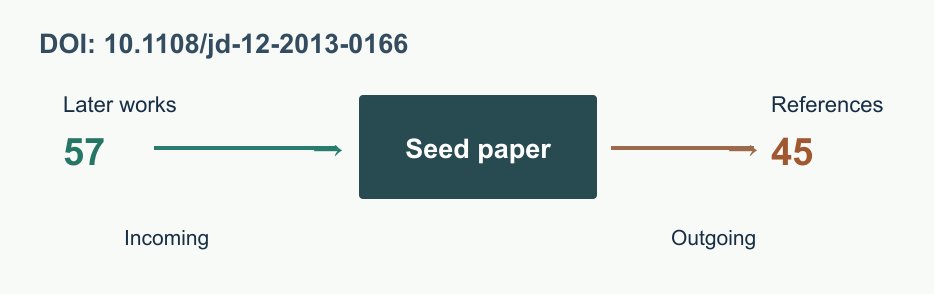
Figure: Incoming and outgoing counts for the same DOI.
For totals, use citation-count/ and reference-count/. On 21 November 2026 the count fields for this DOI returned 57 incoming and 45 outgoing links. Their difference is not a net measure of influence. Nor does a later citation necessarily endorse the seed. To interpret a link's scientific role, read how the citing paper uses its source.[3]
Keep a reproducible edge table
Use one row per directed edge, with citing identifier, cited identifier, source and query date. Read later work by resolving the citing end of incoming edges; trace methodological ancestry through the cited end of outgoing ones. Two seeds can cite the same earlier paper. Preserve both edges as evidence, then deduplicate that earlier work in the reading list. Keeping only a list of distinct titles would discard the path by which each one was discovered.[1][3]
The API can return JSON or CSV. Its documentation specifies 180 requests per minute per IP and encourages applications to send an access token in the authorization header. For full-collection work, use a data dump. The Index release dated 28 July 2026 lists over 2.5 billion citation links. Meta has a separate release schedule. Record both versions to explain differences between a fixed analysis and a later live query.[3][4]