Give each file a destination
An interview produces a recording, an assistant makes a transcript and an analyst builds a coding table. All three record the same conversation, yet different people may be allowed to open them. If the project lead leaves tomorrow, where will a successor find the original, and how will they decide whether to share a table? Research Data MANTRA, a free online course maintained by the University of Edinburgh’s Research Data Service, is well suited to a concrete question like this. Its homepage records an August 2026 update.[1][2]
There are seven learning units with three topics apiece. The homepage offers starting points for information professionals, senior academics, career researchers and postgraduate students. A student can inventory their files and a supervisor can use that inventory to discuss custody and handover. Start with research data in context and data management planning. Identify what the project produces, why it is worth preserving and how funding requirements shape everyday work. Replace “the team will keep it” with a responsible role, a location and a handover date.[1][2]
The third unit covers names, versioning and cloud collaboration. Give an audio file and transcript a common interview identifier and keep the name key in a separately restricted location. When the transcriber corrects a misheard word, a new version and change description help the analyst trace affected codes. The fourth unit introduces archiving, file formats and documentation. Hand one column to a colleague who did not conduct the interview. Can they find its meaning and accepted values, including the distinction between a question never asked and one left unanswered?[1][2]
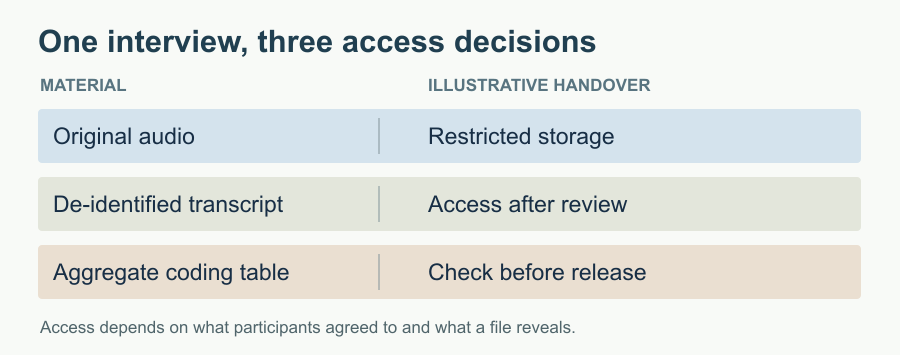
Figure: A sample handover plan for interview materials.
Decide access for each item
Unit five covers backup, passwords, encryption and secure collaboration. Unit six covers sensitive data, consent and safeguards. A renamed recording can still identify someone by voice, and a rare job and location can identify someone in a transcript. Record the permitted purposes and authorised access separately. Restricted storage, reviewed access and a release check in the figure are choices for this fictional project. Test restoration by retrieving a copy and finding its associated documentation.[1][2]
The last unit covers benefits and barriers to sharing, FAIR principles and open licences. A discoverable catalogue record can describe an item and explain how to request restricted access. Before releasing an aggregate table, compare the columns with participants’ permissions and project commitments. Record the decision maker and the date for review. Cataloguing, access decisions and open downloads can each be handled individually.[1][2]
Separate practicals provide open datasets, web exercises or workbooks for Python, R, SPSS and ArcGIS. The Python and R practicals use the same data for cleaning, transformation and plotting. Use the familiar tool and document the steps for a successor. The homepage’s Creative Commons badge links to CC BY 4.0. Starting with the supplied open sample lets a team practise documentation before applying the approach to its own interview project.[1][3]