Project overview

The Atlas main building at Eindhoven University of Technology (photographed in 2020). Coursera course pages list instructor Daniel Lakens’s affiliation as this university. Figure: Wolkenbrij, Wikimedia Commons, CC BY-SA 4.0.

Improving Your Statistical Inferences is an English-language statistics course by Daniel Lakens of Eindhoven University of Technology on Coursera. Its eight modules cover p-values, effect sizes, confidence intervals, sample size and statistical power, preregistration, and open science. The companion course Improving Your Statistical Questions has six modules and focuses on designing more informative studies. Both are labeled intermediate; free learning options and certificate prices remain to be verified.
The first course page marks it intermediate and assumes some related background. It suggests about three weeks at roughly 10 hours per week, with eight modules and 24 assessments. Modules cover, in order: frequentist statistics, p-values, and Type I and Type II errors; likelihood and Bayesian statistics; multiple comparisons, statistical power, and preregistration; effect sizes (Cohen’s d and correlation coefficients); confidence intervals, sample-size justification, and p-curve analysis; philosophy of science and theory building, with an equivalence-testing assignment; open science, covering replication and publication bias, with a peer-reviewed assignment; and finally a practice exam and a graded final exam. Per the course description, assignments include simulating t-tests to observe p-value distributions, computing likelihood ratios, experiencing problems from “optional stopping,” doing a priori power analysis, and preregistering a study and sharing data on the Open Science Framework.
The companion course Improving Your Statistical Questions has six modules and 12 assessments, suggested as about two weeks at roughly 10 hours per week. It starts from “what question is this study actually meant to answer?” and then covers risk prediction and falsifiability, the smallest effect size of interest (SESOI) and equivalence testing, error-rate justification, power analysis and simulation (including power for ANOVA designs), meta-analysis and detection of publication bias, and computational reproducibility, philosophy of science, and research integrity, ending with a graded final exam. The course page says the course stands alone but recommends taking the first course first if you have time; it assumes learners already know t-tests, ANOVA, and basic research design, and treats R only as a “calculator for editing code,” with no programming requirement.
| Item | Improving Your Statistical Inferences | Improving Your Statistical Questions |
|---|---|---|
| Modules and assessments | 8 modules, 24 assessments | 6 modules, 12 assessments |
| Suggested workload on the page | About 3 weeks, 10 hours per week | About 2 weeks, 10 hours per week |
| Level | Intermediate | Intermediate |
| Instruction language | English; the blurb says videos have Chinese subtitles; the page also marks “27 languages available” | English; the page also marks “21 languages available” |
| Assignment formats | Module quizzes, assignment answer sheets, 1 peer review, practice exam and final exam | Assignment answer sheets, plugin-style exercises, final exam |
| Free learning options | To be verified | To be verified |
| Certificate cost | To be verified (no price shown on the page) | To be verified (no price shown on the page) |
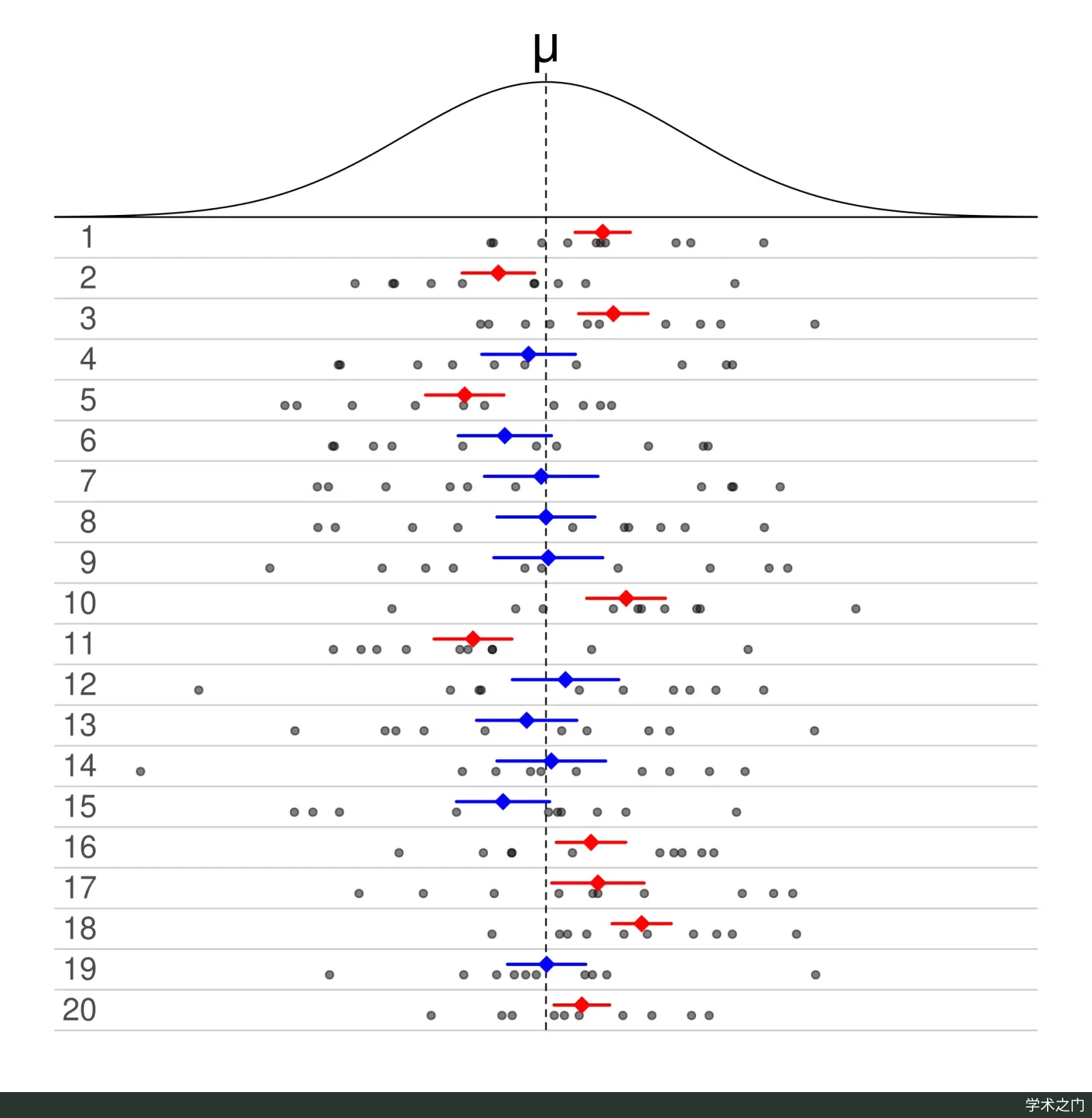
Fifty-percent confidence intervals for the means of 20 normal-distribution samples: blue intervals cover the population mean; red ones do not. Assignment 5.1 in module 5 of the first course (Confidence Intervals and Capture Percentages) likewise uses simulation to illustrate what confidence intervals mean. Figure: FRuDIxAFLG, Wikimedia Commons, CC BY-SA 4.0.

Why they help
These two courses suit graduate students and researchers who already know introductory statistics and are doing empirical work. The first helps clarify which questions p-values, effect sizes, confidence intervals, Bayes factors, and likelihood ratios each answer, and practices using power analysis to set sample size and using preregistration and sequential analysis to control false positives. The second focuses on the stage before data collection: setting a smallest effect size of interest, justifying sample size and error rates, and evaluating existing literature while accounting for publication bias. Readers with no statistics background should not start here; the second course page also states clearly that it is not an introductory statistics course.
Fees and free learning options should be confirmed on the course pages before enrolling. Both course pages show the courses as included in a Coursera subscription plan (exact plan name to be verified), but neither shows a standalone certificate price directly. Coursera FAQ text notes that obtaining all materials, submitting assignments, and earning a certificate requires purchasing the certificate version; eligible learners may start with a free trial, and some courses also offer a “full course, no certificate” option. Coursera Help Center notes that most courses offer a preview of only the first module, and “full course, no certificate” is available only for some courses. Whether these two courses can be completed for free and what certificates cost are both marked here as to be verified; learners with financial hardship can check the course pages for financial-aid application options.
If the main goal is to read the content, Lakens also has an open textbook of the same name, Improving Your Statistical Inferences. The site says it integrates the author’s blog, these two MOOCs, and his research, shared under a CC BY-NC-SA license, downloadable as PDF or EPUB, with interactive exercises at the end of each chapter, continuously updated with a revision log. Whether the textbook matches the course videos chapter by chapter remains to be verified; it works well as post-course reference or as prior reading when you are not yet buying a certificate.
References
-
Daniel Lakens. Improving your statistical inferences. Coursera course page, accessed 2026-10-23.
-
Daniel Lakens. Improving Your Statistical Questions. Coursera course page, accessed 2026-10-23.
-
Coursera. Enrollment options. Coursera Help Center, accessed 2026-10-23.
-
Lakens, D. (2022). Improving Your Statistical Inferences. Open textbook, doi:10.5281/zenodo.6409077.
-
Academic Gateway · a living guide for scholars in the intelligent age
-
Information compiled and published by the Scholay academic one-stop platform; report infringement for takedown.
-
Also published on Enter Scholar, a scholars’ community for the intelligent age