
The European Bioinformatics Institute (EMBL-EBI) in Hinxton, UK, which maintains Europe PMC. Photo: Magnus Manske; source: Wikimedia Commons; license: CC BY-SA 3.0.
Europe PMC (europepmc.org) is a free biomedical literature database maintained by EMBL-EBI: it includes all PubMed abstracts, shares full texts with the US PMC, and additionally integrates preprints, patents, clinical guidelines, and funding information. Based on the official manual and API documentation, this article explains how it relates to PubMed, its field search syntax, section-level full-text searching, and text-mining annotations. It also presents 4 search queries and API requests that were actually executed, and covers key points for interpreting results as well as limitations.
Relationship with PubMed and Coverage
Europe PMC and PubMed complement each other; they are not two unrelated sets of data. According to the annual reports published by the Europe PMC team in Nucleic Acids Research, Europe PMC is a member of PMC International, shares full texts with the US PMC and PMC Canada, and provides all PubMed abstracts. The 2020 report further explains that newly received full texts are exchanged daily between the two sites, and that the website merges a PubMed abstract and the corresponding PMC full text onto a single article page. As a result, records that can be found in PubMed generally appear in Europe PMC under the MED source.
Readers familiar with PubMed MeSH searching, introduced previously on this site, should note two differences. First, the official field list has no standalone MeSH field corresponding to PubMed's [mh]: KW: searches both MeSH terms and publisher-supplied keywords, and CHEM: searches MeSH substance terms, so results will be broader than those of a pure subject-heading search. Second, the API's synonym parameter is off by default; only when it is set to true are search terms expanded with MeSH terms and UniProt synonyms, for example expanding aspirin to acetylsalicylic acid. The manual does not say that this is equivalent to PubMed's Automatic Term Mapping or narrower-term explosion, so do not use it as a substitute for MeSH search strategies in systematic searches.
The official Web Service Reference Guide (version 6.9.0, 31 August 2023) uses SRC: source codes to distinguish types of records. Common ones include:
MED: PubMed/MEDLINE records.PMC: the portion of PubMed Central full texts that have no PubMed record (according to the source description in the Annotations API documentation).PPR: preprints. The 2020 report states that Europe PMC has included preprint abstracts since 2018, at that time from 15 life-science preprint servers, including bioRxiv, medRxiv, Research Square, and F1000Research, and that in the same year it began including the full texts of COVID-19-related preprints.PAT: biology-related patents from the European Patent Office (EPO).HIR: UK clinical guidelines provided by NHS Evidence.AGR,CBA,ETH,NBK: respectively, Agricola agricultural literature, Chinese Biological Abstracts, British Library EThOS doctoral theses, and Europe PMC Bookshelf books.
Funding information is not a source code but a field attached to literature records. The 2020 report introduced the Grant Finder funding database (which then covered 31 European funders). Links between grants and papers are supplied by funders, by Researchfish, or by authors at submission, and Europe PMC also text-mines grant numbers from the acknowledgments and funding sections of articles. When searching, use the GRANT_AGENCY: (funding agency) and GRANT_ID: (grant number) fields. Note that the manual's source table was written in 2023, so it is unclear whether every source is still being updated. Before relying on a source, you can search it on its own with SRC: and check the index date of its most recent records.
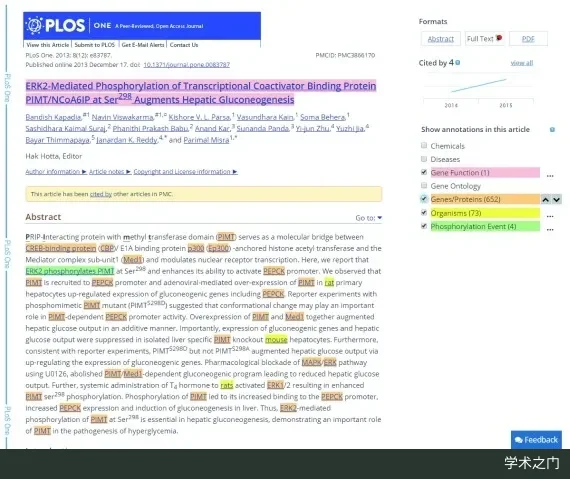
The SciLite interface displaying text-mining annotations in a Europe PMC article, corresponding to the section “REST API and Text-Mining Annotations” below. Figure from the SciLite paper (Wellcome Open Research 1:25); authors: Aravind Venkatesan et al.; source: Wikimedia Commons; license: CC BY 4.0.

Field Search Syntax and Search Queries
Europe PMC search queries take the form “field name:search term”. Phrases go in standard double quotes, terms are combined with AND, OR, NOT, and parentheses, and ranges use square brackets, as in PUB_YEAR:[2020 TO 2024]. The field definitions in the table below come from the appendix of the official reference guide. You can get the complete list of searchable fields by requesting the API's fields module directly; it reflects the current index and is more up to date than the manual.
| Field | Purpose | Manual example |
|---|---|---|
AUTH: |
Author surname, optionally with initials | AUTH:"einstein G" |
TITLE: / ABSTRACT: / TITLE_ABS: |
Title, abstract, title plus abstract | TITLE_ABS:"african swine fever" |
AFF: |
Author affiliation | AFF:"university of cambridge" |
PUB_YEAR: / FIRST_PDATE: |
Publication year, first publication date | PUB_YEAR:[2000 TO 2001] |
SRC: |
Source code | SRC:PPR |
OPEN_ACCESS: |
Restrict to open access | OPEN_ACCESS:y |
IN_EPMC: |
Whether Europe PMC holds the full text | IN_EPMC:y |
PUB_TYPE: |
Publication type | PUB_TYPE:review |
LICENSE: |
Creative Commons license | LICENSE:"cc by" |
GRANT_AGENCY: / GRANT_ID: |
Funding agency, grant number | GRANT_ID:100229 |
METHODS: / ACK_FUND: / BODY: |
Methods section, acknowledgments and funding section, and body of the full text | METHODS:"yeast two-hybrid" |
DISEASE: / GENE_PROTEIN: / ORGANISM: |
Text-mined diseases, genes/proteins, organisms | GENE_PROTEIN:gng11 |
Complete list of searchable fields: fields module
All of the following queries were actually run through the REST API on 22 October 2026, and the hit counts reflect only that day's results. You can paste the same queries directly into the website's search box.
Example 1: Find preprints on a topic
SRC:PPR AND TITLE:"long covid"
Returned 973 records. The first two came from Research Square and Qeios respectively. Their pubType is preprint, and both isOpenAccess and inEPMC are N, meaning Europe PMC has only metadata for these two records and no full text.
Example 2: Search only in the methods section
METHODS:"propensity score" AND OPEN_ACCESS:y AND PUB_YEAR:[2024 TO 2025]
Returned 14,637 records. METHODS: searches only the “Materials and Methods” section of full texts, so it finds articles that “actually used propensity scores” rather than articles that “mention propensity scores in the title”.
Example 3: Filter by funding agency
GRANT_AGENCY:"Wellcome Trust" AND TITLE_ABS:malaria AND OPEN_ACCESS:y
Returned 4,467 records. Note: the manual's example syntax GRANT_AGENCY:wellcome returned 0 records when tested that day (with or without quotes), whereas GRANT_AGENCY:"Wellcome Trust" on its own returned 219,262 records. The safe approach is to first retrieve one record with resultType=core, check exactly how agency is written in grantsList, and then copy that into your query.
REST API and Text-Mining Annotations
The REST search endpoint is https://www.ebi.ac.uk/europepmc/webservices/rest/search. Sending a GET request from a browser or any HTTP tool is enough, and none of the requests in this article involved registering for or using an API key. The parameters mean the same as in the official manual, and the request field in the REST response echoes them back: query holds the search query; format is json or xml; resultType can be idlist (IDs only), lite (basic metadata, the default), or core (full metadata, including abstract, funding, and full-text links); pageSize defaults to 25, with a maximum of 1000; paging uses cursorMark, where you pass * for the first page and then the nextCursorMark returned by the previous page; synonym defaults to false.
Example 4: Retrieve results in bulk via the API
curl "https://www.ebi.ac.uk/europepmc/webservices/rest/search?query=SRC:PPR%20AND%20TITLE:%22long%20covid%22&format=json&resultType=lite&pageSize=100&cursorMark=*"
To retrieve all results, loop through the pages using nextCursorMark. Below is illustrative code written according to the manual's paging rules; it was not used in this article to fetch a complete result set:
import requests

BASE = "https://www.ebi.ac.uk/europepmc/webservices/rest/search"

def fetch_all(query, page_size=1000, result_type="lite"):
    cursor = "*"
    while True:
        params = {"query": query, "format": "json", "resultType": result_type,
                  "pageSize": page_size, "cursorMark": cursor}
        data = requests.get(BASE, params=params, timeout=60).json()
        results = data["resultList"]["result"]
        yield from results
        next_cursor = data.get("nextCursorMark")
        if not results or not next_cursor or next_cursor == cursor:
            break
        cursor = next_cursor
Full-text searching has clear limits. According to the manual, all Europe PMC content is searchable, but most full texts are restricted by copyright and licensing, and for those articles the API returns only metadata and abstracts. Full-text XML, along with figures, tables, and supplementary materials, can be retrieved only for the open access subset. Section fields such as METHODS:, ACK_FUND:, and BODY: also work only for articles whose full text Europe PMC holds, so abstract-only records will not be matched.
Text-mining annotations are a distinctive feature of Europe PMC compared with PubMed. The 2020 report states that the annotation platform holds about 13 hundred million annotations from 10 providers, covering genes/proteins, diseases, organisms, GO terms, chemicals, database accession numbers, and other types; on the website, SciLite highlights these terms within articles. There are two ways to use them in searches: add HAS_TM:y to a query to restrict results to full-text articles with text-mining results, or use DISEASE:, GENE_PROTEIN:, ORGANISM:, and GOTERM: to search the mined terms directly. To retrieve individual annotations, use the Annotations API.
The Annotations API's annotationsByArticleIds accepts 1–8 article IDs at a time, in the format “source:ID”, such as MED:14670548 or PMC:4771370, and can be filtered by type (annotation type), section (article section), and provider (annotation provider). annotationsByEntity finds articles by entity name, 1–8 articles per page, and with filter=1 returns only the annotations that match that entity.
https://www.ebi.ac.uk/europepmc/annotations_api/annotationsByArticleIds?articleIds=PMC:4771370&type=Diseases&format=JSON
When this was called on 22 October 2026, the endpoint returned the record for this article (PMID 26864432), but annotations was an empty array. This only shows that the annotation database has no disease annotations for the article; it does not mean the article does not discuss diseases. Removing the type parameter shows which types of annotations the article does have.
Interpreting Results and Limitations
- Hit counts are live numbers for a given day. Europe PMC is updated daily, so when reporting search results, state the search date and the complete query. All numbers in this article are results from 22 October 2026.
- The same study may have multiple records. The preprint (
PPR) and the journal version (MED) are separate records; the 2020 report states that the two are linked to each other. When merging results, deduplicate by DOI and PMID, and decide in advance whether to keep preprints. - Date fields have different meanings.
firstIndexDateis the date a record was added to Europe PMC, not the publication date. The first record returned by searchingGRANT_AGENCY:"Wellcome Trust"on its own in Example 3 had afirstIndexDateof 2026-09-03 but apubYearof 2027 (the print issue date comes later). When filtering by time, think carefully about whether to usePUB_YEAR:,FIRST_PDATE:, orFIRST_IDATE:. - A license tag does not mean the full text is readable. The
licenseof that same record shows cc by, butisOpenAccessandinEPMCare both N, and its full-text link is labeled Subscription required. To judge whether an article can be read, first check the availability notes for each link infullTextUrlList, and then verify with tools such as Unpaywall. - Section searches miss abstract-only articles. When calculating “the proportion of studies using a given method”, use the same full-text scope for both numerator and denominator (for example, add
IN_EPMC:yto both); otherwise the proportion will be underestimated. - Field values depend on data entry. Funding agency names and license formats vary, and manual examples may not match the current index (such as
GRANT_AGENCY:wellcomeabove). Before running formal searches, retrieve a few records and check the actual values. - Text mining is automated annotation. It may miss terms or label them incorrectly. It is useful for finding leads but should not be used directly as the basis for including or excluding literature.
- Subject-heading searching still relies mainly on PubMed. Europe PMC has no standalone MeSH field. For systematic searches, you can use a PubMed MeSH search strategy as the foundation and then use Europe PMC to add preprints, full-text sections, and the funding dimension.
References
-
Europe PMC in 2020. Nucleic Acids Research, 49(D1): D1507, published 8 January 2021 (PMID 33180112). https://academic.oup.com/nar/article/49/D1/D1507/5976840
-
Europe PMC in 2017. Nucleic Acids Research (PMCID PMC5753258). https://pmc.ncbi.nlm.nih.gov/articles/PMC5753258/
-
EMBL-EBI. EBI Europe PMC SOAP Web Service 6.9.0 Reference Guide, Document Version 1.51, 2023-08-31. https://europepmc.org/docs/EBI_Europe_PMC_Web_Service_Reference.pdf
-
Europe PMC. Annotations API documentation (accessed 2026-10-22). https://europepmc.org/AnnotationsApi
-
Europe PMC. REST API fields module (accessed 2026-10-22). https://www.ebi.ac.uk/europepmc/webservices/rest/fields?format=json
-
Europe PMC. REST API search module (examples in this article called on 2026-10-22). https://www.ebi.ac.uk/europepmc/webservices/rest/search
-
Gateway to Scholarship · A guide for scholars to living in the intelligent era
-
Compiled and published by the Scholay All-in-One Academic Platform. If you believe any content infringes your rights, please let us know and it will be taken down.
-
Also published on Enter Scholar, a community for scholars in the intelligent era